
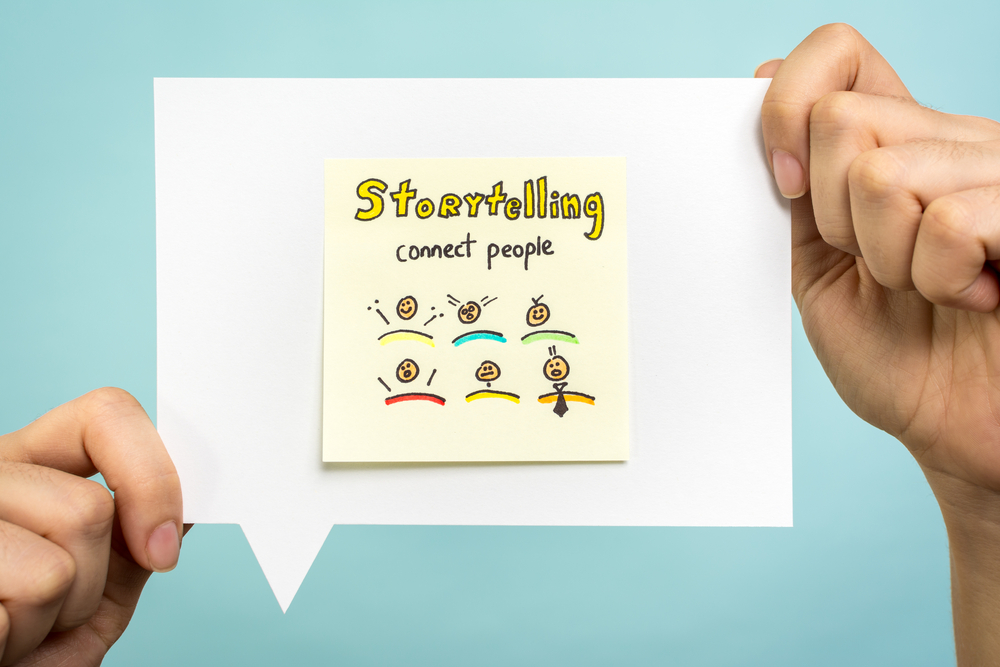
We use design thinking to design and facilitate our storytelling for leaders workshops. Our learning focus is on helping people to take on a challenge to reflect on their life and work to create and design their own stories, and then prototype and test their stories out on their fellow workshop participants. That is how the learning and development happens in this leadership storytelling workshop. It’s a powerful experience to not only create and tell your stories but to also listen to stories from others. It can be both iterative and inspiring.
Here’s a description of one of our favorite leadership storytelling training workshops on the important topic of transformation as well as some quotes about what the storytelling workshop experience was like for participants.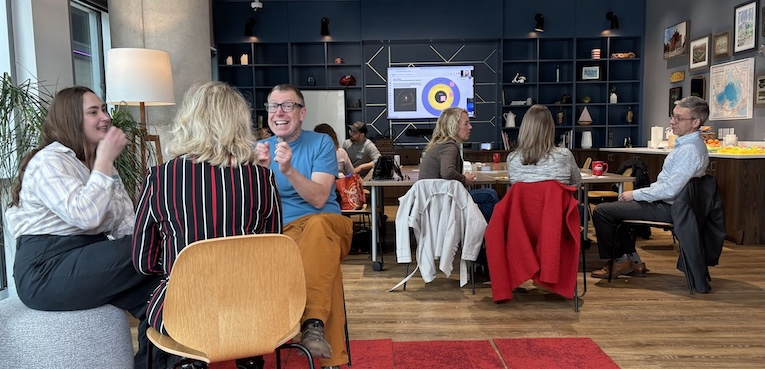
Leadership Storytelling Training at a Glance
This storytelling workshop for leaders is a hands-on session where leaders find, build, and test the stories they need for their real work, such as leading change, sharing a vision, or earning support for a new idea.
- Formats: 60-minute conference session, half-day workshop, full-day or retreat format, live virtual
- Group size: small leadership teams to large groups working at tables
- Best for: leadership summits, offsites, leadership development programs, and kickoffs
- Leaders leave with: a tested story, a reusable story structure, and the Story Toolkit
Book a storytelling workshop for your leaders
Storytelling for Transformation
Storyfinding, Storymaking, and Storytelling
Session Description:
In a design thinking workshop, you will be guided through collaborative reflection activities to help you find your own stories and then build them into something you can storytell in your own work. Use storytelling to build empathy and connect with the head and the heart. Tell stories to communicate data, ideas, innovations or even the vision for transformation as a leader.
Session Vision:
Engage participants in applying design thinking approaches like ideation and rapid prototyping to build, tell, and test important stories for themselves, especially transformations they have experienced. Participants will leave the workshop with a number of story ideas as well as stories they have storyboarded and tested out on participants. They can iterate on these stories which will be ready to share with their colleagues the next day.
The stories you will create, hear and tell at our session can contribute to a deeper connection to purpose, vision, or transformation for you, your organization, and those you help.
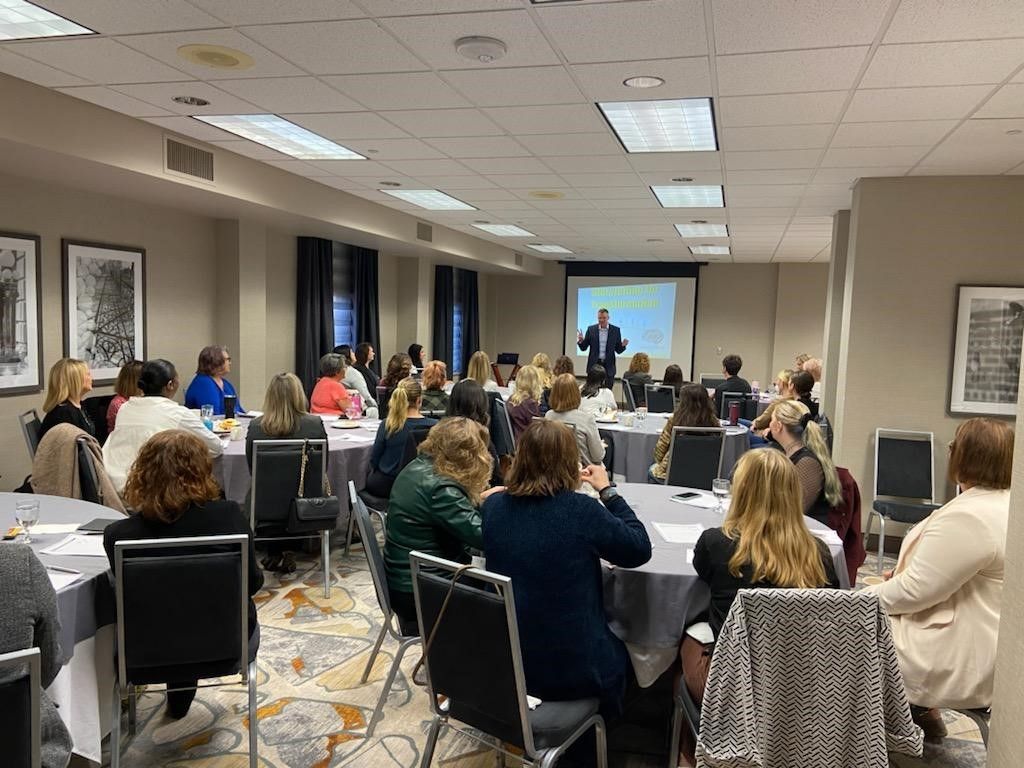
Here’s what some of our attendees have said about the storytelling for leaders workshop experience.
“Wow! This is how my morning started…a power-packed 1-hour workshop to learn how to shift our minds into storytelling mode to relay our business ideas, recap projects, convey technical ideas, share personal journeys, and so much more! Darin Eich, Ph.D. was fantastic leading us through this session. This is why this organization is outstanding…you don’t need to be a techie to learn how to tell a story and connect with your audience.”
“Darin helped us realize the value of a story and, with his “Story Toolkit”, how quickly you can create and apply a story to create deeper connections. We shared powerful stories that exposed vulnerability and learned how to leverage those stories to communicate ideas to support a purpose or transformation. I walked out inspired and ready to use what I learned, starting this afternoon with my current project. This memorable experience was a great way to learn how to better support my work and clients!”
“We had a packed house today and feel inspired by all the connections the storytelling workshop fostered. Thanks to Darin for the incredible workshop and to everyone who could join us.”
“Thanks for a great event this morning! I enjoyed seeing everyone IN PERSON and really enjoyed hearing the stories from other attendees.”
“What a great way to start my day! So many wonderful women learning and practicing design thinking from Darin Eich, Ph.D.”
More Reflections from Storytelling Workshop Participants
From closing reflections in our recent live virtual storytelling workshops.
“It’s rejuvenating to shake the snow globe, so to speak, and loosen up and explore different entry points to our narratives.”
“My stories matter more than I realized.”
“I do actually have some stories that help share a purpose or result I want to drive home. Didn’t think I did.”
“Initially, I told a generic story, but the workshop helped me realize my project could be my family’s story.”
“Sharing my story twice helped me improve its delivery. Listening to others’ stories gave me new ideas for presenting my project.”
“You don’t have to have all the answers. Your story is powerful, regardless.”
“Stories can be transformative for the teller and the listener.”
“Darin created a very human, real and reflective space.”
Inside a Storytelling for Transformation Workshop
In a recent live virtual Storytelling for Transformation workshop with a professional association’s team, Darin modeled the process first by telling one of his own transformation stories, about how adopting AI changed the way he works. Participants then looked back at the turning points in how their own work has changed, chose a story to build, storyboarded it, and told it to colleagues in small groups. To close, they thought about the transformation story they want to be able to tell a year from now, and what that story asks of them today.
Here is some of what participants shared afterward:
“Think of the story you want to be able to tell one year down the line. To make that real, what do you need to do today!”
“It was insightful to look at past transformation points. Something unsuspecting led to much bigger things.”
“I never looked back to see what I have done until the moment I had to list all my accomplishments.”
“Telling a story is not complex: It’s about making it easy to understand and connect.”
“Transformations happen through individual stories.”
“Practice gets faster and more succinct each time.”
“Talking to people in other areas = silo breakdown!”
“Using past stories as a way to envision a future.”
What Makes a Transformation Story Engaging? The Participants’ List
After telling and hearing several stories, the same group listed what made the strongest transformation stories work. Their answers make a useful checklist for any leader telling the story of a change:
- A relatable problem: “a compelling relatable problem statement” and “having a good problem to solve.”
- Emotion and personal connection: passion, belief, and “a personal connection, opening up, vulnerability.”
- Images: “images move emotions,” so show pictures and paint a scene people can imagine.
- A future vision and a path forward: make it aspirational and “easy to implement.”
- Credibility: stats and research, and showing “you’ve considered the challenges, even if you haven’t figured out how to solve them.”
- Audience relevance: “What’s in it for me? Why should I care?”
- Simplicity: no jargon, and a story sized for the time you have.
- A spark: “a little bit of mystery,” humor, or something novel.
Bring a Storytelling for Transformation workshop to your team
Storytelling for Leaders Workshops and Training
Please reach out to us if you’d like to learn more about our leadership or storytelling for business workshops and the various topics we can design for you to learn through an experiential and collaborative program. Storytelling training for leaders can develop critical leadership skills for our changing world.

What Participants Do in the Storytelling Workshop
This is a working session rather than a talk about storytelling. Participants spend most of the time finding, building, and testing their own material, and they leave with stories they have already told out loud at least once.
Storyfinding
Guided reflection activities that surface raw material from your own work and life. Leaders often arrive convinced they have no stories, and the activity is designed to locate them quickly.
Storymaking
Shape that raw material into a structure that holds attention, using a simple frame of challenge, idea, and action that applies to a project update as easily as to a personal turning point.
Storyboarding and Prototyping
Sketch and map your story rather than writing it out. Treating a story as a prototype makes people far more willing to change it.
Testing on Real Listeners
Tell your story to other participants and hear honestly what landed. This is where most of the improvement happens.
Iterating
Revise based on what you heard and leave with a version ready to use with colleagues, often the next day.
The Story Toolkit
Participants work from a Story Toolkit: a collection of resources and worksheets that walk you through finding and creating ideas for your own stories, storyboarding them, and developing them into something you can tell. The worksheets are what make the session repeatable. People leave able to run the process again on a new story months later, which is the difference between an inspiring morning and a skill someone actually keeps.
Groups often ask for the toolkit to be adapted to their context, so the prompts point at the stories their leaders specifically need to tell.
How This Differs from Presentation Skills Training
Presentation training works on delivery: posture, pacing, slide design, managing nerves. Those things matter and plenty of good trainers teach them. Our focus sits earlier in the process, on finding material worth telling and giving it a shape. A leader with a well-built story and average delivery tends to move a room further than a polished speaker with nothing underneath.
The other difference is that participants work on their own real content. Nobody practices on a generic case study. The story someone builds in the session is usually one they need for a meeting, a town hall, a pitch, or a change they are trying to lead.
Where Leaders Use These Stories
Leading Change
Explain why a transformation matters to people who have seen initiatives come and go. Pairs naturally with our change management workshop.
Communicating Data and Technical Work
Give numbers a narrative so an audience remembers what the analysis meant.
Selling an Idea Internally
Move an innovation or proposal past the people who need to feel the problem before they will fund the solution.
Building Trust on a Team
Stories that show something real about a leader do more for credibility than another values slide.
Onboarding and Culture
Pass on what the organization actually believes through the stories people tell about it.
Formats and Group Sizes
One-Hour Session
Enough to run the full find, build, and tell cycle on one short story. Popular as a conference session or a segment inside a larger meeting.
Half-Day Workshop
More reflection time, more rounds of telling, and space to develop more than one story.
Full-Day or Retreat Format
Often delivered inside an offsite or leadership retreat, where the stories shared change how the group works for the rest of the program.
Virtual Delivery
Breakout rooms give every participant a real turn to tell and be heard, which works better online than most people expect.
Large Groups
Sessions have run for small leadership teams and for rooms of several hundred organized into small tables.
Questions Leaders Ask About Storytelling Training
Do I need to be a natural storyteller?
No. Most leaders arrive convinced they have no stories. The workshop’s reflection activities are designed to surface them quickly, and the structure does much of the work.
What kind of stories will we work on?
Real ones from your own work: why a change matters, the story behind a decision, what a project taught you, or why your team does what it does.
Do I have to share something personal?
You decide how much to share. Some leaders tell a story from their life and others stay with a work moment. Both work, and the group setting is built to feel safe and supportive.
Can this be part of our leadership development program?
Yes. The workshop often runs as a module inside an existing program, in person or as a live virtual session, and can be paired with business storytelling training for broader teams.
Can you do this at our offsite or summit?
Yes. It is one of our most requested sessions for leadership gatherings, where the stories shared often change how the group works together for the rest of the event.
Designed for Your Group Rather Than Delivered Off the Shelf
The transformation focus described above is one version. We have designed this workshop around gratitude, around customer empathy, around a specific organizational change, and around the stories a team wants to be able to tell about its own work. The activities stay recognizable and the content shifts to whatever the group needs to be able to say.
If your interest is business communication more broadly, our business storytelling training covers that ground. For the quieter and more personal version, see the gratitude storytelling workshops and retreats. Facilitators who want to lead this kind of session themselves can look at our facilitation workshop.
When a request would be better served by someone else, whether that is a specialist in a particular approach or a facilitator based in your country, we will tell you and point you toward a person or firm we recommend.