
Why Great Workshops Need Time to Reflect
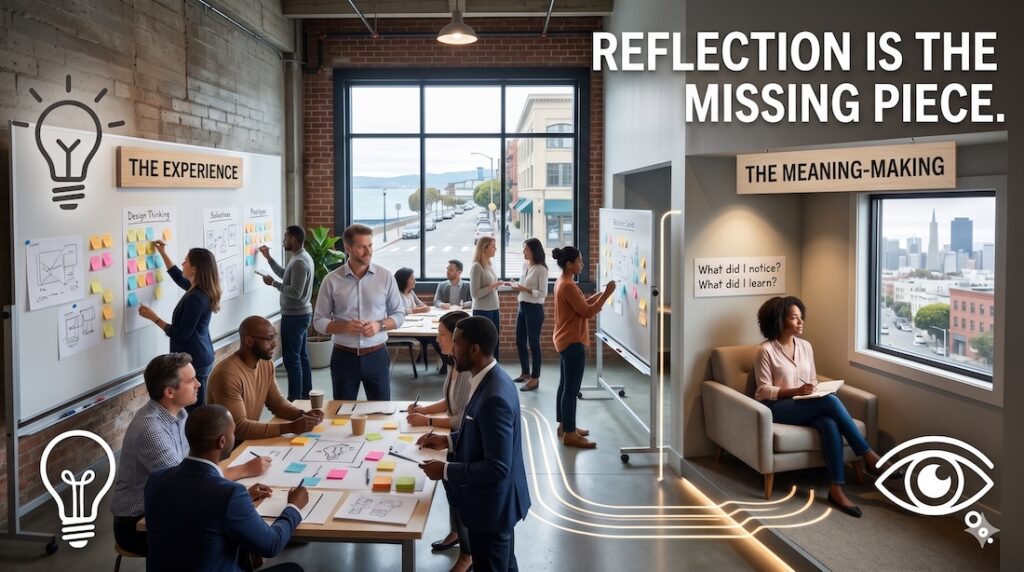
One year I had a very important workshop experience to develop. We were taking over a warehouse in the Dogpatch area of San Francisco and creating a day focused on a culture of innovation, especially the San Francisco and Silicon Valley history and style. We had a professor from Stanford involved and a group was flying in from Europe for the experience, so we really had to get it right.
I remember talking with the CEO of the company putting this on, and he said something that stuck with me. He had been part of many workshops, conferences, leadership programs, and innovation events. Many were the usual passive event. Some were even experiential. People interacted, moved around the room, talked with each other, shared ideas, and experienced something different from the usual sit-and-get conference format.
But he said one critical thing was often missing: reflection.
Don’t Just Have the Experience. Learn From It.
Even in strong workshops or conferences, the experience often stops with the activity. People have the conversation, do the exercise, go on the field trip, listen to the speaker, collaborate with the group, and then move on. But what if the real learning is only halfway complete at that point?
All it might take is going one step further and helping people reflect on the experience they just had. What did we notice? What did we learn? What surprised us? What does this mean for our work, our leadership, our team, or our next action?
That conversation reinforced something I had seen for years in leadership development and workshop design: experience alone does not create all of the learning. Reflection helps turn experience into learning.
A lot of professional development is built around content. Someone shares a model, a framework, a case study, or a set of ideas. That can be useful. Better programs are built around experience. Participants discuss, practice, create, collaborate, and apply. But the best learning experiences do something more. They help people make meaning from what happened.
That is where reflection comes in.
Reflection gives people a chance to pause, notice, name, connect, and integrate. It helps people connect ideas to their own experience. It helps them see patterns. It helps them understand themselves better. It helps them move from passive participation to personal insight.
There is also a deeper concept called reflective practice. Reflective practice is a more systematic way of learning from your own actions, decisions, experiences, and professional work. A reflective practitioner does not only ask, “What happened?” They also ask, “What was I noticing? What assumptions was I making? What worked? What did not? What would I do differently next time?”
This is useful for teachers, leaders, facilitators, coaches, consultants, designers, managers, entrepreneurs, and anyone trying to get better at meaningful work.
Reflective practice often includes reflection after an experience, reflection during an experience, and critical reflection on our assumptions and patterns. In other words, it is not just about reviewing what happened. It is about becoming more aware of how we think, act, decide, lead, and learn.
This is also why reflection is such an important part of experiential learning. A person can attend a conference, lead a project, facilitate a meeting, join a team, launch an idea, or go through a major career transition and still miss much of the learning available to them. Reflection helps complete the experience.
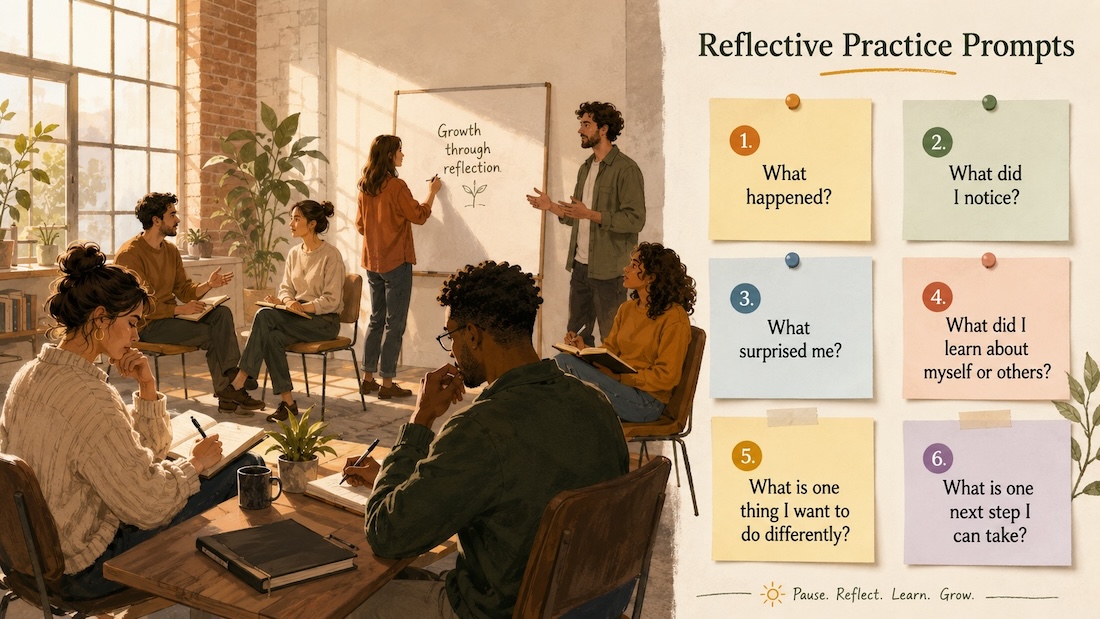
A few simple prompts can make a big difference:
- What happened?
- What did I notice?
- What surprised me?
- What did I learn about myself or others?
- What assumption might I need to question?
- What is one thing I want to do differently?
- What is one next step I can take?
These questions are simple, but they can change the depth of a learning experience. The pause matters. The question matters. The meaning-making matters.
Reflection may look quiet, but it is not passive. It is where people connect the dots, personalize the learning, develop self-awareness, and decide how they want to act next. In a noisy world of constant activity, reflection can feel like a luxury. I think it is a necessity, especially for leaders, teams, and people doing creative, collaborative, and innovative work.
We do not just need more activity, more information, more meetings, more events, or more tools. We need better ways to learn from what we are already experiencing.
That is the power of reflection and reflective practice.
I lead live reflection workshops and reflection activities for groups that want to turn experience into learning, insight, and action. These sessions can be useful for leadership programs, retreats, team development, professional development, project retrospectives, and innovation programs.
You can learn more here: Reflection Workshops and Reflection Activities for Learning and Development. Our train-the-trainer program can also help you 1:1 integrate reflection into your programs in an innovative way.
Reflect,
Darin Eich, Ph.D.
Innovative Workshop Design and Facilitation Coaching