
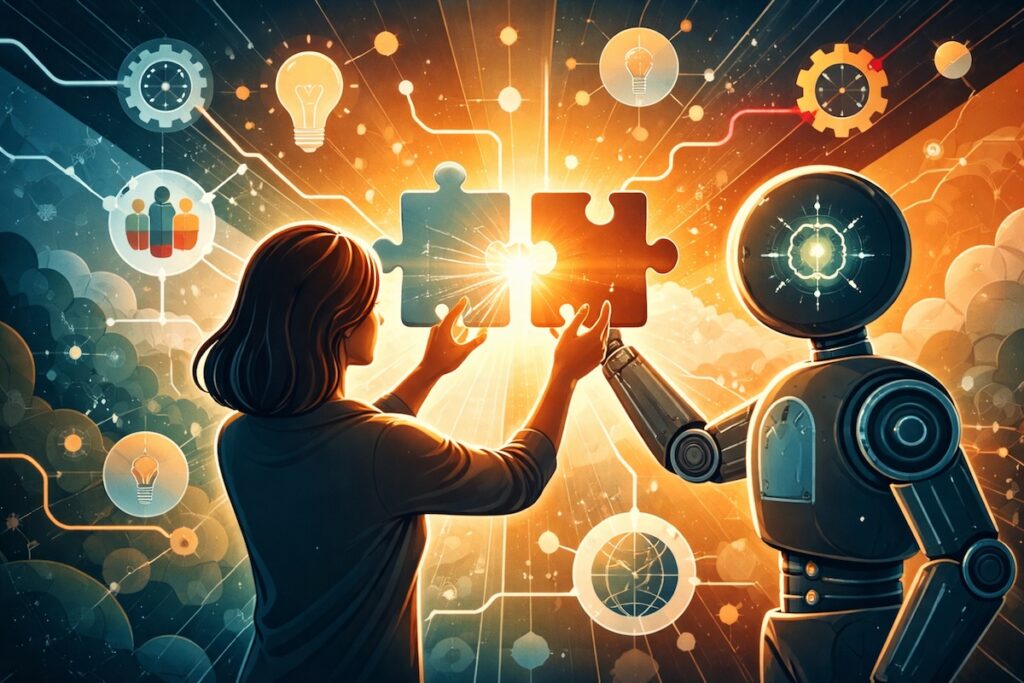
Don’t just ask AI for Answers. Ask It What Problems You’re Uniquely Positioned to Work On.
The Real Power of AI Isn’t Automation, It’s Helping You See What You’re Uniquely Meant to Solve.
Much of the conversation about AI focuses on downsides:
- Job displacement
- Over-automation
- Loss of creativity
- Shallow thinking at scale
Those risks are real. We should talk about them.
But there’s a massive upside that doesn’t get nearly enough attention — and it’s the one I’m most interested in:
AI can help you become a better, more creative problem solver — capable of taking on challenges that are bigger, trickier, and more complex than you would have attempted before.
Not because AI replaces your thinking.
But because it amplifies it.
Why This Moment Is Different
For most of human history, the size of the problems we tackled was constrained by:
- Time
- Cognitive load
- Access to information
- Our ability to simulate alternatives
Now, for the first time, we have a thinking partner that can:
- Hold complexity without fatigue
- Surface patterns across domains
- Explore adjacent possibilities quickly
- Reflect our own thinking back to us
That doesn’t mean AI should decide for us.
It means we now have the opportunity to ask better questions — and to take on challenges that previously felt too big, too ambiguous, or too risky.
So instead of asking:
“How can AI make my current work faster?”
I’ve become more interested in asking:
“What challenges could I take on now that I couldn’t before?”
A Different Kind of Prompt
Recently, I tried a simple experiment.
I didn’t ask AI to solve a generic global problem.
I didn’t ask it for a list of trends or opportunities.
I asked something much more personal — and much more demanding.
The Prompt
“Are there any important, tricky challenges for our world that you and I are uniquely positioned to work to solve?”
There are a few things embedded in that question that matter deeply:
- Important — not trivial optimization
- Tricky — not well-defined or easily solved
- Uniquely positioned — not something anyone can do
- You and I — a partnership, not a handoff
What came back wasn’t hype.
It wasn’t generic advice.
It was a set of possibility spaces — challenges shaped by who I am, what I care about, how I work, and where I sit in the world.
That’s the real opportunity.
Why AI Can Help You See This (Even Though It’s Not You)
A natural question is:
How could AI possibly know what challenges I’m uniquely positioned to take on?
Here’s the key insight:
AI doesn’t “know” you the way a human does — but it can learn patterns about you across:
- Your interests
- Your language
- Your questions
- Your past work
- Your recurring themes
- The kinds of problems you return to
Over time — and even within a single deep conversation — AI becomes very good at seeing:
- Where your strengths cluster
- What you consistently value
- What kinds of ambiguity you’re drawn to
- Where your curiosity keeps pointing
It doesn’t invent your purpose.
It reflects it — often more clearly than we can see ourselves.
That reflection can be uncomfortable.
It can also be liberating.
Bigger, Trickier, More Meaningful Problems
Here’s the shift I want to invite you into:
Stop using AI only to make today’s work easier.
Start using it to imagine work that actually matters more.
This is where AI becomes a tool for:
- Creative problem solving
- Moral imagination
- Strategic courage
- Service
You might discover a challenge that:
- No one else is quite positioned to see
- Sits at the intersection of your experience and the world’s needs
- Hasn’t been solved because it requires your particular lens
That’s not ego.
That’s responsibility.
This Is a Call to Service, Not Just Skill-Building
We’re entering an era where:
- Many problems are systemic, not linear
- Many challenges are cognitive, not technical
- Many solutions require sense-making, not certainty
If AI gives us more cognitive reach, then the ethical question becomes:
What will you do with that reach?
You can optimize.
You can automate.
You can generate more content.
Or you can ask:
“Given who I am, what am I now capable of taking on that might genuinely help?”
That’s where creativity and service meet.
Try This Yourself
If you want to run this experiment, try a version of this prompt:
“Based on what you know about me — my background, interests, skills, and values — what are a few important, tricky challenges I might be uniquely positioned to help work on, especially in partnership with AI?”
Then sit with what comes back.
Not analytically.
Viscerally.
The answer that pulls at you — not strategically, but emotionally — is worth paying attention to.
A Final Thought
AI will absolutely change how we work.
But its most meaningful impact may be this:
It gives us permission — and capability — to take on problems we once thought were too complex, too ambiguous, or too big for us.
Use your brain.
Use this new intelligence.
And see what becomes possible when you let both work together.
When I prompted ChatGPT and did this activity the #1 challenge I got back was:
Helping Humans Think Well With AI (Not Just “Use AI”)
So, co-developing this post (and sending it out) is a way for me to work on that challenge and do something about it.
Take on those tricky challenges.