
Do you need to innovate how you present?
Maybe what really needs to change is not just your content, but your approach and mindset.
That was my mindset too when I started.
I wanted to be a speaker. I wanted to motivate audiences and help them learn and develop their leadership skills. I went to graduate school to learn how to design programs that help people become better leaders.
Then I was shocked to learn that research on effective learning did not match what I was doing.
I learned that when people just listened to a speaker, very little learning happened. And there I was, telling audiences things I had read in other people’s books. I even used PowerPoint slides and bullet-pointed ideas I had read in other people’s books.
At the same time, I was discovering that people learned best when they were engaged in real activities, having conversations and reflections with others, and working on real projects. Yet I was not doing these things myself. I was still stuck in the old sit-and-get paradigm.
Then, as I began research for my dissertation, I interviewed stakeholders and learning leaders connected to some of the most high-impact leadership development programs I could find. From more than 60 people, I heard firsthand about the kinds of experiences that most impacted their leadership development and their lives.
It was not the lectures they heard.
It was the activities, the projects, the relationships, and the reflective experiences that stayed with them and shaped them.
That changed me.
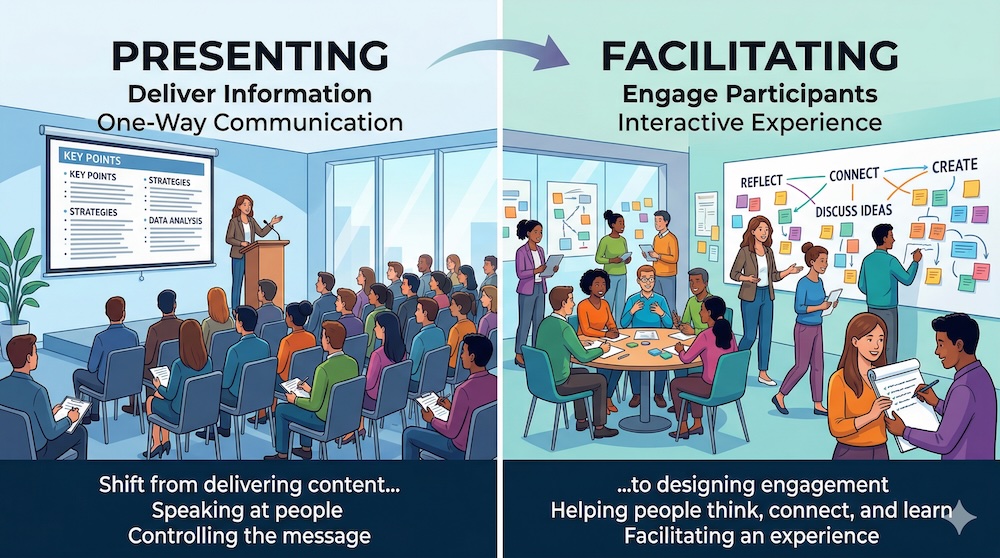
I realized I did not just need to become a better presenter. I needed to become a better facilitator.
I had to shift from lecturing to facilitation. That meant letting go of the idea that my value came mainly from what I said. It meant trusting a process more than a script. It meant designing experiences instead of just organizing talking points. It meant having people connect with each other, do activities, reflect, respond, and engage in ways that helped the learning actually stick.
This was a big change, and it was a little scary.
It was uncomfortable to cut out so many of my great tips and instead create space for participants to interact with each other through activities that I would design and facilitate.
But I soon discovered that I actually enjoyed designing keynotes, workshops, programs, and activities more than I enjoyed scripting speeches. I enjoyed the improvisational nature of facilitation more than trying to remember the exact words to say and saying them the right way.
In many ways, it also helped with the anxiety that can come with public speaking. I was no longer trying to perform in the same way. I was leading a process. I was helping people engage, think, create, and learn together.
This was one of my first big experiences with innovating how I present.
Or maybe more accurately, it was the moment I realized I needed to stop thinking only about presenting and start thinking much more deeply about facilitating.
That shift changed everything.
Since then, more than 1 million people have had the chance to experience activities I have designed or facilitated. That would not have happened if I had stayed attached to the old model.
So maybe this is the real question:
Do you need to innovate how you present because it is time to move beyond presenting?
Do you need to make the shift from delivering content to designing engagement?
From speaking at people to helping people think, connect, and learn?
From controlling the message to facilitating an experience?
Like me, maybe you want to help people learn and develop in a greater way. Maybe you want to increase engagement, be more authentic, reduce your anxiety in front of a group, respond better to what is happening in the room, and freshen up your approach with new tools, techniques, strategies, models, and ideas.
That kind of shift does not happen by accident.
It happens when you treat your own presentations as something you can innovate.
To innovate, we respond to a challenge, either a problem or an opportunity, with new actionable ideas that can have a positive impact.
You can apply that same process to your own work.
A Simple Exercise
What is one challenge you have when you present, teach, lead, or facilitate?
It could be a long-term challenge like redesigning a workshop, keynote, class, or meeting. It could also be an in-the-moment challenge like what to do when the group seems disengaged, uncertain, low-energy, or overly dependent on you.
Write out your answers to these three questions:
- What is a challenge you have related to presenting?
- List at least 10 ideas for how you might address that challenge (through facilitation or activities).
- Based on your ideas, what will you choose to try, and when?
If You Want Help Making This Shift
This is exactly the kind of work I love helping people with.
My Innovation and Design Thinking Facilitator Program has helped people become more innovative facilitators for years.
Now I am also offering Innovative Workshop Design and Facilitation Coaching for people who want personalized support as they improve and evolve how they lead successful sessions, design engaging workshops, and facilitate learning experiences.
The shift from presenting to facilitating can change everything.
I’ve lived it myself.
Facilitate Forward!
Darin Eich, Ph.D.