
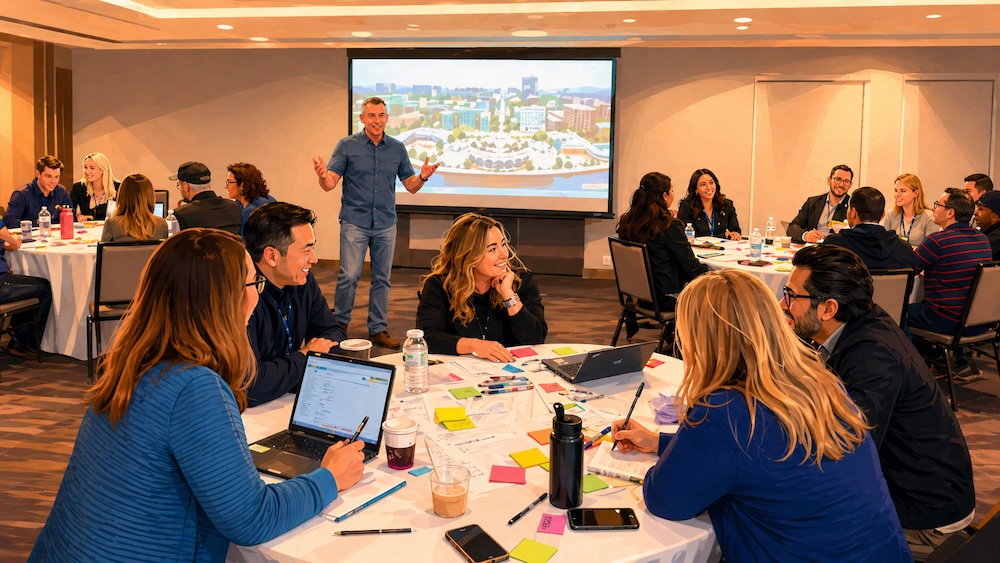
AI Adoption Hackathon: A Team-Based Sprint for Innovation, Collaboration, and Action
Many organizations now have access to AI tools, but adoption is still uneven. AI Adoption needs AI change leadership.
Some people are experimenting every day. Others are curious but cautious. Some teams are unsure what is allowed, useful, or relevant to their work. Leaders may want more AI adoption, but another generic training session may not be enough to create real momentum.
An AI adoption hackathon helps teams learn AI by using it together on real organizational challenges. We lead these hackathons and design thinking AI experiences virtually or at your site.
This is not a coding event or a lecture about artificial intelligence. It is a hands-on, facilitated sprint where participants use AI to explore challenges, generate ideas, develop solutions, communicate insights, and create practical next steps. It combines the energy of a hackathon with the structure of an innovation workshop and a design thinking experience.
What Is an AI Adoption Hackathon?
An AI hackathon is a team-based workshop where participants apply AI to meaningful work.
Instead of learning AI tools in isolation, people use AI to support activities such as:
- creative problem-solving
- design thinking
- idea generation
- idea development
- idea selection
- rapid prototyping
- storytelling and communication
- synthesizing insights
- exploring possibilities and scenarios
The goal is not just AI awareness. The goal is AI confidence, shared learning, innovation, and practical action.
This type of session can also connect well with a broader AI innovation workshop or design thinking AI training when an organization wants to build deeper capability over time.
Why AI Adoption Needs More Than AI Tools or Training
AI adoption usually requires more than information.
People adopt new tools when they experience value for themselves. They need to see how AI can help them think, create, collaborate, communicate, and solve problems. They also need a safe setting to ask questions, compare results, and build shared norms for responsible use.
That is why a facilitated AI hackathon can be so useful for AI adoption. Participants do not just hear about AI. They practice using it with colleagues on work that matters.
The workshop can be aligned to organizational priorities such as:
- strengthening innovation
- improving communication
- learning across the organization
- building a culture of experimentation
- generating ideas for better processes, programs, or services
- developing leadership capacity for a changing future
When AI is connected to real priorities, adoption feels relevant instead of optional.
A Simple AI Adoption Sprint Format
Our typical AI hackathon can be designed as a half-day, full-day, or multi-session experience. It can work for leadership teams, departments, cross-functional groups, internal conferences, retreats, offsites, or learning days. We can do it virtually or in person.
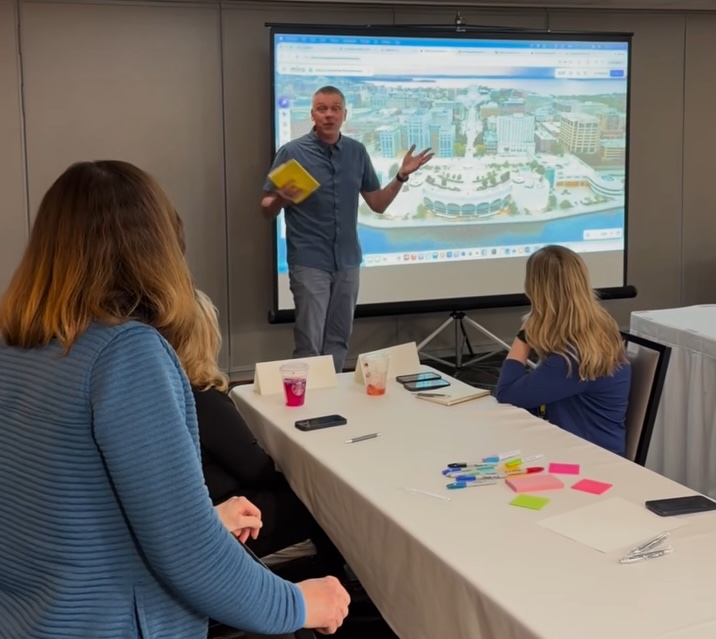
We like to apply AI for design thinking in this human-centered experience. Here is one possible format.
1. Frame the Challenge
The session begins with a clear innovation or adoption goal.
Instead of simply saying “use AI,” the group focuses on a meaningful challenge or opportunity. It can be your current strategy, vision, or mission. For example:
- How could AI help us solve a real organizational challenge?
- Where could AI help us improve communication or collaboration?
- How could AI help us generate and develop better ideas?
- What AI use cases are valuable, safe, and realistic for our organization?
- Where could AI help us innovate services, processes, or experiences?
- How could AI support a stronger culture of learning and experimentation?
This gives participants a shared purpose before they begin using AI.
2. Build Confidence Through Hands-On AI Use
Teams start with practical AI activities that help them experience value quickly.
They may use AI to summarize information, improve a message, generate questions, spark fresh ideas, compare options, organize messy notes, or explore different ways to frame a problem.
The emphasis is on learning by doing. Participants build comfort by actively using AI, not by sitting through a long demonstration.
This phase helps people see AI as a practical creative partner while still keeping human judgment at the center.
3. Learn About the Organization (and each other)
Teams can then use AI to better understand an area of the organization, a key challenge, a program, a service, a stakeholder group, or an internal process. They can learn about each other and how their colleagues are using AI to get results…or even transformation.
This makes the session more than an AI tools exercise. People learn about AI while also learning more deeply about their organization and the opportunities within it. They don’t just learn about the topic or challenge they are taking on. They learn about the larger organization and each other. They start to foster a culture of AI teaching, learning, and peer mentoring and coaching to help each other (and the org) apply AI in an effective and responsible way.
4. Generate, Develop, and Select Ideas
This is where the hackathon really comes alive.
Teams use AI to help them generate bold ideas, build on one another’s thinking, and explore multiple directions. The focus is strongly on innovation and design thinking. Participants can use AI to support brainstorming, pattern finding, concept creation, comparison, refinement, and prioritization.
Teams might explore questions such as:
- What are possible solutions to this challenge?
- What fresh ideas have we not considered yet?
- Which concepts are most promising?
- What would make this idea stronger?
- How could we combine or improve ideas?
- What small experiment or prototype should we test?
The goal is not just to produce more ideas. The goal is to create better ideas, develop them further, and move toward action.
This is where the format connects naturally to a team hackathon innovation workshop and broader custom design thinking workshops.
5. Prototype and Make the Ideas Real
Rather than stopping at discussion, teams can use AI to rapidly create something visible and tangible.
Depending on the session, teams might create:
- posters
- concept boards
- mockups
- short videos
- images
- prototype screens
- storyboards
- role plays
- pitch concepts
- visual summaries
- simple apps or tools
This is often one of the most energizing parts of the experience. People start to say, “Wow, AI can do that?”
In some sessions, teams may even use tools such as Claude Code, Codex, or similar platforms to bring an idea to life in a simple prototype or app. The point is not to build polished final products. The point is to help people see what becomes possible when AI supports creativity, experimentation, and action.
6. Share Stories and Bring the Learning to Life
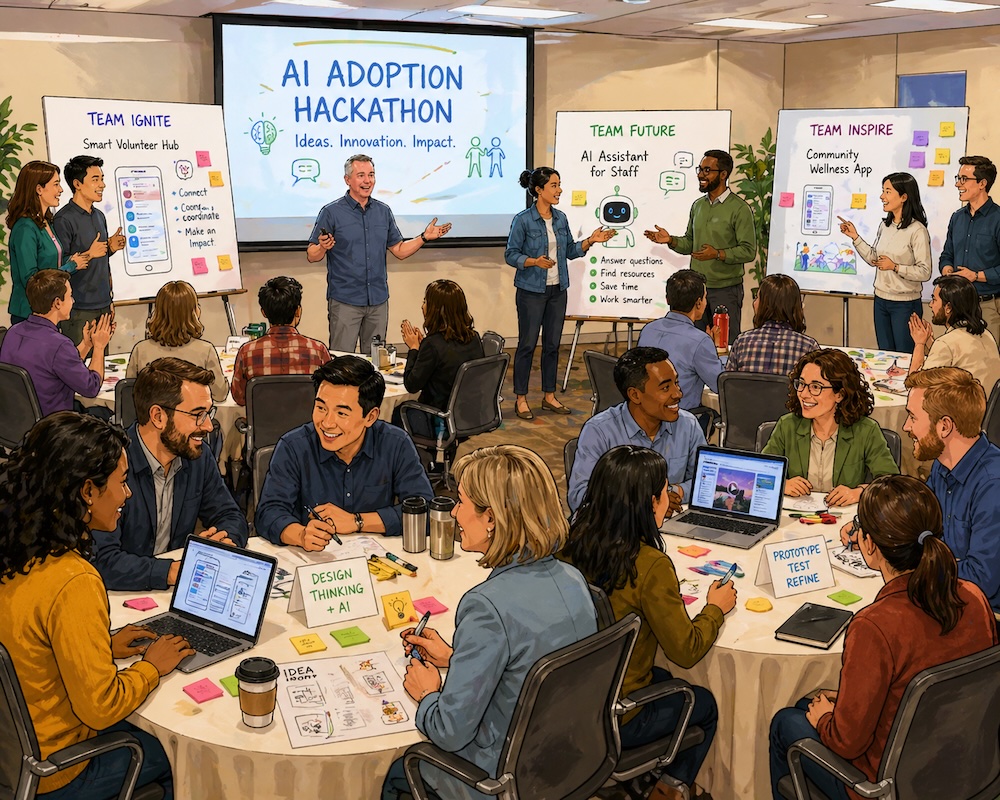
A strong AI adoption hackathon should end with an engaging share-out.
Instead of only giving standard presentations, teams can showcase their work through creative outputs that help others see and feel what they explored. This might include posters, visual concepts, short demos, mock campaigns, images, short videos, role plays, or storytelling-based pitches.
This matters because AI adoption spreads through stories, examples, and shared experiences.
Participants do not just leave with ideas. They leave with stories they helped create, stories they can share with others, and new stories about what their organization can become. That is one reason this kind of event can be so powerful for organizational culture. It helps people learn together, create together, and imagine together.
What Makes This Different From a Traditional AI Training?
An AI adoption hackathon is different because participants use AI repeatedly in a meaningful context.
They are not just watching a demo. They are not just learning prompt tips. They are working together to solve problems, generate ideas, create prototypes, and communicate possibilities.
This creates several benefits:
- AI use becomes social and shared
- participants learn from peers
- teams practice innovation and creative problem-solving
- leaders see where confidence and hesitation exist
- the organization develops common language around AI
- adoption is connected to strategy, culture, and action
- participants help shape a stronger culture of learning and experimentation
The format also helps reduce fear. AI can feel abstract or risky when people encounter it alone. In a facilitated group setting, participants can ask questions, compare outputs, and talk openly about quality, privacy, trust, and human judgment.
Leadership, Storytelling, and Culture
This kind of workshop is not only about tools. It is also about leadership.
Organizations need leaders who can help people navigate change, make sense of new possibilities, and create a culture where people feel supported in learning. An AI adoption hackathon helps leaders do exactly that by creating a shared experience around innovation, experimentation, and responsible use.
It is also a storytelling experience.
Participants find and share stories about the challenges they face, the opportunities they see, and the future they want to help create. In many cases, they create those stories together through the concepts, prototypes, visuals, and demonstrations they produce.
That makes this more than a workshop about AI. It becomes an experience that supports leadership, storytelling, and a stronger culture of innovation.
Outcomes of an AI Adoption Hackathon
By the end of an AI adoption sprint, participants often leave with:
- more confidence using AI tools
- practical examples of how AI can support innovation and daily work
- stronger creative problem-solving skills
- fresh ideas and more developed concepts
- visible prototypes and engaging outputs
- a clearer sense of where AI is useful and where caution is needed
- shared language for responsible AI use
- stories and examples they can bring back to others
- ideas for next steps and future experimentation
Leaders may also gain insight into where adoption is taking hold, where hesitation remains, and what support people need next.
Who Is This For?
An AI adoption hackathon can be useful for organizations that have AI tools available but are not seeing consistent use.
It can help:
- leadership teams exploring AI adoption
- departments beginning to use AI in daily work
- cross-functional teams that need better collaboration
- organizations with cautious or uneven AI adoption
- schools, universities, nonprofits, and government agencies
- internal conferences or learning days
- innovation events and strategy sessions
- teams that want practical progress without a large system change
The session can be designed for beginners, mixed-experience groups, or teams ready to identify and prototype AI-enabled solutions.
Design an AI Adoption Hackathon for Your Organization
Every organization’s AI adoption challenge is different.
Some teams need a safe introduction. Others need a practical sprint focused on innovation, prototyping, and real use cases. Some leaders want to build confidence across a department. Others want to connect AI adoption to strategy, storytelling, culture, communication, and creative problem-solving.
We can design and facilitate an AI adoption hackathon around your organization’s goals, tools, policies, and people.
The session can be customized around your strategic priorities, approved AI tools, internal guidelines, current adoption challenges, and the kinds of outputs you want participants to create.
If your organization wants to move beyond AI awareness and help people learn by doing, an AI adoption hackathon can be a practical way to build momentum.
Contact us to design an AI adoption hackathon for your team, department, conference, or organization.