
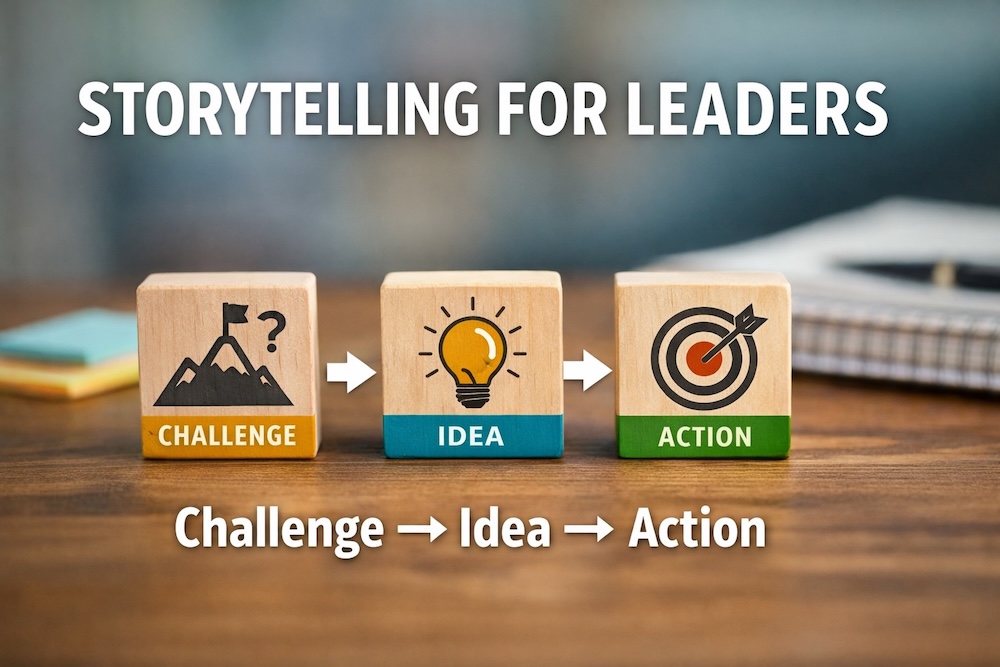
In my storytelling for business leadership training workshops, I teach a simple story structure that works across leadership, consulting, innovation, and facilitation:
Challenge → Idea → Action
It’s a clean, reliable way to “pitch” a story in a meeting, a workshop, a presentation, or a change effort. It also maps nicely to a very simple innovation process I teach in The Design Thinking Mindset: start with a real challenge, explore ideas, and move toward action.
This post focuses on the core model itself. In future posts, we can apply it to different story types leaders use all the time (vision stories, change stories, proof stories, and more).
Challenge (the setup)
The Challenge is what helps people understand the context and care.
It can include the character, setting, problem, opportunity, scenario, or what’s at stake.
Good challenges are specific. They create tension. They help the listener feel the gap between where we are and where we want to be.
A few prompts to shape the Challenge:
What is happening right now?
What pain, friction, or opportunity are we facing?
What is changing in the environment?
What’s the cost of doing nothing?
If you skip the Challenge, your audience often thinks: “So what?”
Idea (the move)
The Idea is your proposed solution or approach.
It’s the concept, intervention, or “thing to do,” described clearly enough that people can picture it.
A few prompts to sharpen the Idea:
What’s the idea in one sentence?
What are the key components?
Why is this the right approach for this challenge?
What does this make easier, better, faster, or more possible?
If you skip the Idea, people may agree there’s a problem, but they won’t know what you’re proposing.
Action (the outcome and next steps)
Action is what happens next.
It includes the benefits or results of acting on the idea, and it often includes concrete next steps so the story lands with momentum.
A few prompts to make Action real:
What changes if we do this?
What does success look like in 30/60/90 days?
What’s the first small step we can take this week?
How will we know we’re making progress?
If you skip Action, people may like the idea but won’t commit.
A simple way to practice
One of the fastest ways to build skill with this is to storyboard it like a three-panel comic:
Challenge
Idea
Action
Even sketching it on paper forces clarity. You quickly see what’s missing or vague.
Here’s a quick template you can copy into a notes app and use before your next meeting:
Challenge:
Idea:
Action:
Try it for something real you’re working on right now. If it feels fuzzy, that’s not failure, it’s feedback. The model shows you what to strengthen.
Challenge, Idea, Action Examples
Here are three quick examples of how the model sounds in everyday leadership moments. Each one can be told in about a minute.
A project update
Challenge: New clients were telling us their first month with us felt confusing, and onboarding was taking about three weeks. Idea: We tested a one-page welcome guide and a 20-minute kickoff call with five new clients. Action: Onboarding for those clients dropped to about eight days, so I’m asking to roll it out to every new client starting next month.
Pitching a new idea
Challenge: Our field technicians spend close to an hour on many visits just searching for the right machine manual. Idea: A shared photo library on their phones, organized by machine model, so the answer is two taps away. Action: Let’s pilot it with one region for 60 days and compare visit times before we decide anything bigger.
Leading a change
Challenge: Our Monday status meeting has become an hour where most people listen and very few speak. Idea: Replace it with a short written update plus a 20-minute conversation about one real challenge the team is facing. Action: We’ll try it for four weeks and then decide together whether to keep it.
Notice that none of these are long or dramatic. The structure does the work. People hear why it matters, what you propose, and what happens next.
A Challenge, Idea, Action Worksheet
When I teach this model in a storytelling workshop, I give people a few prompts for each part before they storyboard. You can use the same prompts on your own story right now.
Challenge
- Who is this story about (a person, a team, a customer)?
- What is at stake, and what happens if nothing changes?
- What detail would help your listener picture it?
Idea
- What is the idea in one sentence?
- What would people see or experience differently?
- Why does this idea fit this particular challenge?
Action
- What do you need from your listener?
- What is the first small step, and when will it happen?
- How will you know it is working?
Then do the part most people skip: tell the story out loud to a colleague in about a minute and ask what landed and what was unclear. In my workshops this round of telling and retelling is where most of the improvement happens. The second version is almost always tighter and more human than the first.
Why I like this storytelling model for leaders and facilitators
In many organizations, the default “story” is a pile of facts, a set of slides, or a status update. This model helps you turn information into meaning and momentum.
It also helps in workshops. When participants share updates or pitch ideas using Challenge–Idea–Action, you get:
more clarity
less rambling
better shared understanding
faster alignment
stronger follow-through
What Workshop Participants Say About Using This Model
Before Challenge, Idea, Action, I taught Paul Smith’s Context, Action, Result (CAR) model from his book Lead with a Story, and over time I saw how Challenge, Idea, Action fit the leadership and innovation stories people most need to tell. I still design workshops around whatever model fits a group best, including CAR, the Hero’s Journey, and a classic three-act structure. Across all of them, participants keep coming back to how much a simple structure helps:
“Loved the CAR model!”
“The 3-panel storyboard is helpful.”
“Context, Action, Result framework really helped me out.”
“How to improve your story by continuing to tell it and improving it as you tell it.”
“We learned the power of getting messy, stepping back, then refining.”
“Having a good purpose (or catalyst) for your story helps to focus it.”
Bring the Challenge, Idea, Action Model to Your Team
I teach this model in my business storytelling training and my storytelling workshops for leaders. It also works well as a session at a leadership summit, offsite, or conference, where everyone in the room builds and tells a story about their own real work. Groups leave with stories they have already tested, plus a simple structure they can keep using for updates, pitches, and change.
If you would like your leaders or team to practice this together, contact me and we can design a session around the stories your group needs to tell.
Recommended learning and next steps
If you want to go deeper into storytelling as a practical leadership skill, here are a few places to continue:
My short online storytelling course for innovators, leaders, and facilitators
More storytelling inspiration (quotes about the power of storytelling)