
Design the Workshop or Retreat Only You Can Lead
Recently I designed and led three short retreats in three days. None of them were for a client. None of them were for work at all.
That surprised me as much as it might surprise you. I have spent more than twenty years designing workshops, trainings, and retreats for organizations. It is what I do. But somewhere along the way, the skill stopped staying inside my career. It started showing up in my life, in the moments that mattered most, with the people I care about most.
Here is what those three days looked like, and what they taught me about why this is a skill worth learning, no matter what you do for a living.
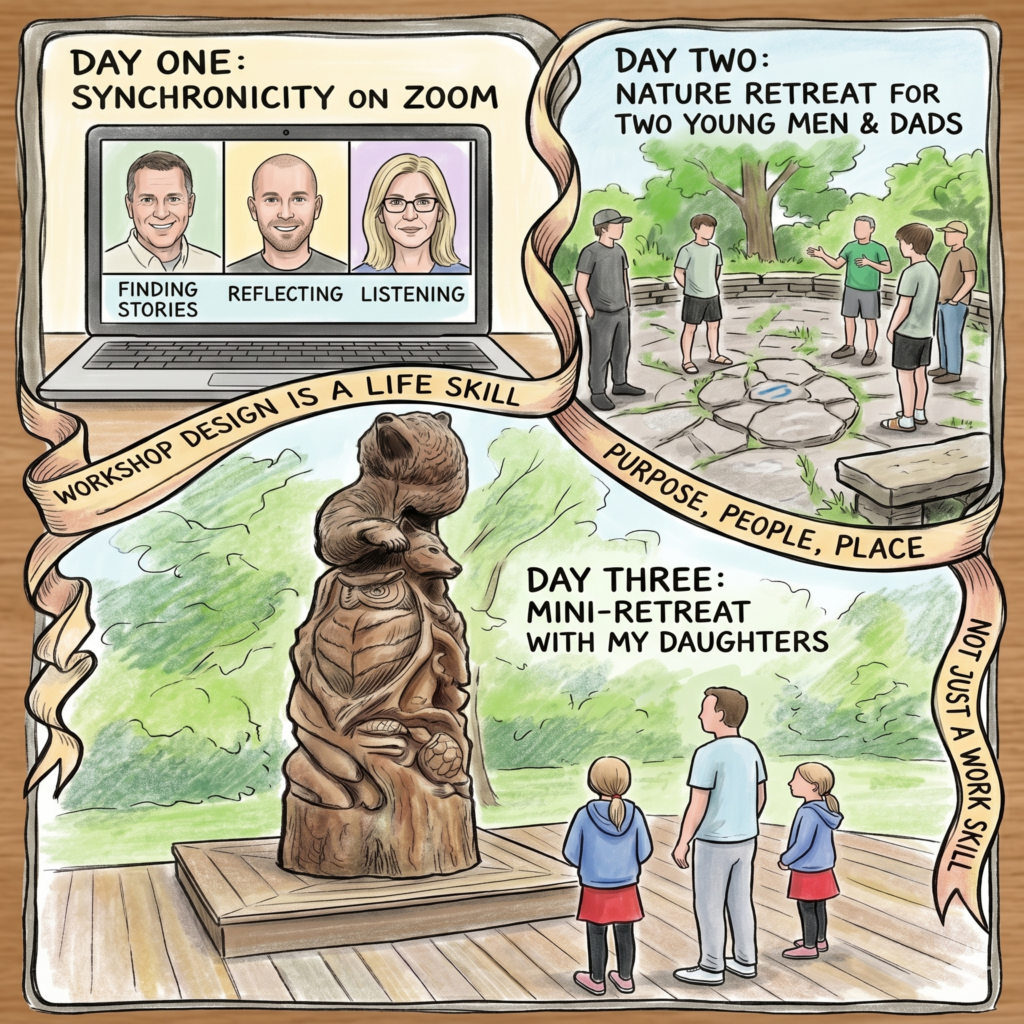
Day one: a retreat on the stories we never get to tell
I had recently attended an excellent conference that touched on synchronicity. (Carl Jung defined synchronicity as meaningful coincidence: those moments that feel too significant to be random.) The speakers were excellent. The topics were fascinating. But the format was almost entirely one-directional. We listened, and we listened well, but we never got the chance to reflect, share our own experiences, or connect with each other.
I left with a strange feeling wanting to take things to the next level. The conference content thought provoking but it needed the formal reflection activities and human connection for storytelling.
So I designed a small retreat on Zoom for a few people I knew who had attended. The whole point was the part the conference left out. We made space to find our own stories of synchronicity, to reflect on them, to share them, and to really listen to each other. It became one of the more meaningful gatherings I have been part of in a long time, and I put it together in an afternoon, because I knew how.
Day two: a nature retreat for two young men (and some Dads)
A friend has two sons in high school, one graduating and one a sophomore. He wanted to give them something more lasting than a gift or a speech: a real experience where they could learn and gain a little wisdom from a few of the adults in their lives.
Another friend and I asked ourselves a simple question. If we had a few hours with these two young men, what would we most want to share with them?
I brought them to one of my favorite gathering spots in the UW Arboretum here in Madison. We led a nature retreat built around a single theme: wandering for inspiration. Wisdom from yourselves, wisdom from nature. I got to use a few activities I love and try one I had been wanting to experiment with. Hopefully the boys (and Dads) gained something real that morning that they will remember. I know I did.
Day three: a mini-retreat with my daughters
By then I was on a roll, and still happily outdoors. I took my daughters to a special place we love, a beautiful natural spot with a totem pole that has always meant something to us. I led a small version of the same wandering-for-inspiration retreat, shaped just for them.
It was simple. It was short. It is one of my favorite memories of that whole stretch of time.
The skill underneath all three
None of these were complicated to create. What made them possible was not a template. It was a way of thinking I have practiced for years and now reach for almost instinctively.
Look closely, and the same building blocks show up in all three.
Purpose. Each retreat existed to fill a real gap and seize a deeper opportunity. The conference was intriguing but reflection was needed, so I designed the reflection and brought a few people together. A milestone deserved more than a card, so I designed a passage. Time with my daughters could have just happened, so I gave it a shape instead.
People. Each one was built for specific people, not a generic audience. Who is in the room (virtually or in nature), what they need, and what would actually matter to them. That is the starting point for everything else.
Place. A spot in the Arboretum. A totem pole in the woods. Even a Zoom room can be designed to feel like somewhere. Place does a lot of the quiet work if you let it.
A few signature activities you trust. You do not need fifty. You need a handful of things you know how to lead well, plus the willingness to try one new thing each time.
Purpose, people, place, and a few activities you believe in. That is most of it. Almost everything else is arrangement.
Why this matters more right now
We are living in a moment where generic is free and infinite. Anyone can ask an AI for a meeting agenda or a workshop outline and get a perfectly reasonable, perfectly forgettable answer in seconds. I use these tools every day, and they are helping me take my reflections, insights, and stories and develop them into an edited post you are reading now…and hopefully understanding!
But the more available the generic becomes, the more valuable the specific becomes. A gathering that is truly about your people, your purpose, and your place is the one thing no model can hand you. AI can be a wonderful thinking partner for the design work itself. The judgment about who needs to be in the room (or space if we are innovative and doing this outside or online), what they are quietly hoping for, and why this moment matters is yours. That part is the craft.
I think a lot of us feel the sameness. The same icebreakers, the same templates, the same five activities pulled from the same sources and dropped onto wildly different people and purposes. We deserve gatherings that are more interesting, more personal, and more our own.
You can learn this too
Here is the part I most want you to take with you. This is a learnable skill, not a personality trait. Once you understand the building blocks, you start seeing chances to use them everywhere: a team offsite, a family milestone, a community gathering, a goodbye, a fresh start.
It deepens your work, and it deepens your life. The same craft that helps me design an organizational innovation session is what helped me lead a retreat for Dads and sons and a morning in the woods with my daughters. Designing for a real place and real people is exactly the thinking behind the offsite workshops and retreats I design with organizations, too. It is also what makes a storytelling retreat land: you build the space for people to reflect and share, then you get out of the way.
If you want to build this skill deliberately, that is exactly what my Innovative Workshop Design and Facilitation Coaching program is for. Across three personalized sessions and a capstone, we design something real that you actually intend to lead, whether that is a workshop, a leadership retreat, a strategy session, or something personal that matters to you. You leave with the building blocks and a session you are ready to facilitate.
Start with one question, the same one I asked myself before each of those three days. Who are these people, and what would make this memorable for them?
Then find the intersection with what you are feeling and design backward from the answer.