
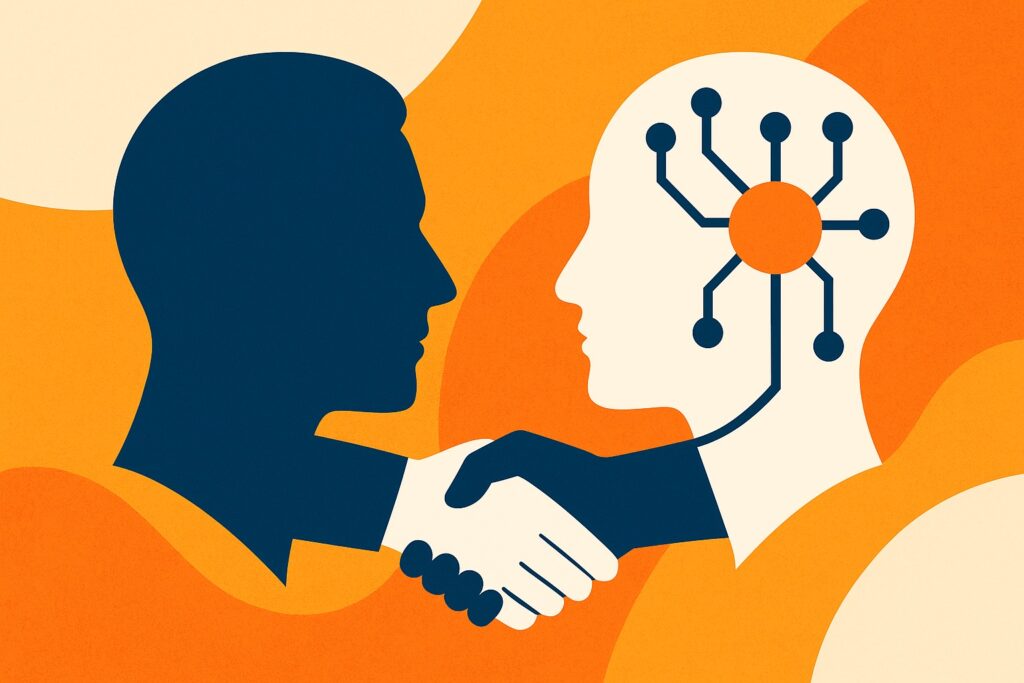
Why the biggest opportunity isn’t doubling down on your human strengths — it’s growing your AI fluency to match them.
Everywhere you look, you see lists of “the top skills for the future.”
They almost always sound the same:
- Creative thinking
- Adaptability
- Empathy
- Leadership
- Communication
- Curiosity
And yes — those are all essential.
But they’re only half of the story.
The Missing Half: AI Skills
We’re hearing a lot about human skills right now — especially after new research from MIT Sloan showing that AI is more likely to complement rather than replace us.
The EPOC model (Empathy, Presence, Opinion, Creativity, Hope) captures what humans bring to the partnership that machines can’t.
But here’s the catch:
Most people who are naturally strong in those “EPOC” skills are not building their AI skills.
They lean further into empathy, communication, and creativity —
but avoid or postpone learning how to truly work with AI.
And that’s a challenge.
The Real Future Skill: Partnership
The future isn’t about being more human than ever.
It’s about becoming better partners with AI.
That means learning to:
- Communicate clearly to AI (through better prompting, questioning, and structuring).
- Use AI to extend your creativity, not replace it.
- Combine human intuition with AI’s analytical reach.
- Let AI handle 80% of the routine so you can focus on the 20% that matters most.
It’s not AI vs. human.
It’s AI × human.
The future belongs to people who know how to blend the two.
The Growth Equation
Here’s the paradox:
People who are already strong in human-centered skills tend to focus on developing more of what they already do well.
But growth doesn’t happen most where you’re already strong.
It happens where you’re underdeveloped.
It’s usually easier to move:
from a 2 / 10 → 7 / 10 (on new AI skills)
than from a 8 / 10 → 9 / 10. (on human-centered skills)
If you’re a facilitator, coach, or leader who’s an 8 in empathy and creativity but a 2 in AI fluency — your real growth opportunity is in learning AI, not in squeezing another point out of what you already do well.
That’s where the exponential value lies.
A Balanced Skill Portfolio
Think of your capabilities as an investment portfolio.
You wouldn’t put 100% of your money in one category, even if it’s performing well.
You diversify.
The same goes for your professional development.
You don’t need to become a coder — you just need to become AI-fluent.
Fluency means you can think with it, communicate with it, and use it as a partner.
Practical Ways to Grow Both
Here are five simple ways to cultivate the AI × Human partnership this month:
- Run one project “with AI.”
Treat it as a collaborator — from brainstorming to delivery. - Shadow yourself with AI.
Ask ChatGPT, “How would you have approached this?” after a task. Compare notes. - Blend a creative tool and an analytical one.
For example, use Miro AI for idea generation and ChatGPT for synthesis. - Host a 30-minute peer session on “AI + Human Skills.”
Share what’s working for each of you. - Pick one AI tool a week.
Ten minutes of exploration per day builds compound fluency.
The Real Opportunity
The goal isn’t to become more like a machine or more human.
It’s to become the person who knows how to get the best of both.
If creative thinking is your strength —
use AI to go wider and faster.
If analysis is your weakness —
use AI to augment and simplify it.
The leaders, innovators, and facilitators of the future aren’t competing with AI.
They’re composing with it.
Call to Action
Start tracking your two scores:
- Your Human Skill Index (how well you connect, empathize, lead, and create)
- Your AI Skill Index (how effectively you use AI to think, decide, and make)
Then ask yourself:
“Which side needs the most investment this month?”
That’s your growth edge.
That’s your real future skill.