
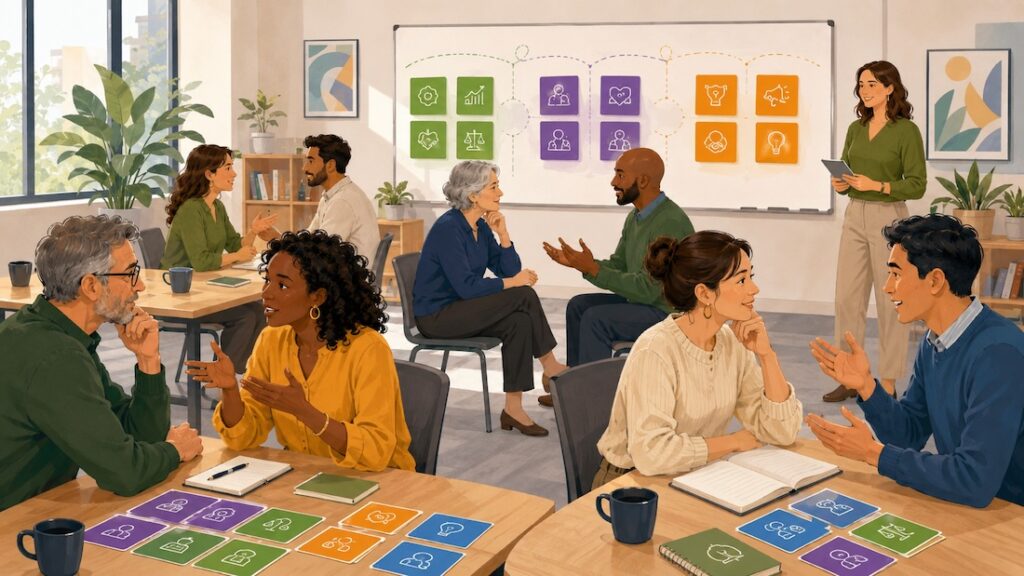
Workshop and Training to Discover, Assess and Apply your Strengths as a Professional and Team in your Organization
Strengths Workshop Guide: Using Assessments like CliftonStrengths/StrengthsFinder to Build Better Teams and Leaders
Self-assessments can create powerful moments of awareness in leadership development, team building, and professional development programs. They help people understand how they work, communicate, lead, collaborate, and contribute.
One of the most widely used strengths-based tools is CliftonStrengths, formerly known as StrengthsFinder. A Strengths workshop helps people move from a general sense of “what I’m good at” to a more practical understanding of how they can use their natural talents at work.
A well-designed Strengths workshop can help participants understand their strengths, appreciate the strengths of others, improve team communication, and apply strengths to real projects and challenges.
Reach out to us if you are interested in a Strengths workshop, training, or a custom leadership and team development workshop using assessments for your organization or team.
What Is CliftonStrengths?
CliftonStrengths is a strengths assessment from Gallup that helps people identify their natural patterns of thinking, feeling, and behaving. The assessment is organized around 34 talent themes.
Many people first encounter CliftonStrengths through their “Top 5” results. Others use the full CliftonStrengths 34 report, which ranks all 34 themes and gives a broader picture of a person’s strengths profile.
The 34 themes are grouped into four domains:
- Executing
- Influencing
- Relationship Building
- Strategic Thinking
These domains help teams see how people contribute in different ways. Some people naturally help the group get things done. Others help build relationships, influence stakeholders, think strategically, or make sense of complex information.
In a workshop setting, CliftonStrengths gives teams a shared language for questions like:
- What do I naturally bring to the team?
- What kinds of work energize me?
- How do I help ideas move forward?
- How do I build trust, influence others, think strategically, or execute?
- What do I need from teammates to do my best work?
- Where might my strengths become overused or misunderstood?
The value of a CliftonStrengths workshop is not just in the assessment results. The value comes from facilitated reflection, team conversation, practical application, and action planning.
Benefits of a Strengths Workshop
A Strengths workshop can help teams and organizations use strengths as a practical development tool.
Enhanced Self-Awareness
Participants gain a clearer understanding of their natural talents, motivators, and ways of contributing. Instead of focusing only on weaknesses, they learn how to name and apply what already works well.
Better Team Communication
When team members understand one another’s strengths, they can communicate with more empathy and specificity. A teammate with strong Strategic Thinking themes may need time to explore options. Someone with strong Executing themes may want clarity, ownership, and next steps.
A workshop helps make these preferences visible.
Stronger Collaboration
Teams often work better when they can see the range of strengths in the room. CliftonStrengths can help a group notice who helps generate possibilities, who builds relationships, who creates momentum, who influences stakeholders, and who turns plans into action.
More Effective Leadership
Leaders can use CliftonStrengths to understand their own leadership tendencies and better support different people on their team. A strengths-based leadership workshop can help leaders ask better questions, delegate more thoughtfully, coach more effectively, and build more balanced teams.
Practical Development Planning
The best strengths workshops do more than celebrate positive qualities. They help participants identify where to apply their strengths next, how to manage blind spots, and how to partner with people whose strengths are different.
What to Expect in a CliftonStrengths Workshop
CliftonStrengths workshops can be designed in many formats depending on your goals, group size, timeline, and whether the session is part of a larger leadership, team building, or professional development program.
Short Session: 1 to 2 Hours
A short CliftonStrengths session works well as an introduction. Participants learn the basics of the assessment, reflect on their top themes, and discuss how strengths show up in their work.
Half-Day Workshop
A half-day workshop allows for deeper reflection and team activities. Participants can share their strengths, explore the four domains, discuss team patterns, and identify ways to collaborate more effectively.
Full-Day Workshop
A full-day CliftonStrengths workshop can include individual reflection, partner coaching, team mapping, leadership application, communication exercises, and action planning. This format is useful for intact teams, leadership cohorts, or groups going through change.
Multi-Session Program
A longer strengths-based development program can combine CliftonStrengths with leadership development, coaching, team effectiveness, innovation, communication, or change management. This works well when the goal is not just awareness, but ongoing behavior change.
Typical Strengths Workshop Components
A CliftonStrengths workshop can be customized, but a strong session often includes the following components.
1. Pre-Workshop Assessment
Participants complete an assessment like the CliftonStrengths before the session. Depending on the program, they may use their Top 5 report or the full CliftonStrengths 34 report.
Participants may also complete a short reflection before the workshop:
- Which strengths feel most accurate?
- Which strengths have helped you succeed?
- Which strengths do others see in you?
- Which strengths do you want to use more intentionally?
- Where might one of your strengths be overused?
2. Introduction to Strengths-Based Development
The workshop begins with a practical overview of strengths-based development. Participants learn that strengths are not labels or fixed boxes. They are starting points for reflection, conversation, and action.
The facilitator helps the group shift from “What are my results?” to “How can I use this insight to contribute more effectively?”
3. Understanding the 34 CliftonStrengths Themes
Participants explore the 34 talent themes and what each theme can look like in real workplace behavior. This helps the group understand that strengths are not abstract traits. They show up in how people solve problems, build relationships, make decisions, learn, lead, and follow through.
4. Exploring the Four CliftonStrengths Domains
The four domains help participants see team patterns more clearly:
Executing strengths help teams make things happen.
Influencing strengths help teams speak up, persuade, and create momentum.
Relationship Building strengths help teams create trust and connection.
Strategic Thinking strengths help teams analyze, learn, imagine, and make sense of complexity.
A team map can show where the group has many strengths and where it may need stronger partnerships, processes, or support.
5. Individual Reflection
Participants reflect on their own results and connect them to real work. This may include prompts like:
- When am I at my best?
- What kinds of work give me energy?
- What do people often come to me for?
- Which strengths help me lead, collaborate, or create?
- Which strengths might I overuse?
- What do I need from others to do my best work?
6. Partner and Small-Group Conversations
Participants share strengths stories with others. This is often where the workshop becomes most valuable. People begin to understand not just what someone’s strengths are, but how those strengths show up in real experiences.
Example partner prompts:
- Tell a story about a time you used one of your top strengths well.
- What kind of work brings out your best contribution?
- What do you want teammates to understand about how you work?
- What kind of support helps you thrive?
- What is one strength you want to apply more intentionally this month?
7. Team Strengths Mapping
The group creates a team strengths map. This can show:
- Common strengths across the team
- Strengths that are rare or missing
- Domain patterns
- Potential collaboration opportunities
- Possible blind spots
- How the team may approach change, innovation, communication, and execution
The goal is not to create a perfect balance of strengths. The goal is to understand the team’s natural tendencies and design better ways of working together.
8. Applying Strengths to Real Work
A CliftonStrengths workshop should connect assessment results to current challenges. Depending on the group, this might include:
- Improving team communication
- Planning a project
- Leading change
- Building trust
- Creating a better meeting culture
- Strengthening manager and employee conversations
- Improving cross-functional collaboration
- Designing a team charter
- Preparing for a strategic initiative
This is where the workshop moves from insight to impact.
9. Strengths-Based Leadership Practice
For leadership groups, the workshop may include strengths-based coaching and leadership practice.
Leaders can explore:
- How their strengths shape their leadership style
- How to coach team members using strengths language
- How to avoid leading only from their own preferences
- How to build complementary partnerships
- How to assign roles based on strengths and development goals
- How to use strengths in feedback, recognition, and delegation
10. Action Planning
Participants identify one or two ways they will apply their strengths after the workshop.
Example action commitments:
- I will use my Strategic Thinking strengths to help the team clarify options before making a decision.
- I will use my Relationship Building strengths to strengthen trust with a new stakeholder group.
- I will use my Executing strengths to help turn our ideas into next steps.
- I will use my Influencing strengths to help communicate the value of our work.
- I will ask teammates how they want to use their strengths in our next project.
Strengths Workshops for Leadership Development
CliftonStrengths works especially well in leadership development because leaders need self-awareness and practical language for understanding others.
A strengths-based leadership session can help leaders explore:
- How they naturally lead
- How they may unintentionally overuse strengths
- How to partner with people who think and work differently
- How to recognize strengths in others
- How to build more engaged teams
- How to support growth without making development feel deficit-based
CliftonStrengths can also pair well with broader leadership and human skills programs, including Softest of the Soft Skills training workshops, growth mindset workshops, and business storytelling training workshops.
For example, leaders might use strengths to understand how they communicate, how they support others through uncertainty, how they build trust, and how they tell stories about purpose, progress, and change.
Strengths Workshops for Teams
Teams can use CliftonStrengths to better understand how they work together.
A team-focused workshop might help participants answer:
- What strengths do we rely on most?
- What strengths do we need to appreciate more?
- Where do we have gaps?
- How do our strengths affect meetings?
- How do our strengths affect decision-making?
- How do our strengths affect conflict?
- How can we design better collaboration habits?
For intact teams, the most useful part of the session is often the team application work. The group can look at a real project or challenge and ask:
- Who should help frame the problem?
- Who should help build stakeholder support?
- Who should help generate options?
- Who should help evaluate risks?
- Who should help move the plan into action?
- Who should help the team reflect and learn?
This helps strengths become practical, not just interesting.
Strengths, Innovation, and Change
Strengths-based development can support innovation and change because both depend on people working well together through uncertainty.
A team working on a new strategy, change initiative, customer experience, or innovation project may need people who can:
- Build empathy with customers or stakeholders
- Notice opportunities
- Frame problems clearly
- Generate ideas
- Test assumptions
- Share stories
- Influence decision-makers
- Turn ideas into action
Different strengths can support different parts of that work. Someone with strong Relationship Building themes may help create trust with users and stakeholders. Someone with strong Strategic Thinking themes may help make sense of research and identify patterns. Someone with strong Influencing themes may help communicate ideas and build support. Someone with strong Executing themes may help turn experiments into progress.
This makes Strengths assessment a useful addition to design thinking training workshops, innovation workshops, workshops for change management, leadership retreats, and custom team development programs.
Strengths Workshop Activities
Here are a few activities that can be included in a Strengths workshop.
Strengths Storytelling
Participants tell a short story about a time they used one of their top strengths successfully. This helps the group move beyond reading theme descriptions and into real examples.
Strengths Pair Interviews
Partners interview each other about how their strengths show up in work, communication, learning, and leadership.
Team Strengths Map
The team maps everyone’s top themes by domain. The group discusses what the map suggests about how they naturally work together.
Strengths in Action Challenge
Participants apply one strength to a current team challenge and identify one next action.
Overuse and Blind Spot Reflection
Participants explore how a strength can become less effective when overused. For example, a drive for action might move too quickly without enough input, while a love of analysis might delay decisions.
Strengths Appreciation Round
Team members name strengths they see in each other. This can build trust and help people feel seen for the contributions they make.
Project Role Design
The team looks at an upcoming project and identifies how different strengths can support discovery, planning, communication, execution, and learning.
Choosing a Strengths Workshop Format
The right format depends on your purpose.
Choose a short introductory workshop if your goal is awareness.
Choose a half-day or full-day workshop if your goal is team building, communication, leadership development, or practical application.
Choose a multi-session program if your goal is culture change, manager development, leadership growth, or integration with a larger initiative.
Choose a custom workshop if you want CliftonStrengths combined with leadership development, team building, innovation, change management, storytelling, facilitation, or future-ready skills.
How CliftonStrengths Compares to Other Assessments
CliftonStrengths is one of several assessments that can be useful in team building, leadership development, and professional development. i2 Skills is another newer one in this assessment genre.
A DISC workshop often focuses on communication styles, behavioral tendencies, and how people interact with others.
A Big Five personality workshop can help participants understand broad personality traits and how those traits may shape work, communication, and leadership.
A CliftonStrengths workshop focuses more directly on natural talents and how people can apply those talents productively.
Organizations do not always need to choose only one assessment. The best tool depends on the learning goal. Some teams need better communication. Some need stronger self-awareness. Some need a practical language for collaboration. Some need a strengths-based way to support leadership, engagement, or culture change.
For a broader look at assessment-based development, see our guide on using assessments for team building and leadership development.
Additional Resources and Next Steps
A Strengths workshop can help people understand what they naturally do well, how they contribute to a team, and how they can use their strengths more intentionally. It can also help teams build a shared language for collaboration, communication, leadership, and innovation.
The best workshops do not stop with the assessment report. They help people reflect, discuss, practice, and apply strengths to real work.
If you are interested in a Strengths workshop, Strengths discovery and application training, or a custom leadership or team development session using assessments, reach out to us. We can help design a session for your organization, leadership cohort, retreat, or team development program.