
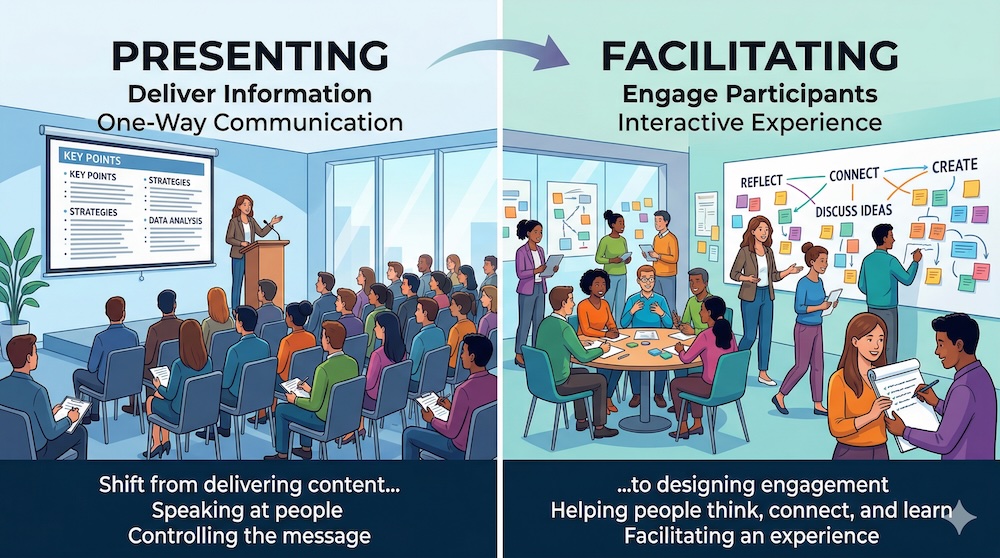
Facilitation is one of those words people use constantly at work and rarely define. A meeting “needs a facilitator,” a workshop is “facilitated,” and a leader is told to “facilitate more and present less.” This guide explains what facilitation means, what a facilitator actually does, the core facilitation skills, the main types of facilitation, and what good facilitation looks like in practice.
What Is Facilitation? (Definition)
Facilitation is the work of guiding a group through a process so it can think, learn, and decide well together. A facilitator designs that process and leads the group through it, while the group supplies the knowledge, ideas, and decisions.
The word comes from the Latin facilis, meaning “easy.” Facilitation literally means making something easier. A skilled facilitator makes it easier for a group to share what it knows, hear every voice, work through disagreement, and reach an outcome people will act on.
The key distinction is between content and process. A presenter or trainer is usually responsible for the content: they are the expert and deliver the information. A facilitator is responsible for the process: how the group spends its time, how people participate, and how the conversation moves toward a result. Many sessions blend both, but the mindset is different.
What Does a Facilitator Do?
- Clarifies the purpose. Works with the sponsor or group to define what the session needs to produce, such as ideas, a decision, a plan, or shared understanding.
- Designs the process. Chooses activities, questions, and timing that will get the group from where it starts to where it needs to be.
- Creates the conditions. Sets up the room or virtual space, establishes working agreements, and helps people feel safe enough to contribute.
- Guides the conversation. Gives clear instructions, asks open questions, listens, summarizes, and keeps the group on track.
- Balances participation. Draws out quieter voices and makes room so no single person dominates.
- Stays neutral on content. Helps the group reach its own conclusions rather than steering it toward the facilitator’s preferred answer.
- Captures and closes. Makes the group’s thinking visible, confirms decisions and next steps, and makes sure people leave knowing what happens next.
Core Facilitation Skills
Designing the session
Good facilitation starts well before anyone walks into the room. Facilitators translate a goal into a sequence of activities, each with a purpose, a time box, and an output. Most of the quality of a session is decided at this stage.
Asking powerful questions
The question a facilitator puts to a group shapes everything that follows. “What problems do we have?” produces a list of complaints. “Where are we losing the most time, and what would help most?” produces focus. Open, specific, and well-timed questions are the facilitator’s main tool.
Listening and summarizing
Facilitators listen for themes, agreements, and tensions, then reflect them back so the group can see its own thinking. A short, accurate summary often moves a stuck conversation forward faster than any new activity.
Managing group dynamics
Every group brings different personalities, power differences, and histories. Facilitators notice who is speaking and who is not, redirect side conversations, and handle conflict so it becomes productive instead of personal.
Managing time and energy
Facilitators watch the clock and the room at the same time. They know when to extend a valuable discussion, when to move on, and when a group needs to stand up, switch formats, or take a break.
Making thinking visible
Sticky notes, flip charts, whiteboards, and digital tools like Miro or MURAL let a group see and build on each other’s ideas. Visual capture also creates a record of what was decided.
Staying flexible
No session goes exactly as planned. Strong facilitators hold the purpose firmly and the agenda loosely, adapting activities when the group needs something different.
Types of Facilitation
- Meeting facilitation. Guiding regular or high-stakes meetings so they stay focused and end with clear decisions.
- Workshop facilitation. Leading interactive sessions where participants generate ideas, solve problems, or build plans. See how to facilitate a workshop.
- Training facilitation. Leading learning experiences where participants practice and apply skills rather than only listening to content. See this guide to experiential, participant-focused facilitation methods.
- Strategic facilitation. Helping leadership teams set direction, align priorities, and plan, often at an offsite or retreat.
- Innovation and design thinking facilitation. Guiding groups through creative processes such as brainstorming, prototyping, and testing ideas.
- Large group facilitation. Using methods such as the World Café or Open Space so dozens or hundreds of people can contribute.
- Virtual facilitation. Running any of these online, with breakout rooms, digital whiteboards, polls, and chat.
Facilitation Examples
A project team is stuck on a recurring problem. Instead of an open discussion that circles for an hour, a facilitator has each person write causes on sticky notes in silence, groups the notes into themes, and asks the team to vote on the two causes to tackle first. The team leaves in 45 minutes with a short action plan.
A leadership team holds an annual planning retreat. A facilitator designs the day so leaders reflect on the past year, explore future scenarios in small groups, and agree on three priorities, with owners and dates captured before lunch on the second day.
A training program on customer service could be delivered as a 60-minute lecture. A facilitator redesigns it so participants analyze real customer stories, role-play difficult conversations, and write one change they will make the next day.
Facilitation vs. Presenting vs. Training
| Facilitation | Presenting | Training | |
|---|---|---|---|
| Main role | Guide the group’s process | Deliver a message | Build specific skills or knowledge |
| Who has the answers | The group | The presenter | Mostly the trainer |
| Participant role | Active contributors | Audience | Learners who practice |
| Typical output | Ideas, decisions, plans | Understanding or persuasion | New capability |
The best trainers and speakers borrow heavily from facilitation. Shifting even part of a session from telling to involving changes how much people remember and use. The essay from presenter to facilitator describes that shift in practice.
Frequently Asked Questions
What is the role of a facilitator?
A facilitator’s role is to help a group achieve its goal by designing and guiding the process, managing participation and time, and remaining neutral about the content so the group owns the result.
What is facilitation in the workplace?
In the workplace, facilitation means leading meetings, workshops, planning sessions, and trainings so teams collaborate effectively and reach clear outcomes. Many managers facilitate regularly without the title.
What is facilitation in education?
In education, facilitation means guiding students to learn through discussion, inquiry, and activity rather than only through lecture. The teacher acts as a guide who structures the learning and supports students as they work.
Can facilitation be learned?
Yes. Facilitation is a set of skills that improves with practice, feedback, and a toolkit of reliable methods. Most strong facilitators learned by co-facilitating, studying methods, and reflecting after every session.
Build Your Facilitation Skills
InnovationTraining.org helps leaders, trainers, and teams become more engaging, effective facilitators. The facilitation workshop builds practical facilitation skills with your group, and the facilitator training program develops people who design and lead innovative sessions across your organization. Get in touch to talk about the right fit for your team.