
Most organizations have already tried innovation once. There was a speaker, an offsite, maybe a wall of sticky notes and a photo for the intranet. People left energized. Six weeks later, nothing in the actual work had changed.
An innovation program is the answer to that pattern. Instead of a single event, a program gives a group of people a repeatable process, real challenges to apply it to, and enough structure that the ideas reach someone who can say yes. This guide covers what innovation programs are, the main types, how to build one step by step, how to measure it, and why programs stall.
What is an innovation program?
An innovation program is a structured, multi-session effort that builds innovation skills in a group of people and applies those skills to challenges the organization actually cares about. A program has four parts that a one-off session lacks:
- A defined group. A cohort, a department, a leadership team, or a cross-functional set of people who move through it together.
- A real challenge. Work that matters to the business, chosen before the program starts.
- A repeatable process. A shared method for framing problems, generating ideas, developing concepts, and testing them.
- A decision point. A moment when concepts go in front of someone with budget or authority, and something gets funded, piloted, or stopped.
Programs go by many names inside organizations: innovation training, an ideation series, an innovation lab, an intrapreneurship program, a design thinking cohort, an employee innovation initiative. The label matters less than whether those four parts are present.
Types of innovation programs
Five patterns cover most of what organizations build.
1. Employee innovation programs
Open to people across the organization, often with an idea submission process attached. These work when employees can see their ideas move somewhere, and they fail when submissions disappear into a portal nobody reviews. If you run one, decide in advance who reviews ideas, on what schedule, and what happens to the good ones.
2. Leadership and strategy programs
A leadership team works through a strategic challenge together, using innovation methods to surface options they would not reach in a standard planning meeting. These are usually shorter, more intensive, and tied directly to a decision the group has to make. Our strategy workshops often function this way.
3. Product, service, or business unit programs
A single team applies the process to a specific product or service challenge over several weeks, moving from customer understanding to tested concept. The output is concrete: prototypes, pilots, and a recommendation.
4. Capability-building programs
The goal is internal capacity. You train a group of employees to facilitate innovation sessions themselves so the organization stops depending on outside help for every session. This is the option with the longest payoff for organizations that expect to keep doing this work. The Train the Trainer program and innovation facilitation training exist for exactly this.
5. Challenge or sprint programs
A time-boxed push on one question, run as a multi-day sprint or a short series. Useful when there is urgency, a clear problem, and a decision waiting on the other side.
When an innovation program is worth the investment
Programs take time and money, so it is worth being honest about whether one fits. A program tends to be the right call when several of these are true:
- People generate ideas but the ideas stall before anyone decides on them.
- The same problems resurface every year in different forms.
- Teams work hard inside their own functions and rarely solve anything across them.
- Leaders ask for innovation without naming what would count as success.
- A previous workshop created energy that faded within a month.
- You want the capability to outlast any one champion or consultant.
If the real issue is a single specific problem rather than a pattern, a focused workshop may serve you better than a program. A useful first step is diagnosing what is actually wrong, even looking at the culture for innovation, and this innovation culture assessment is a practical way to do it.
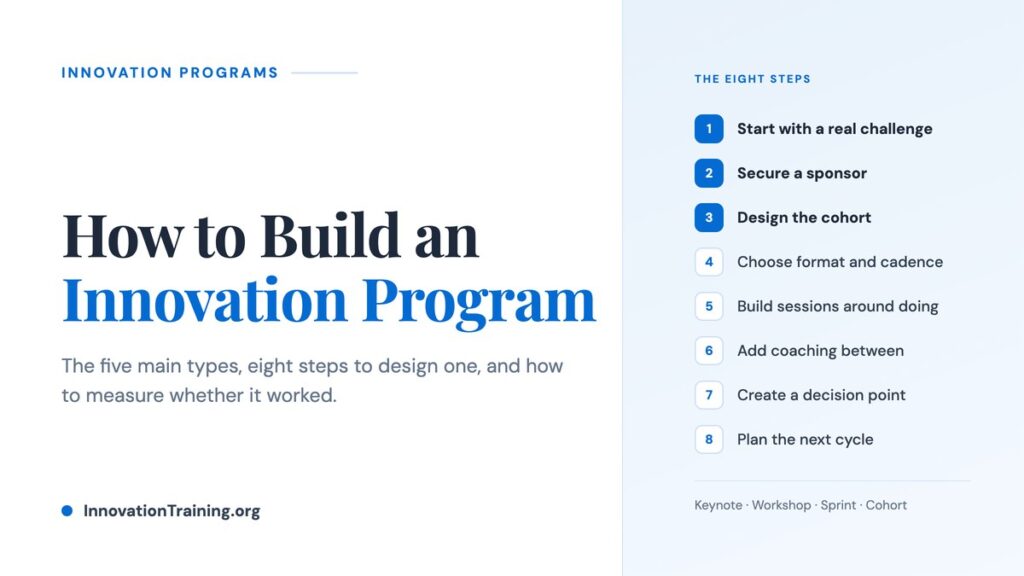
How to build an innovation program: eight steps
Step 1: Choose a real challenge before you design anything
The single biggest predictor of whether a program produces results is whether participants work on something that matters. “Innovation in our department” is a theme. “How might we cut the time between a customer’s first call and their first resolved issue?” is a challenge. Themes produce interesting conversations. Challenges produce decisions.
Pick challenges that are genuinely open, where leadership has not already settled on an answer. Nothing drains a program faster than participants discovering the conclusion was predetermined.
Step 2: Secure a sponsor with decision rights
Find the person who can approve a pilot, release a small budget, or assign someone’s time. Get them to commit to two things before the program starts: attending the session where concepts are presented, and making a decision within a defined window afterward.
This is the step most often skipped, and its absence is why good ideas from good programs quietly expire.
Step 3: Design the cohort
Decide who is in the room and why. A cohort of 15 to 30 gives you enough diversity for good ideas and enough intimacy for real conversation. Mix functions deliberately, since the person from finance often sees the constraint the product team has stopped noticing. Include at least a few people who will be responsible for implementing whatever gets chosen.
Step 4: Choose a format and cadence that fit your reality
Format follows constraints. Here is how the common options compare:
| Format | Typical length | Best for |
|---|---|---|
| Interactive keynote or conference session | 60 to 90 minutes | Shared language across a large group, often as a starting point |
| Single workshop | Half day to full day | One challenge, one team, a concrete output |
| Multi-day bootcamp | 2 to 4 consecutive days | Full process applied end to end with an intact group |
| Session series | 4 to 10 sessions over weeks | Skills that stick, because people practice between sessions |
| Capability build | Several months | Internal facilitators who can run sessions themselves |
Spacing sessions out is usually better for learning, because people apply the method to live work between meetings. Concentrated formats are better when calendars will never align twice or when a deadline is driving the work.
Step 5: Build sessions around doing, not presenting
In a well-designed program session, participants spend most of their time working: mapping the problem, interviewing users, generating ideas, sorting and choosing, sketching concepts, and pressure-testing them. Content input should be short and should arrive just before people need it.
The activities themselves matter. A group that has only ever brainstormed by shouting into a whiteboard will produce predictable results, while structured methods produce range. Our roundup of innovation activities to try and the expert brainstorming series both offer activities you can slot into a program design.
Step 6: Add coaching between sessions
Between-session work is where programs either take hold or fall apart. Give each team a small commitment: talk to three customers, test one assumption, bring back what surprised you. Then give them somewhere to take questions, whether that is a short check-in call, an internal coach, or office hours with the facilitator.
Step 7: Create a real decision point
End the core program with a session where teams present concepts to the sponsor and decisions get made in the room. Fund it, pilot it, park it with a reason, or stop it. Participants can accept a no. What they cannot accept is silence, and silence is what teaches an organization that innovation work is theater.
Step 8: Plan the next cycle before the first one ends
Decide during the program what happens after it. Who owns the pilots? When does the next cohort start? Which participants are ready to co-facilitate next time? Programs that name these answers while energy is high tend to continue. Programs that wait until afterward usually do not.
How to measure an innovation program
Executives will ask what the program produced, and “people loved it” will not hold up for long. Measure at three levels.
Participation and experience. Attendance, completion, and whether participants would recommend it. These are the easiest to collect and the least convincing on their own.
Capability. Whether people can now do something they could not do before. A short self-assessment before and after works well, as does a simple observable test: how many participants have facilitated a session themselves within three months?
Outcomes. The measures leadership cares about. Concepts developed, concepts funded or piloted, time from idea to decision, and where possible the results of the pilots themselves. Agree on which of these count before the program starts, because retrofitting metrics afterward rarely convinces anyone.
One practical habit: capture a short written record of each cycle, including what was tried, what was decided, and what happened next. Organizations that keep this record build an institutional memory for innovation. Organizations that do not tend to repeat the same starting conversation every two years.
Why innovation programs stall
- No decision maker in the room. Concepts need someone who can act on them, present at the moment they are presented.
- Vague challenges. Broad themes produce broad ideas that are hard to act on.
- Training with no application. Methods taught in the abstract fade within weeks.
- No time protected. If participants are expected to do program work on top of a full workload with no adjustment, the program loses to the day job every time.
- One champion. When the program depends entirely on one enthusiastic leader, it usually ends when that person changes roles. Capability-building formats are the defense against this.
- Stopping at ideas. Idea generation is the easy part. Development, testing, and the decision are where value appears.
Running it internally or bringing in a facilitator
Both work, and the honest answer depends on where you are starting. An external facilitator is useful for the first cycle, when the methods are new, when the topic is politically charged, or when leadership needs to participate rather than run the session. Internal facilitators are better long term, because they know the context, cost less per session, and can sustain the work.
Many organizations use a sequence: bring in outside facilitation for the first cohort, train internal people alongside it, then shift delivery in-house while keeping outside support for the harder sessions. If that path fits, the facilitation workshop is a common starting point for building those internal skills.
Common questions
How long should an innovation program run?
Anywhere from a two-day bootcamp to a year of cohorts. A useful rule: the program needs to be long enough for participants to apply the method to real work at least twice, since the second attempt is where the skill becomes theirs.
What does an innovation program cost?
Cost tracks format, group size, how much custom design is required, and whether facilitation is internal or external. A single workshop and a multi-cohort capability build are different orders of magnitude. The most useful first step is to describe your group, your timeline, and what needs to be different afterward, then price the options against that.
Should an innovation program include AI?
Increasingly yes, but as part of the work rather than the subject of it. Participants can use AI to research a problem space, synthesize interview notes, or push past their first few ideas, and the judgment about which ideas matter stays with the group. We cover the practical side of this in AI and innovation training.
Does this work in regulated or risk-averse industries?
Yes, with adjustments. In highly regulated settings, the constraint work happens earlier and the testing is smaller and more careful. Healthcare is a good example of a sector where the method holds up when the pace is adapted, which we explore in our work on healthcare innovation.
Where to start
If you are considering a program, start smaller than the vision. Pick one real challenge, one cohort, and one sponsor who will make a decision at the end. Run that cycle well, capture what happened, and use it to design the next one. A program that produces one funded pilot and five newly capable facilitators has earned the right to grow. A program that starts with a grand launch and no decision point rarely gets a second cycle.
We design and lead innovation programs for organizations worldwide, in formats ranging from a single innovation workshop to multi-session creativity and innovation training built around your challenges, along with design thinking training for teams that want a shared process. If you are working out which format fits your people and your timeline, tell us what the program needs to accomplish and we will recommend an approach.