
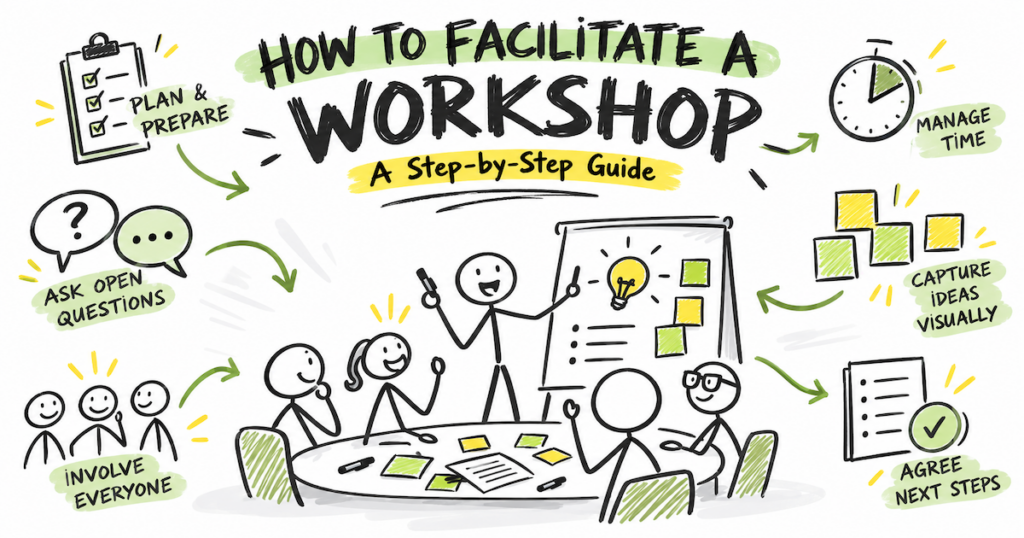
Whether you are leading a strategy session, a leadership team offsite, a design thinking workshop, or an agile retrospective, facilitation is what turns a room full of people into a group that gets something done. This guide is for leaders, trainers, internal facilitators, and anyone preparing to facilitate a workshop, especially for the first few times. It walks through what to do before, during, and after the session, with the facilitation moves that make the biggest difference and the mistakes that are easiest to avoid.
What Workshop Facilitation Means
A workshop facilitator designs and guides a process that helps a group think, decide, or create together. The facilitator is responsible for how the group works: the structure, the timing, the questions, and making sure every voice is heard. The group is responsible for the content: the ideas, the decisions, and the plan. That division is what separates facilitating from presenting or chairing a meeting. When the facilitator is also the expert or the boss, the role is harder, because people will look to you for answers. Much of good facilitation is resisting the urge to supply them.
Before the Workshop: Preparation That Makes the Session Work
Clarify the purpose and the outcome
Start by talking with the person who asked for the workshop. Ask what the group should leave with, who will be in the room, and what has already been tried. Then write the outcome in one sentence, such as “The leadership team leaves with three agreed priorities for next year and an owner for each.” Every decision about the agenda should serve that sentence.
Learn about the participants
A short survey or a few conversations with participants before the session tells you what they care about, where the tension is, and what language they use. A facilitator who walks into a leadership offsite knowing that two departments disagree about resources can design time to surface that disagreement productively instead of being surprised by it.
Design the agenda and write your facilitator notes
Build the agenda as a sequence of activities, each with a purpose, a time, and a clear set of instructions. Alternate individual thinking, small-group work, and full-group discussion. Write your notes as the exact questions and instructions you will give, since clear wording in the moment is harder than it looks. If you are building the session from scratch, our guide on how to turn any training topic into an interactive workshop covers the design process step by step.
Prepare the room and materials
Set up tables for small groups rather than rows, and put sticky notes, markers, and any worksheets on the tables before people arrive. Test the projector, the timer, and any digital tools. For virtual workshops, set up breakout rooms and a shared board in Miro or Mural ahead of time, and have a co-host manage the technology so you can focus on the group.
How to Open a Workshop
The first ten minutes set the tone for everything that follows. Welcome people, state the purpose and the outcome, and walk through the agenda briefly so the group knows where the session is going. Then get every person talking early. A short pair conversation or a quick round on a question connected to the topic, such as “What is one thing that would make today worth your time?”, signals that this session depends on participation.
Agree on a few working norms, such as one conversation at a time, phones away during activities, and “yes, and” before “yes, but” during idea generation. Invite the group to add their own. Norms the group chose are far easier to hold people to later.
How to Facilitate Activities and Discussion
Give clear instructions
Most activities fail at the instructions. Say what people will do, who they will do it with, how long they have, and what they should produce. Put the instructions on a slide or flip chart so groups can check them. Then ask “What questions do you have?” before starting the timer, rather than “Any questions?”, which usually gets silence.
Ask open questions and listen
Your main tool is the question. Open questions such as “What are you noticing?”, “What would that look like in practice?”, and “Who sees it differently?” deepen the conversation without steering it. Paraphrase what you hear to check understanding and to show the group they have been heard. When a design thinking team says their customers “just want it faster,” a question like “Faster at which step?” often reveals the real problem.
Balance participation
In most groups, a few people do most of the talking. Structure solves this better than calling people out. Use silent writing before discussion, round-robin sharing, and small groups, all of which give quieter participants space. When one person dominates, thank them and redirect: “That’s a helpful view. Let’s hear from someone who hasn’t spoken yet.”
Capture the group’s thinking
Write key points, ideas, and decisions where everyone can see them, using the participants’ own words. Visible capture keeps the conversation on track, helps people build on each other’s ideas, and becomes the record of the session. In a strategy workshop, for example, a wall of clustered sticky notes showing the group’s priorities is far more persuasive to the team than a set of notes someone types up later.
Managing Time and Energy
Keep a visible timer and give warnings: “Two more minutes, then we’ll hear from each table.” If an activity is producing valuable discussion, it is fine to extend it, but decide what you will shorten to make room and tell the group. Plan breaks every 60 to 90 minutes. Watch the energy in the room. When attention drops after lunch, switch to an activity that gets people standing and moving, such as a gallery walk or a quick pair conversation on their feet.
Handling Difficult Moments
Disagreement. Conflict about ideas is useful. Name it and make space for it: “It sounds like we see this two ways. Let’s map out both before deciding.” Keep the focus on the issue rather than the people.
Silence. Silence after a question often means people are thinking. Wait longer than feels comfortable, or give a minute to write first and then share.
Going off topic. Keep a visible “parking lot” for important issues that do not fit the current agenda, and commit to what happens to them after the session.
A senior leader taking over. Talk with senior participants before the session about the role you need them to play. Many leaders are glad to hold back once they understand that their team will speak more freely if they do.
How to Close a Workshop
End with clarity and commitment. Summarize what the group created and decided, confirm owners and dates for next steps, and review the parking lot. Then give each person a moment to reflect on what they are taking away, individually or in a quick round. Our guide to reflection activities for workshops has options for this. Close on time, and thank the group for the work they did.
After the Workshop: Follow Up
Send a summary within a day or two while the session is fresh: the outcomes, decisions, next steps with owners, and photos of the key charts. Check in with the person who asked for the workshop about what worked and what to change next time. Then reflect on your own facilitation. Note one thing that went well and one thing you would do differently, since that habit is how facilitators improve fastest.
Common Workshop Facilitation Mistakes
Presenting instead of facilitating. Long stretches of slides turn a workshop back into a lecture. Keep your input short and let the group do the work.
Overpacking the agenda. Every activity takes longer than planned. Cut the agenda by a third before the session, and keep one optional activity in reserve.
Unclear instructions. If groups start an activity by asking each other what they are supposed to do, the instructions were not clear enough.
Skipping the close. A workshop that runs out of time before next steps are agreed often produces nothing. Protect the last 15 minutes.
Build Your Workshop Facilitation Skills
Facilitation improves with practice and feedback. If you want to build these skills with a group of leaders, trainers, or internal facilitators, our facilitation workshop gives participants hands-on practice leading real sessions. For individuals, the innovative facilitator training program combines online workshops with coaching and a certificate, and our workshop design and facilitation coaching works one-to-one on a session you need to lead. You can also check your strengths with the free facilitation skills self-assessment.
What is the next workshop you need to facilitate? Tell us about it, and we will help you plan it.