
Train yourself on the trending field of behavior change with our recommended books about behavioral economics and behavior design. These are some of the best books in the field to apply to make better choices, build positive habits, and change behavior for the better. These books can not only help in your own understanding and personal or professional development, but are also great resources for behavioral economics training programs and workshops.
The changing of behavior in others (and ourselves) can be a very challenging thing to begin and sustain. Some of the techniques and activities detailed in these books can help, especially when it comes to choices and habits. New ways of thinking and behaving are critical for succeeding with innovation or actually applying new changes or ideas. Insights from the research on behavior change can help with taking and sustaining needed action.
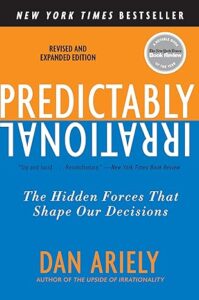
Predictably Irrational, Revised and Expanded Edition: The Hidden Forces That Shape Our Decisions by Dan Ariely
Amazon Description:
Behavioral economist and New York Times bestselling author Dan Ariely offers a much-needed take on the irrational decisions that led to our current economic crisis.
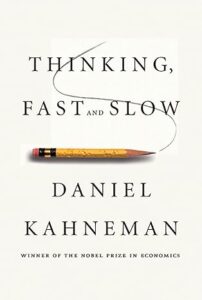
Thinking, Fast and Slow by Daniel Kahneman
Amazon Description:
In his mega bestseller, Thinking, Fast and Slow, Daniel Kahneman, world-famous psychologist and winner of the Nobel Prize in Economics, takes us on a groundbreaking tour of the mind and explains the two systems that drive the way we think.
System 1 is fast, intuitive, and emotional; System 2 is slower, more deliberative, and more logical. The impact of overconfidence on corporate strategies, the difficulties of predicting what will make us happy in the future, the profound effect of cognitive biases on everything from playing the stock market to planning our next vacation—each of these can be understood only by knowing how the two systems shape our judgments and decisions.
Engaging the reader in a lively conversation about how we think, Kahneman reveals where we can and cannot trust our intuitions and how we can tap into the benefits of slow thinking. He offers practical and enlightening insights into how choices are made in both our business and our personal lives—and how we can use different techniques to guard against the mental glitches that often get us into trouble. Topping bestseller lists for almost ten years, Thinking, Fast and Slow is a contemporary classic, an essential book that has changed the lives of millions of readers.
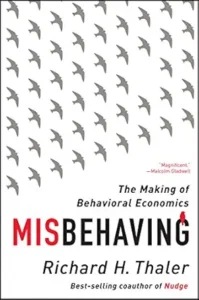
Misbehaving: The Making of Behavioral Economics by Richard H. Thaler
Amazon Description:
Nobel laureate Richard H. Thaler has spent his career studying the radical notion that the central agents in the economy are humans—predictable, error-prone individuals. Misbehaving is his arresting, frequently hilarious account of the struggle to bring an academic discipline back down to earth—and change the way we think about economics, ourselves, and our world.
Traditional economics assumes rational actors. Early in his research, Thaler realized these Spock-like automatons were nothing like real people. Whether buying a clock radio, selling basketball tickets, or applying for a mortgage, we all succumb to biases and make decisions that deviate from the standards of rationality assumed by economists. In other words, we misbehave. More importantly, our misbehavior has serious consequences. Dismissed at first by economists as an amusing sideshow, the study of human miscalculations and their effects on markets now drives efforts to make better decisions in our lives, our businesses, and our governments.
Coupling recent discoveries in human psychology with a practical understanding of incentives and market behavior, Thaler enlightens readers about how to make smarter decisions in an increasingly mystifying world. He reveals how behavioral economic analysis opens up new ways to look at everything from household finance to assigning faculty offices in a new building, to TV game shows, the NFL draft, and businesses like Uber.
Laced with antic stories of Thaler’s spirited battles with the bastions of traditional economic thinking, Misbehaving is a singular look into profound human foibles. When economics meets psychology, the implications for individuals, managers, and policy makers are both profound and entertaining.
The Power of Habit: Why We Do What We Do in Life and Business by Charles Duhigg
Amazon Description:
In The Power of Habit, award-winning business reporterCharles Duhigg takes us to the thrilling edge of scientific discoveries that explain why habits exist and how they can be changed. Distilling vast amounts of information into engrossing narratives that take us from the boardrooms of Procter & Gamble to the sidelines of the NFL to the front lines of the civil rights movement, Duhigg presents a whole new understanding of human nature and its potential. At its core, The Power of Habit contains an exhilarating argument: The key to exercising regularly, losing weight, being more productive, and achieving success is understanding how habits work. As Duhigg shows, by harnessing this new science, we can transform our businesses, our communities, and our lives.
Nudge: Improving Decisions About Health, Wealth, and Happiness by Richard H. Thaler and Cass R. Sunstein
Amazon Description:
Since the original publication of Nudge more than a decade ago, the title has entered the vocabulary of businesspeople, policy makers, engaged citizens, and consumers everywhere. The book has given rise to more than 200 “nudge units” in governments around the world and countless groups of behavioral scientists in every part of the economy. It has taught us how to use thoughtful “choice architecture” – a concept the authors invented – to help us make better decisions for ourselves, our families, and our society.
Now, the authors have rewritten the book from cover to cover, making use of their experiences in and out of government over the past dozen years as well as an explosion of new research in numerous academic disciplines. To commit themselves to never undertaking this daunting task again, they are calling this the “final edition”. It offers a wealth of new insights, for both its avowed fans and newcomers to the field, about a wide variety of issues that we face in our daily lives – COVID-19, health, personal finance, retirement savings, credit card debt, home mortgages, medical care, organ donation, climate change, and “sludge” (paperwork and other nuisances we don’t want and that keep us from getting what we do want) – all while honoring one of the cardinal rules of nudging: make it fun!
Atomic Habits: An Easy & Proven Way to Build Good Habits & Break Bad Ones by James Clear
Amazon Description:
No matter your goals, Atomic Habits offers a proven framework for improving–every day. James Clear, one of the world’s leading experts on habit formation, reveals practical strategies that will teach you exactly how to form good habits, break bad ones, and master the tiny behaviors that lead to remarkable results.
If you’re having trouble changing your habits, the problem isn’t you. The problem is your system. Bad habits repeat themselves again and again not because you don’t want to change, but because you have the wrong system for change. You do not rise to the level of your goals. You fall to the level of your systems. Here, you’ll get a proven system that can take you to new heights.
Clear is known for his ability to distill complex topics into simple behaviors that can be easily applied to daily life and work. Here, he draws on the most proven ideas from biology, psychology, and neuroscience to create an easy-to-understand guide for making good habits inevitable and bad habits impossible. Along the way, readers will be inspired and entertained with true stories from Olympic gold medalists, award-winning artists, business leaders, life-saving physicians, and star comedians who have used the science of small habits to master their craft and vault to the top of their field.
Switch: How to Change Things When Change Is Hard by Chip and Dan Heath
Amazon Description:
The primary obstacle is a conflict that’s built into our brains, say Chip and Dan Heath. Psychologists have discovered that our minds are ruled by two different systems—the rational mind and the emotional mind—that compete for control. The rational mind wants a great beach body; the emotional mind wants that Oreo cookie. The rational mind wants to change something at work; the emotional mind loves the comfort of the existing routine. This tension can doom a change effort—but if it is overcome, change can come quickly.
In Switch, the Heaths show how everyday people—employees and managers, parents and nurses—have united both minds and, as a result, achieved dramatic results:
• the lowly medical interns who managed to defeat an entrenched, decades-old medical practice that was endangering patients
• the home-organizing guru who developed a simple technique for overcoming the dread of housekeeping
• the manager who transformed a lackadaisical customer-support team into service zealots by removing a standard tool of customer service
In a compelling, story-driven narrative, the Heaths bring together decades of counterintuitive research in psychology, sociology, and other fields to shed new light on how we can effect transformative change. Switch shows that successful changes follow a pattern, a pattern you can use to make the changes that matter to you.
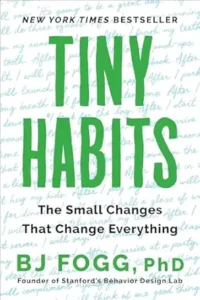
Tiny Habits: The Small Changes that Change Everything by BJ Fogg, PhD
Amazon Description:
BJ FOGG is here to change your life—and revolutionize how we think about human behavior. Based on twenty years of research and Fogg’s experience coaching more than 40,000 people, Tiny Habits cracks the code of habit formation. With breakthrough discoveries in every chapter, you’ll learn the simplest proven ways to transform your life. Fogg shows you how to feel good about your successes instead of bad about your failures.
This proven, step-by-step guide will help you design habits and make them stick through positive emotion and celebrating small successes. Whether you want to lose weight, de-stress, sleep better, or be more productive each day, Tiny Habits makes it easy to achieve—by starting small.
Behavior Design & Behavioral Economics Books
Many of the books I’ve enjoyed (and needed) most over the past 10 years as a design thinking trainer have been on behavior change, decision, habit, etc. It’s such a challenging and important area needed for helping others start and sustain innovation in their work.
There are many other great behavior change authors and practices such as Stanford professor BJ Fogg’s Tiny Habits approach which has worked well for me. What other behavioral economics books have been influential for you and your practice? Please suggest other books, activities or resources that have helped you learn more about behavior change, do it yourself, or help others. Just leave a comment below to let us know what you’ve appreciated.