
A strategy template gives a team somewhere to start. It turns an open ended conversation about direction into a structured working session with a clear shape, so a group can move from discussion to decisions inside a couple of hours rather than across a couple of months.
The templates below are grouped by the job you are trying to do rather than by the tool they come from. Under each one you will find how to actually run a session with it: roughly how long it takes, who should be in the room, and where groups usually get stuck. A template on its own rarely produces alignment. A template plus a facilitated conversation usually does.
One note on tools before the templates. The templates below are Figma’s, and they are good. The board we actually work in is Miro. We have been paying customers for years, it has the deepest template library of any of these tools, and for collaborative strategy work we think it is the strongest option in the category. If you are picking a whiteboard to standardise on, start there.
Setting direction: mission, vision, and values
Use this when the team cannot agree on priorities because they have never agreed on the destination. Arguments about tactics are often disagreements about purpose that nobody has surfaced.
Mission, Vision and Values Template
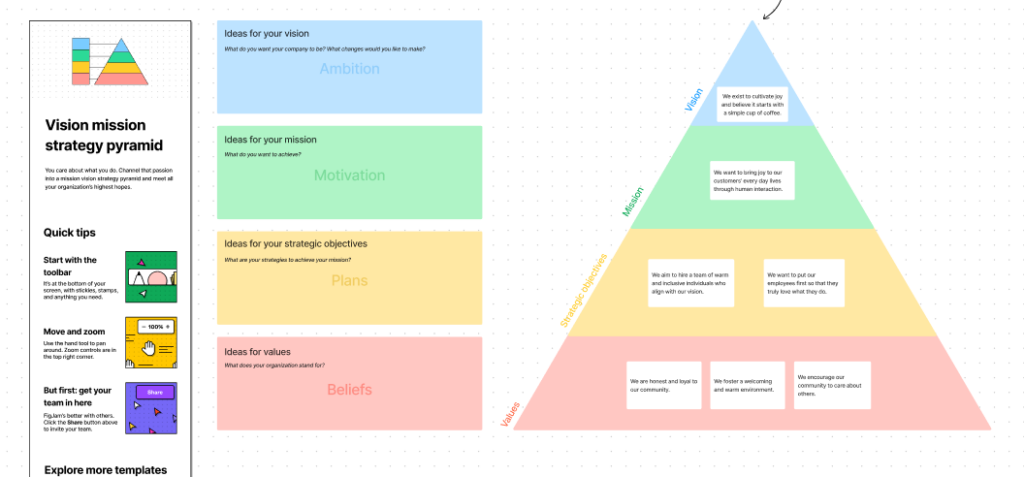
This template centers on establishing the organizational vision, mission, and principles that guide strategy and business decisions.
How to run it. Allow two to three hours. Invite the people who will be accountable for the strategy, not only the people who will write it. Start with individual silent writing before any group discussion, because the loudest voice in the room otherwise anchors the vision to one person’s view. Collect drafts, cluster the themes, then work toward shared language.
Where groups get stuck. Wordsmithing. A group can lose an entire afternoon to a single sentence. Agree the substance first and assign the final wording to one or two people afterwards.
Planning the work: strategic plans and quarterly cycles
Use these when the direction is broadly agreed and the question is what happens next.
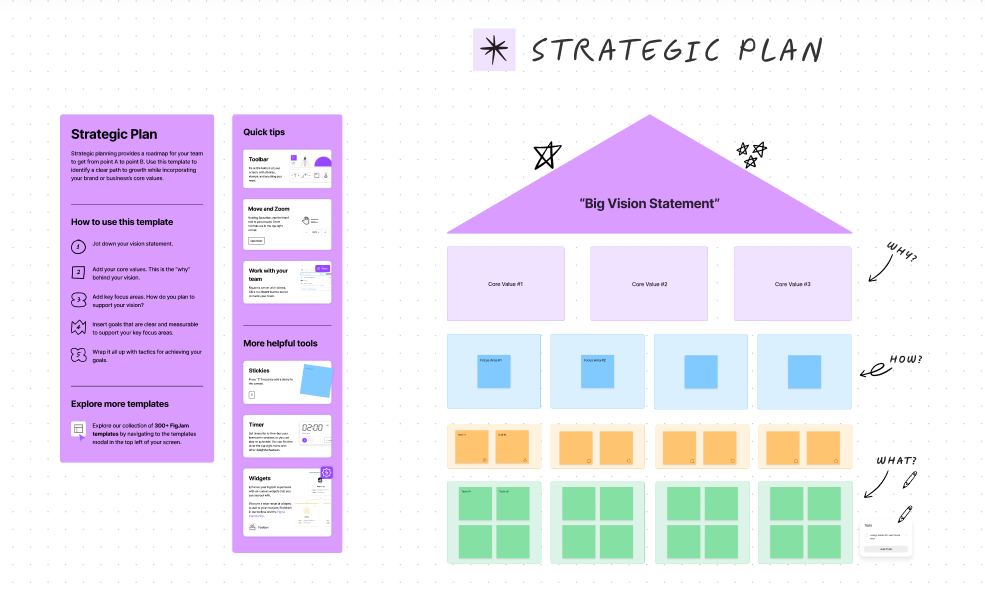
This template helps a team define its next move and plot a plan for the road ahead, working through vision, objectives, and action plans together.
How to run it. Half a day. Work backwards from the outcome you want a year out, then identify what has to be true at six months and three months for that to happen. Teams that plan forwards from today tend to produce a list of current activities relabeled as strategy.
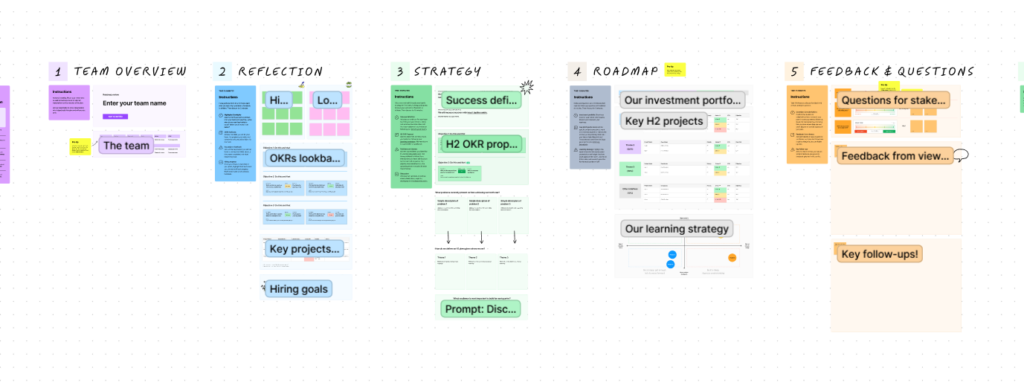
This one supports reflecting on performance and decisions from the previous period while looking ahead and planning for the next.
How to run it. Ninety minutes, every quarter, same format each time. The reflection half matters more than the planning half and is usually the part that gets cut when time runs short. Protect it. A quarterly cycle that never looks backwards repeats the same mistakes with new labels.
Making it stick: communication and rollout
Most strategies do not fail at the planning stage. They fail in the gap between the people who wrote the plan and the people expected to act on it.
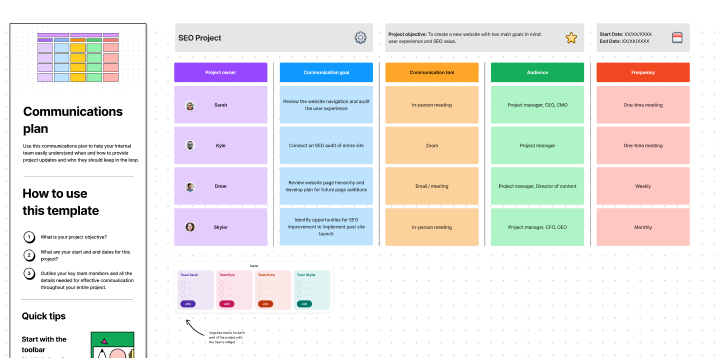
This template helps you outline how and when people will work together and communicate, which is particularly useful for hybrid and remote teams trying to get organized around a shared plan.
How to run it. One hour, immediately after the planning session while the reasoning is still fresh. Answer three questions for each audience: what do they need to know, what do they need to do, and what will they want to ask. The third question is the one teams skip and the one that determines whether the plan survives contact with the organization.
Choosing a tool for strategy sessions
Miro is what we use and what we recommend. It has the largest template library of any of these tools, the widest range of strategy and planning frames, and it holds up when a session gets big and messy, which strategy sessions do. We have run workshops on it for years as paying customers.
The templates above run on Figma’s whiteboard, which works well if your team already lives in Figma for design work. MURAL is also worth knowing about, particularly for its facilitation features: timers, private voting, and attention controls that help when you are guiding a large group.
That said, the tool matters far less than the facilitation. A well run session on a paper flipchart produces better strategy than a poorly run session in the best software available. Pick whichever your team will actually open again next quarter.
Getting more out of a strategy session
A few things separate sessions that produce alignment from sessions that produce a document nobody opens again.
- Decide what the session is for before choosing a template. Setting direction, making a plan, and communicating a decision are three different sessions. Trying to do all three in one meeting usually accomplishes none of them.
- Get input before the session, not during it. Ask participants to submit their view of the biggest opportunity and biggest risk in advance. You will start from real material instead of an empty canvas.
- Separate generating from deciding. Groups that evaluate every idea as it appears converge too early on the safest option. Generate first, evaluate second, as distinct activities with a visible break between them.
- Name the owner and the date before anyone leaves. An action without a name attached is a wish. This single habit does more for follow through than any template.
- Build in reflection. Close by asking what the group learned about how they work together, not only what they decided. That is where the value compounds across quarters.
Working with a facilitator
Templates work best when someone is guiding the conversation rather than participating in it. That is difficult for a leader to do for their own team, because the person with the most authority in the room cannot easily be neutral about the outcome.
We design and facilitate strategy workshops for leadership teams, onsite or virtually, built around the decisions your organization actually needs to make. Sessions are custom designed rather than run from a standard agenda, and participants leave with a plan they helped build and are committed to.
Tell us about your team and what you are trying to decide and we will suggest a format.
Disclosure: the Miro links above are affiliate links, and if you start a plan through one of them we may earn a commission at no additional cost to you. We have been paying Miro customers for years and it is the tool we work in. The other templates here are options we researched and thought were worth sharing, not tools we use daily.