
Future Skills Assessments for Soft Skills, Human Skills, and Workplace Readiness
Work is changing quickly. Teams are dealing with AI, hybrid collaboration, shifting customer expectations, organizational change, and more complex problems. In this environment, technical knowledge is important, but it is not enough.
Professionals also need the human capabilities that help them adapt.
They need to ask better questions. They need to listen carefully. They need to notice opportunities. They need to work across silos. They need to test assumptions before investing too much time or money. They need to reflect on what they are learning and adjust.
We have been following this topic for many years through our work in innovation skills and the capabilities people need to create, collaborate, and lead in changing environments. More recently, we have also been writing about future skills in our Substack and the capabilities professionals need to develop now as work continues to shift.
The more we study this space, the clearer the pattern becomes: the future of work needs people who can combine human skills with innovation skills.
What is a future skills assessment?
A future skills assessment helps individuals and teams reflect on the capabilities they need for changing work.
These skills may be described in different ways. Some organizations call them soft skills. Others call them human skills, workplace skills, durable skills, power skills, or future-ready skills.
The language varies, but the underlying need is similar.
Organizations need people who can communicate, collaborate, adapt, think creatively, solve problems, and keep learning.
A useful assessment should help people answer practical questions:
How do I respond when the path forward is uncertain?
How well do I notice new opportunities?
How do I build relationships that support collaboration?
Do I test assumptions before moving forward?
How do I reflect, learn, and adapt over time?
These are not just personality questions. They are development questions.
That distinction matters.
Moving beyond basic personality assessments
Many people have already taken assessments like DISC, Big Five, MBTI, CliftonStrengths, or other personality and communication style tools. These assessments can be helpful. They give people language for understanding preferences, tendencies, strengths, and interpersonal styles.
That kind of self-awareness can be a good starting point.
But future-ready work requires more than knowing your style.
A team may understand its communication preferences and still struggle to innovate. A leader may know their strengths and still have difficulty navigating ambiguity. A group may have strong personality awareness and still avoid experimentation, reflection, or difficult conversations.
The next step is not just more self-awareness.
The next step is skill development.
That is where a future skills assessment becomes useful. It helps people identify the capabilities they can practice and improve so they are better prepared for uncertainty, innovation, and change.
The i2 Skills Assessment
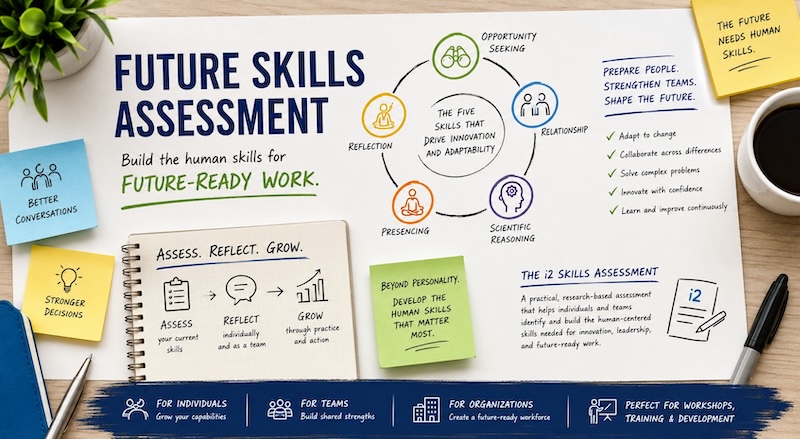
The i2 Skills Assessment is designed to help people assess and develop the human-centered skills that support innovation and future-ready work.
It is especially useful for organizations that want to move beyond basic personality or style assessments and into the deeper skills people need for adaptation, collaboration, experimentation, and learning.
The assessment focuses on five skill areas:
Opportunity Seeking
Relationship
Scientific Reasoning
Presencing
Reflection
These five areas help people understand how they notice possibilities, build trust, test ideas, stay open in uncertainty, and learn from experience.
That makes the i2 Skills Assessment a strong fit for teams and leaders working on innovation, design thinking, leadership development, change, and future-ready professional growth.
It can be used as an individual reflection tool, but it is especially powerful when used with a team. People can review their own results, look at group patterns, discuss shared strengths and development areas, and identify specific skills to practice together.
This is one reason we see it as a strong option for a team workshop, retreat, leadership program, or design thinking training experience.
The five i2 skill areas behind future-ready work
One helpful way to think about future-ready human skills is through the five skill areas used in the i2 Skills Assessment.
Opportunity seeking is the ability to notice possibilities, unmet needs, and places where something could be improved. People with this skill look for openings. They pay attention to what is changing. They are curious about what could be better.
Relationship is the ability to build trust, collaborate with others, and work well across differences. Future-ready work is rarely done alone. People need to listen, connect, and create conditions where others can contribute.
Scientific reasoning is the ability to test assumptions, experiment, gather evidence, and learn from what happens. This is especially important in innovation, design thinking, and change work, where no one knows the perfect answer in advance.
Presencing is the ability to stay aware, grounded, and open in complex or uncertain situations. When teams face uncertainty, they need people who can pause, notice what is happening, and respond thoughtfully rather than react automatically.
Reflection is the ability to learn from experience. People and teams need to look back, notice patterns, name lessons, and adjust their behavior. Without reflection, teams can stay busy without getting better.
Together, these five areas offer a practical way to think about soft skills, human skills, and workplace skills in a more future-ready way.
From soft skills to future-ready human skills
For years, “soft skills” sounded secondary to technical skills. That language can make these capabilities seem optional or easy.
They are not.
The ability to collaborate, listen, adapt, experiment, and learn may be some of the hardest and most valuable work skills people can develop.
A stronger way to think about soft skills is to connect them to future-ready work. The question is not only, “Are people good communicators?” The better question is, “Can people use communication, collaboration, creativity, and reflection to solve real problems in changing conditions?”
That shift matters.
It turns soft skills from a vague category into a practical development path.
This also connects to the kind of future-ready skills workshop many teams need now: a learning experience that helps people identify a skill, connect it to real work, and practice it in a meaningful way.
A workplace skills assessment for changing work
Many organizations are looking for a workplace skills assessment that goes beyond basic job readiness.
They want people who can contribute in situations that are new, uncertain, or cross-functional. They want teams that can make progress even when the problem is not fully defined. They want leaders who can guide learning, not just manage tasks.
In that context, workplace skills include more than productivity or technical competence. They include the human skills that help people work through ambiguity and create better outcomes together.
That is why assessment can be so useful in leadership development, innovation training, design thinking workshops, and team development. It gives people a shared language for the skills that are often talked about but rarely made concrete.
It also gives learning and development leaders a better way to design training. Instead of offering a generic workshop on creativity, collaboration, or communication, they can start with assessment results and then focus development where it is most needed.
How to use a future skills assessment in a workshop
The real value of an assessment is not just the report. The value comes from the conversation and action that follow.
A future skills assessment can be used before a workshop, during a team retreat, as part of a leadership development program, or within a design thinking training experience.
In a workshop, participants can review their individual results, look for team patterns, identify shared strengths, and choose specific growth areas. The group can then connect those insights to real work.
For example, a team might discover that it is strong in relationship-building but needs to improve scientific reasoning. That could lead to more prototyping, assumption testing, and evidence-based decision making.
Another team might discover that it is good at generating ideas but weaker in reflection. That could lead to better after-action reviews, learning loops, and project retrospectives.
A leader might notice that they are strong in action but need to practice more presencing before making decisions in uncertain situations.
This is where a team assessment workshop can move from insight to behavior change.
Future skills and design thinking
Future skills connect naturally to design thinking.
Design thinking is not just a process. It is a way of working that depends on human skills. People need to notice needs, build empathy, frame problems, generate ideas, test assumptions, and learn from feedback.
A future skills assessment can help people understand the deeper capabilities behind those design thinking activities.
Opportunity seeking supports discovery and problem finding.
Relationship supports empathy, collaboration, and stakeholder engagement.
Scientific reasoning supports experimentation and prototyping.
Presencing supports openness during ambiguity.
Reflection supports learning from feedback and improving over time.
This is why assessment can be useful before or after a design thinking training experience. It helps participants see that design thinking is not only about using tools. It is also about developing the human skills that make those tools work.
Teams can learn journey mapping, brainstorming, prototyping, and experimentation methods. But those tools become much more useful when people also build the underlying skills of curiosity, collaboration, testing, and reflection.
Future skills and innovation
Innovation depends on more than ideas.
Teams need the ability to notice opportunities, build relationships, test possibilities, stay open, and learn. Without those skills, even good ideas can get stuck.
A future skills assessment helps teams look beneath the surface of innovation. Instead of only asking, “Do we have enough ideas?” the team can ask better questions:
Are we noticing the right opportunities?
Are we building trust with the people affected by our work?
Are we testing assumptions early enough?
Are we staying open when things get uncertain?
Are we learning from what we try?
These are the skills that help turn innovation from a buzzword into a repeatable way of working.
For teams that want to build this capability, an assessment can pair well with innovation workshops, leadership retreats, or custom learning experiences.
Future skills and leadership development
Leaders play a critical role in helping people prepare for what is next.
Future-ready leaders need to do more than set goals and assign work. They need to help people navigate uncertainty, learn quickly, and collaborate across differences.
That requires human skills.
Leaders need to ask better questions. They need to create trust. They need to support experimentation. They need to notice when a team is stuck. They need to reflect on what is working and what needs to change.
A future skills assessment can help leaders see which of these capabilities they are already using well and which ones they can strengthen.
It can also help leadership teams have better conversations about how they work together. Instead of only discussing strategy, they can discuss the skills and behaviors needed to carry that strategy forward.
This is where the connection to innovation facilitation becomes important. Future-ready leaders often need to facilitate better conversations, create participation, draw out ideas, and help teams move from uncertainty to action.
Turning assessment results into action
The best use of an assessment is to start a development cycle.
First, people reflect on their results.
Then they discuss what the results mean in the context of their real work.
Next, they identify one or two skills to practice.
Then they experiment with new behaviors.
Finally, they reflect on what changed and what they learned.
This cycle is simple, but powerful. It turns assessment from a one-time activity into an ongoing learning process.
That is especially important for future skills because these capabilities are not developed in one workshop. They are built through repeated practice in real situations.
This is also why the i2 Skills Assessment works well as part of a workshop or learning program. It gives people a starting point, but the real value comes from what they do with the insight.
The future of work needs human skills
As technology changes, human skills become more important, not less.
Organizations will continue to need people who can think creatively, collaborate across boundaries, adapt to uncertainty, and learn from experience. They will need teams that can test ideas, build trust, and make progress when the answer is not obvious.
A future skills assessment gives people a way to see those capabilities more clearly.
It helps individuals understand what they can develop next.
It helps teams talk about the human skills behind innovation and change.
It helps organizations move from broad statements about future readiness to focused development action.
Personality assessments can help people understand who they are. Future skills assessments help people understand what they need to build next.
That is the real opportunity.
The future of work will not only reward people who know more. It will reward people and teams who can keep learning, adapting, collaborating, and creating what is needed next.
Watch this i2 skills video to learn more about the assessment we recommend or contact us about workshops, programs, and assessments.