
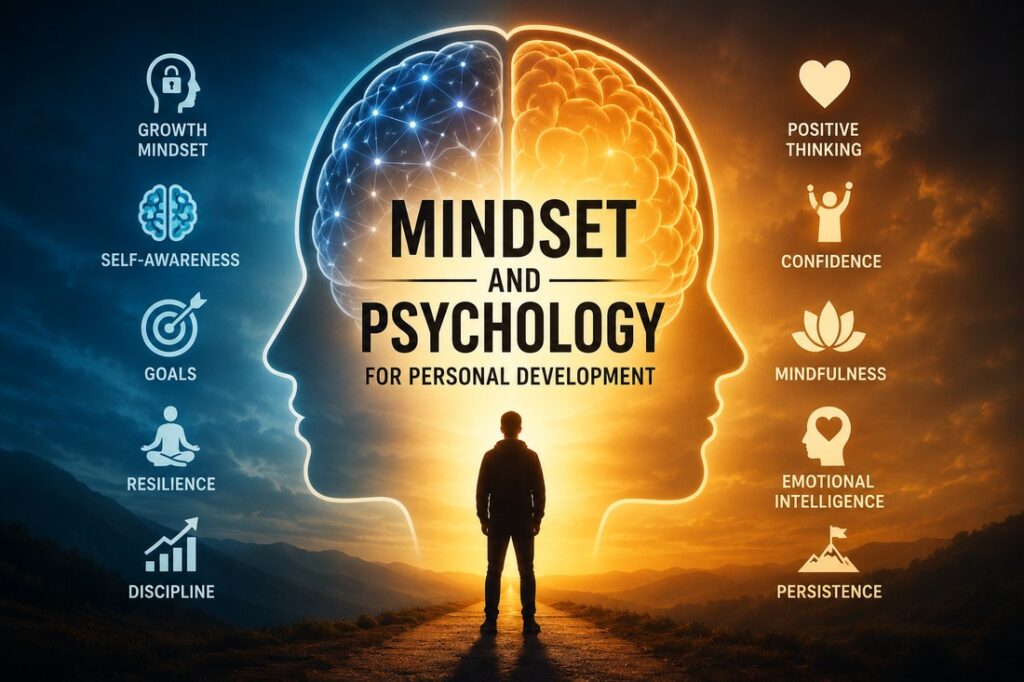
Mindset work is often the hidden layer of a great training program. Before a team can innovate, collaborate, or lead change, individuals need to believe growth is possible, manage their own state under pressure, and understand what actually drives human behavior. These are the best mindset and psychology videos we have curated for use in workshops, retreats, and personal development programs, each with a note on how to put it to work with a group. Many of these themes are the foundation of our growth mindset workshop, where teams move from watching these ideas to practicing them.
Videos on Growth Mindset and Improvement
The Power of Believing That You Can Improve (Carol Dweck, TED)
Carol Dweck, the researcher behind mindset theory, explains the power of “not yet”: how believing abilities can grow changes effort, persistence, and results. Workshop use: the essential opener for any growth mindset session. Follow it by having participants recall one skill they once could not do at all, and map how they learned it.
How to Stop Languishing and Start Finding Flow (Adam Grant, TED)
Organizational psychologist Adam Grant names the “meh” feeling between depression and flourishing: languishing. His antidote is flow built from three ingredients, mastery, mindfulness, and mattering, illustrated by his slightly embarrassing Mario Kart theory of peak performance. Workshop use: strong for team wellbeing sessions and post-change check-ins. Have each person identify which of the three ingredients is most missing from their current work, then design one small win for the coming week.
Why Learning to Fail Can Teach Us to Thrive (Amy Edmondson, RSA)
Drawing on her book Right Kind of Wrong, Amy Edmondson distinguishes intelligent failures worth celebrating from preventable ones worth eliminating, a distinction most “embrace failure” advice misses entirely. Workshop use: have teams sort their last five failures into her categories. The conversation about which were actually intelligent changes how the group experiments going forward.
The Happy Secret to Better Work (Shawn Achor, TED)
Shawn Achor’s fast, funny talk flips the formula: happiness fuels performance rather than following it, and small daily practices can rewire the pattern. Workshop use: close a session by having each person pick one of the practices mentioned and commit to it for 21 days, with an accountability partner from the room.
The Power of Vulnerability (Brené Brown, TED)
Brené Brown’s research on connection, courage, and the willingness to be seen. One of the most watched talks ever, and still one of the most useful for teams building trust. Workshop use: show before a storytelling exercise where participants share a moment of challenge. The talk gives the room permission to be real.
Videos on Managing Your Mind Under Pressure
How to Stay Calm When You Know You’ll Be Stressed (Daniel Levitin, TED)
Neuroscientist Daniel Levitin introduces the pre-mortem: thinking ahead to what could go wrong while your brain is still calm enough to plan well. Workshop use: run a live pre-mortem on an upcoming project immediately after watching. This is one of the fastest video-to-practice transitions available.
How Your Brain Can Turn Anxiety into Calmness (UCSF)
A research-grounded look at how the brain produces anxiety and the practices that settle it. Workshop use: fits wellbeing-focused retreats and resilience programs, especially paired with a short guided breathing or reflection practice.
The Healing Power of Mindfulness (Dartmouth)
The evidence behind mindfulness practice and what it changes in attention and stress response. Workshop use: good pre-work for retreat participants who may be skeptical about reflective practices.
Neuroplasticity, Memory and Human Potential
Google Tech Talks from Dr. Michael M. Merzenich on Think Faster,Focus Better and Remember More-Rewiring Our Brain To Stay Younger and Smarter about Neuroplasticity, Memory and Human Potential.
When The Mind Matters For Morality (NYU)
Mental state reasoning is critical for moral cognition, allowing us to distinguish, for example, murder from manslaughter. I will present neural evidence for distinct cognitive components of mental state reasoning for moral judgment, and investigate differences in mental state reasoning for distinct moral domains, i.e. harm versus purity, for self versus other, and for groups versus individuals. I will discuss these findings in the context of the broader question of why the mind matters for morality.
Videos on Understanding People
Thinking, Fast and Slow (Daniel Kahneman)
Nobel laureate Daniel Kahneman on the two systems of thinking and the predictable errors our fast system makes. Workshop use: foundational for decision-making workshops. Have teams identify one recent decision made entirely on System 1 and re-run it slowly.
Your Body Language Shapes Who You Are (Amy Cuddy, TED)
Amy Cuddy on how posture and presence affect how others see us and how we feel ourselves. Workshop use: practical before pitch practice or presentation skills sessions, where participants immediately apply it standing up.
The Importance of Emotional Intelligence (Yale)
From the university that houses the Yale Center for Emotional Intelligence: why recognizing and regulating emotion is a workplace skill, not a soft extra. Workshop use: a natural companion to the interpersonal skills we develop in our softest of the soft skills workshops.
Scientifically Proven Ways To Be Persuasive
Noah Goldstein on Scientifically Proven Ways to Be Persuasive.
The Psychology of Human Misjudgement (Buffett)
Audio of the often referred to speech by Charlie Munger on the psychology of human misjudgement given to an audience at Harvard University circa Jun 1995. Mr. Munger speaks about the framework for decision making and the factors contributing to misjudgements. c. Jun 1, 1995
Does money make you mean? (TED Talk)
It’s amazing what a rigged game of Monopoly can reveal. In this entertaining but sobering talk, social psychologist Paul Piff shares his research into how people behave when they feel wealthy. (Hint: badly.) But while the problem of inequality is a complex and daunting challenge, there’s good news too. (Filmed at TEDxMarin.)
Videos on Meaning and Work
The Way We Think About Work Is Broken (Barry Schwartz, TED)
Barry Schwartz asks why we design jobs as if people only work for pay, when meaning, challenge, and autonomy are what make work worth doing. Workshop use: strong discussion starter for leaders redesigning roles or rethinking engagement.
Why Some of Us Don’t Have One True Calling (Emilie Wapnick, TED)
A reframe for multipotentialites: people with many interests are not unfocused, they are integrators. Workshop use: resonates in career development programs and with early-career cohorts feeling pressure to specialize.
How to Find Work You Love (Scott Dinsmore, TED)
A framework for aligning strengths, values, and daily work. Workshop use: pairs well with strengths assessments and individual development planning.
The Puzzle of Motivation
Career analyst Dan Pink examines the puzzle of motivation, starting with a fact that social scientists know but most managers don’t: Traditional rewards aren’t always as effective as we think. Listen for illuminating stories — and maybe, a way forward. Bidding adieu to his last “real job” as Al Gore’s speechwriter, Dan Pink went freelance to spark a right-brain revolution in the career marketplace.
How Too Many Rules at Work Keep You from Getting Things Done (TED Talk)
Modern work — from waiting tables to crunching numbers to dreaming up new products — is about solving brand-new problems every day, flexibly, in brand-new ways. But as Yves Morieux shows in this insightful talk, too often, an overload of processes and sign-offs and internal metrics keeps us from doing our best. He offers a new way to think of work — as a collaboration, not a competition.
How Improved Health and Longer Lives Drive Global Prosperity (Milken Institute)
Improvements in health that have given us longer, more productive lives are also responsible for as much as half of the world economy’s expansion over the last two centuries. The savings that come with earlier detection and prevention of disease, more effective therapies and diagnostics and more efficient delivery of care pay large social and economic dividends. This panel will explore innovations in public health, research and medical care that are improving our productivity and economic outlook as well as our vitality. Among the topics our experts will address: reducing the time and cost of developing treatments, increasing transparency in the quality and price of health services and making best use of big data and new technology to improve decision-making.
Bringing Mindset Work into Your Organization
The pattern across all of these: mindset shifts stick when they are practiced, not just watched. A talk creates the opening. The exercise, the reflection, and the commitment afterward create the change. That sequence, from insight to practice to action, is how we design every session. If your team or leadership group would benefit from a facilitated experience on growth mindset, resilience, or the human side of performance, we build custom workshops and retreats around exactly these themes. See our gratitude workshops and storytelling retreats for one example, or contact us to design a session for your people.