
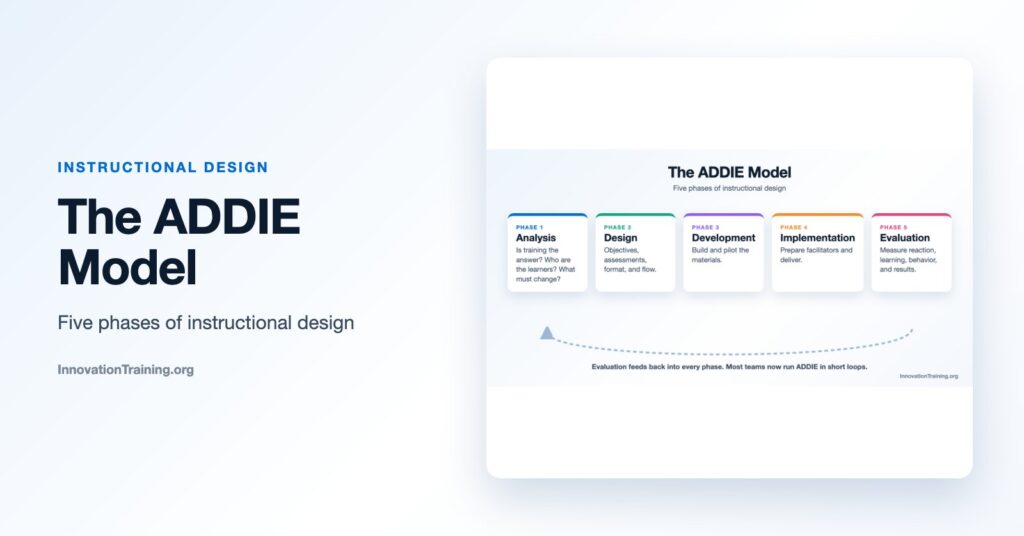
Behind most well-built training programs is a simple sequence: figure out what people need, plan the learning, build it, deliver it, and check whether it worked. The ADDIE model gives that sequence a name and a structure. This guide explains the five phases of ADDIE, the key questions and outputs for each phase, an example of ADDIE in action, and how it compares with more agile approaches like SAM and design thinking.
What Is the ADDIE Model?
ADDIE is an instructional design framework with five phases: Analysis, Design, Development, Implementation, and Evaluation. Instructional designers, trainers, and L&D teams use it to plan and build training programs, e-learning courses, and workshops in a systematic way.
The model traces back to the mid-1970s, when Florida State University’s Center for Educational Technology developed an instructional systems development process for the U.S. armed forces. Over time, the five phases became known by the acronym ADDIE and spread into corporate training, higher education, and government. Its lasting appeal is that it makes sure no important step gets skipped, especially analysis at the start and evaluation at the end.
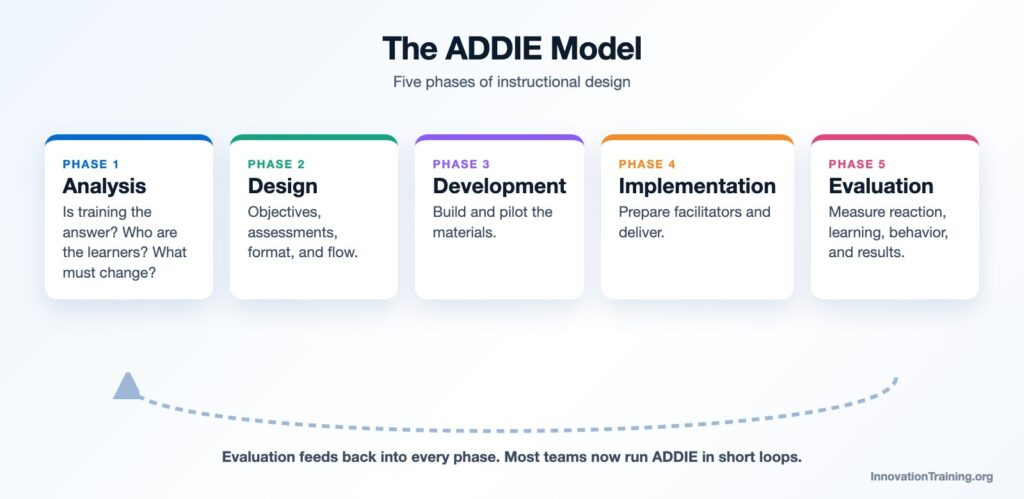
The Five Phases of ADDIE
1. Analysis
Understand the problem before designing a solution. Is training actually the right answer? Who are the learners? What do they need to be able to do, and what is getting in the way?
Key questions: What business problem are we solving? What does good performance look like? Who is the audience, and what do they already know? What constraints exist (time, budget, technology, location)?
Outputs: needs analysis, audience profile, performance goals, and a decision about whether training is needed at all.
2. Design
Plan the learning experience. Write learning objectives, decide how learning will be assessed, choose the delivery format, and outline the structure and activities.
Key questions: What will learners be able to do at the end? How will we know? What sequence and activities will get them there? What format fits best: live workshop, virtual session, e-learning, or a blend?
Outputs: learning objectives (often written with Bloom’s taxonomy), assessment plan, course outline, and a design document or storyboard.
3. Development
Build the materials. Create slides, facilitator guides, participant workbooks, videos, e-learning modules, job aids, and assessments, then test them.
Key questions: Do the materials match the design? Are they clear and accurate? Have subject matter experts reviewed them? Have we tested them with a few real learners?
Outputs: finished learning materials and a pilot or review with feedback.
4. Implementation
Deliver the training. Prepare facilitators, set up technology, schedule sessions, communicate with learners and managers, and run the program.
Key questions: Are facilitators prepared? Do learners know why they are attending? Are managers ready to support application afterward? Is the logistics and technology working?
Outputs: delivered sessions, facilitator train-the-trainer, communication plan, and participant records.
5. Evaluation
Measure whether the training worked and how to improve it. Evaluation happens both during the process (formative) and after delivery (summative).
Key questions: Did learners react well? Did they learn? Are they applying it on the job? Did it affect the business problem identified in analysis?
Outputs: evaluation data and recommendations. Many teams use the Kirkpatrick Model to structure this phase across reaction, learning, behavior, and results.
ADDIE Example: Training New Managers
Analysis. An HR team notices high turnover on teams led by first-time managers. Exit interviews mention unclear expectations and little feedback. The team interviews new managers and finds most have never been taught how to run one-on-ones or give feedback.
Design. Objectives include “Run a structured one-on-one using a shared agenda” and “Give specific, behavior-based feedback in a role-play.” The team designs a blended program: two half-day live workshops, short practice assignments between sessions, and peer coaching circles.
Development. The team builds a facilitator guide, role-play scenarios based on real situations, a one-on-one template, and a feedback job aid. They pilot one workshop with eight managers and adjust the timing and scenarios.
Implementation. The program launches with three cohorts. Each participant’s own manager receives a short briefing on how to support practice back on the job.
Evaluation. Participants rate relevance highly, demonstrate the skills in role-plays, and report more regular one-on-ones at 90 days. Over the next year, turnover on participating managers’ teams drops compared with the previous year.
Advantages and Limitations of ADDIE
Advantages
- Clear, logical structure that is easy to explain to stakeholders.
- Strong emphasis on analysis, which prevents building training nobody needs.
- Built-in evaluation that links learning to performance.
- Works well for large, high-stakes, or compliance-heavy programs.
Limitations
- Can be slow if followed strictly as a linear, one-pass process.
- Learner feedback may arrive late, after most of the budget is spent.
- Can produce heavy documentation that slows teams down.
Many practitioners now use ADDIE iteratively, cycling through design, development, and evaluation in smaller loops instead of completing each phase once.
ADDIE vs. SAM vs. Design Thinking
| ADDIE | SAM | Design thinking | |
|---|---|---|---|
| Approach | Phased, often linear | Iterative, rapid prototyping | Human-centered, iterative |
| Starting point | Needs analysis | Quick “savvy start” with stakeholders | Empathy with learners |
| Best for | Large, structured programs | Fast-moving e-learning projects | New or unclear learning challenges |
| Feedback | Mainly at evaluation | Throughout, through prototypes | Throughout, through testing |
SAM (the Successive Approximation Model) was developed by Michael Allen as a faster, more iterative alternative. Design thinking brings a strong focus on understanding learners as people and testing ideas early. Many L&D teams blend all three, using ADDIE’s structure with iterative prototyping and learner research built in. Our guide to learning experience design explores this human-centered approach further.
Frequently Asked Questions
What does ADDIE stand for?
Analysis, Design, Development, Implementation, and Evaluation.
Is ADDIE still used?
Yes. ADDIE remains one of the most widely used instructional design models, often in a more iterative form than the original linear version.
What is the most important phase of ADDIE?
Many instructional designers consider analysis the most important, because it determines whether training is the right solution and what it needs to achieve. Skipping it often leads to well-built training that does not solve the real problem.
Design Learning Programs That Work
InnovationTraining.org combines structured instructional design with human-centered, interactive facilitation. Explore our design thinking for learning approach and the facilitator training program, or contact us to talk about a custom program. Which phase of ADDIE does your team most often rush?