
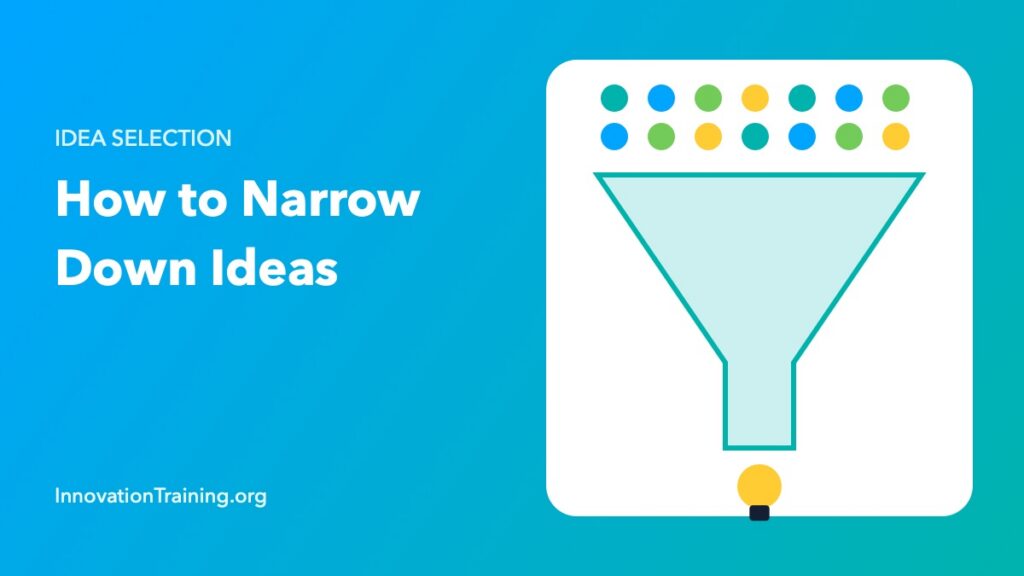
Generating ideas is the fun part. Choosing among them is harder. A list of 50 ideas can feel overwhelming, and many teams respond by picking the loudest idea in the room or the one that feels safest. A simple, repeatable process helps you narrow down ideas with more confidence and less wasted effort.
This guide covers a four-step way to move from a long list to one concept worth launching: highlight and theme, combine, score against selection criteria, and capture the winner on a one-page concept sheet. It includes a clip from a live innovation workshop where Darin Eich guides participants through each step.
In this clip from a live workshop, Darin Eich shows how to analyze an idea list, combine ideas into stronger concepts, and test them before building.
Step 1: Highlight Your Best Ideas and Look for Themes
Read through your full list quickly and mark the ideas that fit your challenge, your purpose, and what you or your organization want right now. Do not overanalyze. A star or highlight is enough.
As you read, notice what several ideas have in common. Write those themes in the margin. Themes are often more valuable than any single idea, because they point to a need or direction that keeps coming up. If seven ideas involve coaching in some form, that is information.
Step 2: Combine Ideas into Concepts
An idea is usually a one-liner. A concept is richer: it combines ideas or adds enough detail that someone else could picture it. One of the fastest ways to build a concept is a mashup, combining two or three ideas from your list into something better than any of them alone.
Here is a playful example from a workshop. A list of ways to be cool included “make your own movie” and “hang out with Steve.” Combine them, and you get “make a documentary about Steve.” Real examples work the same way. An online course idea, a coaching idea, and a train-the-trainer idea can merge into one program: a self-paced course with a coaching session at the start and the end. If a customer has already asked for part of it, even better.
Aim for three to five concepts. Each one can be a mashup, a theme developed further, or a single strong idea with more detail added. For more combining techniques, see our guide to the SCAMPER technique.
Step 3: Score Concepts Against Idea Selection Criteria
Now test each concept against criteria that matter for your situation. You can use a quick yes or no, a letter grade, or a simple matrix with criteria in rows, concepts in columns, and a score of 1 to 5 in each cell. Useful idea selection criteria include:
- Strength. Can we do this well and deliver real quality?
- Speed. Can we launch a first version quickly?
- Investment. Does it build on assets we already have, keeping cost low?
- Scalability. Can it grow to serve many more people without a matching increase in our time?
- Demand. Do people want it, and is there evidence they will pay for it?
Demand is the criterion most often skipped. Friendly feedback (“that sounds great!”) is not evidence. A request, a budget, a signed agreement, or a pre-order is. When the evidence is missing, the next move is to get it: describe the concept to a few people who fit the target audience and see whether anyone wants to buy or join.
Adjust the criteria to fit your goals. A team inside a large company might add strategic fit or regulatory risk. A nonprofit might weigh mission impact first.
Pick one
Several concepts may score well. Choose one to advance first. Splitting effort across four concepts usually means moving each a little and none far enough to succeed.
Step 4: Capture the Concept on One Page
Many product teams at large companies ask for new concepts on a single sheet or slide. A concept sheet makes an idea easy to understand and easy to evaluate. Include:
- A headline and a simple visual
- What it is and how it works
- The problem it solves or the benefit it provides
- Who it is for, ideally named as a specific group or person
- What makes it different from what already exists
- Your next steps to test and launch it
Then share it one-on-one with a few people in your target audience. Ask whether it makes sense and whether it would help them. Those conversations improve the concept and sometimes produce your first customer. For tips on presenting concepts persuasively, see our article on idea communication.
When Nothing Passes
If none of your concepts hold up, that is useful news before you have spent time and money. Go back a step: generate more ideas, write a more focused question, or revisit the challenge itself. Our guides to coming up with new product ideas and writing an innovation problem statement cover those steps.
Three Ways to Go Further
- Bring a workshop to your team. Our innovation workshops take teams from a long list of ideas to tested concepts on their own challenge.
- License the course for a group. Organizations license Innovation 101 for teams and cohorts. Contact us about group access.
- Learn at your own pace. The Innovation 101 online course includes the full workshop recording, slides, and workbook.
Which concept on your list has the strongest evidence that someone will pay for it?