
Retrospectives are one of the most valuable habits a team can build, and one of the quickest to go stale. After a few months of the same three questions, people give the same three answers and the meeting stops producing change. These fifteen retrospective ideas give agile teams, project teams, and any group that works together fresh formats to keep reflection honest and useful, along with tips for choosing and facilitating them.
What Makes a Good Retrospective?
A retrospective is a regular meeting where a team looks back on a period of work, discusses what went well and what did not, and agrees on a small number of improvements. In Scrum, it happens at the end of every sprint, but any team can use the practice after a project, a quarter, or a major event.
Many facilitators use the five-stage structure from Esther Derby and Diana Larsen’s book Agile Retrospectives: set the stage, gather data, generate insights, decide what to do, and close the retrospective. The formats below fit into the gather data and generate insights stages. Whatever format you use, a good retrospective ends with one to three specific actions that someone owns.
Classic Retrospective Formats
1. Start, Stop, Continue
Ask what the team should start doing, stop doing, and continue doing. Simple, fast, and action-oriented. A good default for new teams or short retros.
2. Mad, Sad, Glad
Team members sort their reflections into what made them mad (frustrations), sad (disappointments), and glad (things that went well). This format brings emotions into the conversation, which often reveals issues that a purely process-focused retro misses.
3. 4Ls: Liked, Learned, Lacked, Longed For
Four prompts that balance appreciation, learning, gaps, and wishes. The “longed for” column is especially useful for surfacing ideas the team has not voiced.
4. Went Well, To Improve, Action Items
The most common retrospective structure. It works, but rotate it with other formats so answers stay fresh.
Visual and Metaphor-Based Retrospective Ideas
5. Sailboat (or Speedboat)
Draw a boat heading toward an island. The wind represents what pushed the team forward, anchors represent what held it back, rocks represent risks ahead, and the island represents the team’s goal. Metaphors give people an easier way to talk about problems without pointing fingers.
6. Hot Air Balloon
Similar to the sailboat: hot air lifts the team up, sandbags weigh it down, and storm clouds are risks on the horizon. Good for teams that enjoy visual formats.
7. Starfish
Five categories: keep doing, more of, less of, stop doing, and start doing. The extra nuance of “more of” and “less of” helps teams adjust practices that are partly working instead of keeping or dropping them entirely.
8. Timeline
Draw a timeline of the sprint or project. Team members add key events above the line for highs and below the line for lows. Patterns across the timeline often reveal the moments where things went off track. Especially useful for longer projects or teams whose members remember the period differently.
Retrospective Ideas for Deeper Conversations
9. 5 Whys on the biggest problem
Vote on the single most important issue from the sprint, then ask “why” five times as a group to get to a root cause. Spending a whole retro on one problem can produce a better fix than listing ten issues.
10. Team health check
Rate the team on dimensions such as delivering value, speed, fun, learning, support, and ease of release, using green, yellow, and red. Discuss the reds and any changes since last time. A health check every few sprints shows trends over time.
11. Appreciation round
Each person thanks a teammate for something specific they did during the sprint. Use this as the opening or closing of any retro. Appreciation builds the trust that makes honest conversation possible.
12. Futurespective
Instead of looking back, imagine the next sprint or quarter has gone extremely well. What happened? What did the team do differently? Work backward to identify the actions that would make that future more likely. Useful after a difficult period when the team needs energy and direction.
Quick and Fun Retrospective Ideas
13. One word
Each person describes the sprint in one word, then explains why. A fast check-in that sets the tone and gives the facilitator a read on the room.
14. Lean Coffee
Team members write topics on sticky notes, vote on which to discuss, and talk through them in order with a short time box for each. The team controls the agenda, which works well for mature teams who know what they want to discuss.
15. Rose, Bud, Thorn
A rose is something that went well, a bud is something promising that could grow, and a thorn is a challenge. Short, friendly, and easy to explain to new teams or cross-functional groups.
How to Choose a Retrospective Format
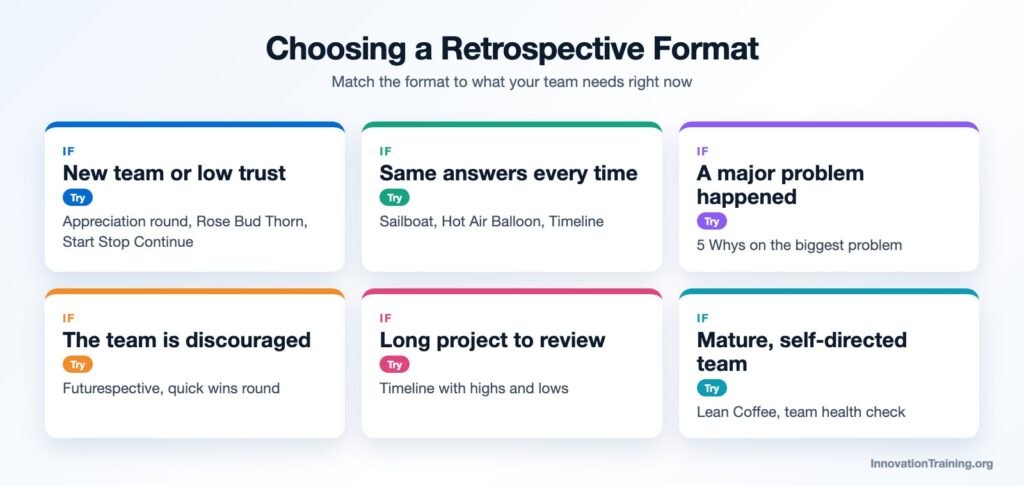
- New team or low trust: start with appreciation, Rose Bud Thorn, or Start Stop Continue.
- Same answers every time: switch to a metaphor format like Sailboat or a timeline.
- A major problem happened: use 5 Whys or a focused discussion on one issue.
- The team is discouraged: try a futurespective or a quick wins round.
- Long project: use a timeline so everyone’s memory is represented.
Tips for Facilitating Better Retrospectives
- Protect safety. Many teams read Norm Kerth’s Prime Directive at the start, which reminds everyone that people did the best job they could with what they knew at the time.
- Give silent writing time. Three to five minutes of individual sticky notes before discussion gets more voices into the room.
- Limit actions. One to three actions with clear owners beat a long list nobody follows.
- Review last time’s actions. Start each retro by checking whether the previous actions happened.
- Rotate the facilitator. Letting different team members run the retro builds facilitation skills and fresh perspectives.
- Use visual templates for remote teams. Our collection of agile sprint retrospective templates includes ready-made boards for Miro, MURAL, and other tools.
Frequently Asked Questions
How long should a sprint retrospective be?
The Scrum Guide sets a maximum of three hours for a one-month sprint, with shorter sprints usually needing less. Many teams with two-week sprints hold retros of sixty to ninety minutes.
Who should facilitate the retrospective?
The Scrum Master often facilitates, but rotating the role among team members or inviting a facilitator from another team can bring new energy and keep the facilitator from also being a key participant.
How often should you change the retrospective format?
Many teams change formats every two to four retros. If answers become predictable or energy drops, it is time for something new.
Build Stronger Facilitation and Agile Habits
Retrospectives are a facilitation skill as much as an agile practice. InnovationTraining.org helps teams and leaders run better sessions through the facilitation workshop and agile mindset training. Contact us to design a session for your team. Which format will you try at your next retrospective?