
Most people learn the most important lessons of their careers by doing something, getting it partly wrong, and figuring out what to do differently. Kolb’s experiential learning cycle describes that process and turns it into something trainers, facilitators, and leaders can design for. This guide explains the four stages of the cycle, the learning styles associated with it, how to apply it in workshops and training, and the main criticisms of the model.
What Is Kolb’s Experiential Learning Cycle?
Kolb’s experiential learning cycle is a model of how adults learn from experience. Educational theorist David Kolb introduced it in his 1984 book Experiential Learning: Experience as the Source of Learning and Development, building on earlier work by John Dewey, Kurt Lewin, and Jean Piaget.
Kolb defined learning as “the process whereby knowledge is created through the transformation of experience.” The key idea is that experience alone does not produce learning. People learn when they reflect on an experience, make sense of it, and then try out what they have figured out. The model describes this as a cycle with four stages that learners move through, again and again.
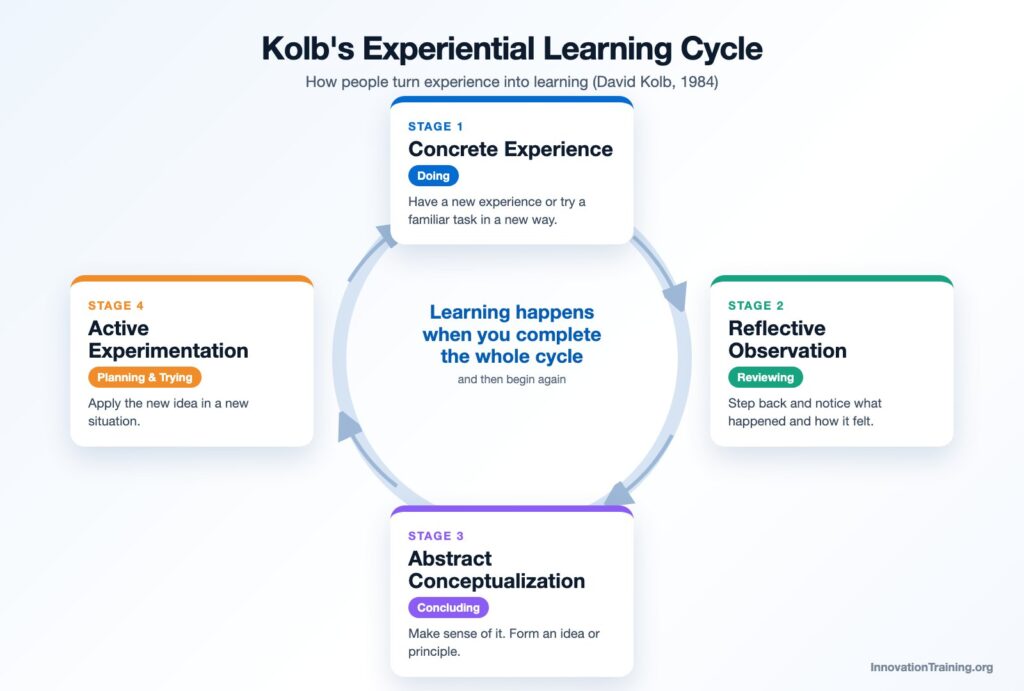
The Four Stages of Kolb’s Learning Cycle
1. Concrete experience (doing)
The learner has a new experience or encounters a familiar situation in a new way. In a workshop, this could be a role-play, a simulation, a hands-on build, or a real task. At work, it might be leading a meeting for the first time or handling a difficult customer.
2. Reflective observation (reviewing)
The learner steps back and reflects on what happened. What did I notice? What did I feel? What did others do? How did the result compare with what I expected? This stage is often skipped in busy workplaces, which is one reason people repeat the same mistakes.
3. Abstract conceptualization (concluding)
The learner makes sense of the reflection by forming ideas, principles, or theories. “When I explain the purpose before giving instructions, the group engages faster.” This is also where a trainer might introduce a model or framework that helps explain the experience.
4. Active experimentation (planning and trying)
The learner applies the new idea in a new situation to see if it works. That attempt creates a new concrete experience, and the cycle begins again.
Learners can enter the cycle at any stage, but effective learning usually requires moving through all four. A lecture that only covers abstract concepts, or a team-building activity with no debrief, leaves out important parts of the cycle.
Kolb’s Learning Styles
Kolb also proposed that people tend to prefer certain parts of the cycle, which led to four learning styles based on two dimensions: how people take in experience (feeling versus thinking) and how they process it (watching versus doing).
- Diverging (feeling and watching). Prefer to look at situations from different perspectives, gather information, and use imagination. Often strong in brainstorming.
- Assimilating (thinking and watching). Prefer clear explanations, logical models, and ideas. Often drawn to theory and reading.
- Converging (thinking and doing). Prefer to apply ideas to practical problems and find solutions. Often enjoy technical tasks.
- Accommodating (feeling and doing). Prefer hands-on experience and learning by trial and error. Often comfortable with risk and new challenges.
Learning styles are useful as a reflection tool, but research has not supported the idea that teaching to a person’s preferred style improves results. The more practical takeaway is that good learning design takes everyone through all four stages of the cycle.
How to Use Kolb’s Cycle in Training and Workshops
The cycle gives trainers and facilitators a simple design check: does every major part of the session include doing, reflecting, concluding, and planning? Here is how a ninety-minute session on giving feedback might look.
Experience
Participants work in groups of three. One gives feedback on a short scenario, one receives it, and one observes. Each round takes five minutes.
Reflect
After each round, the trio debriefs with guiding questions: What did the receiver hear? What landed well? What felt awkward? The observer shares specific moments.
Conceptualize
The facilitator asks the whole room what patterns they noticed, then introduces a simple feedback model that connects to what the groups discovered. Because participants have just experienced the problem, the model feels relevant instead of theoretical.
Experiment
Participants plan one feedback conversation they will have in the next week, using the model. They practice the opening line with a partner, which starts the next cycle before they leave the room.
This flow is the backbone of most experiential, participant-focused facilitation methods. It also explains why the debrief after any activity matters as much as the activity itself.
Using Kolb’s Cycle Beyond the Classroom
- Project reviews. After a project, a team reflects on what happened, agrees on lessons, and plans what to try on the next project. This is the cycle at team level.
- Coaching. Coaches often guide people through reflection and conceptualization after a real work experience, then help them plan an experiment.
- On-the-job learning. The 70-20-10 model suggests most learning happens through experience at work. Kolb’s cycle explains how to turn that experience into actual learning.
- Personal development. A weekly reflection routine (What happened? What did I learn? What will I try?) applies the cycle to everyday work. Our guide to reflection activities for learning and development has more ideas.
Criticisms and Limitations of Kolb’s Model
- Learning is not always a neat cycle. In practice, people often move back and forth between stages or work through several at once.
- Learning styles lack strong evidence. As noted above, matching instruction to learning styles has not been shown to improve outcomes.
- Social context is underplayed. Critics argue the model focuses on the individual and gives less attention to how culture, relationships, and groups shape learning.
- Reflection is harder than it looks. The model assumes people will reflect effectively, but many need structure, time, and good questions to do it well.
Despite these limits, the cycle remains one of the most useful frameworks for designing learning that sticks, because it reminds designers to build in reflection and application rather than relying on content alone.
Frequently Asked Questions
What are the four stages of Kolb’s experiential learning cycle?
Concrete experience, reflective observation, abstract conceptualization, and active experimentation. Learners move through doing, reflecting, concluding, and trying again.
What is an example of experiential learning?
A new manager runs a team meeting, reflects afterward on what worked, learns a facilitation technique that addresses what went wrong, and tries it at the next meeting. That is one full loop of the cycle.
How is Kolb’s cycle used in education?
Teachers and trainers use it to design lessons that combine activities, discussion, concepts, and application, so learners do more than listen to information.
Design Learning Experiences That Stick
InnovationTraining.org designs workshops and programs built on experiential learning, where participants practice, reflect, and apply new skills to their real work. Explore our facilitation workshop and facilitator training program, or contact us to design a session. Which stage of the cycle gets skipped most often in your organization’s training?