
Every training program eventually faces the same question from a leader: was it worth it? The Kirkpatrick Model is the most widely used framework for answering that question. This guide explains the four levels of the Kirkpatrick Model, gives examples and measurement ideas for each level, and shows how to use the model to design better training, not just evaluate it afterward.
What Is the Kirkpatrick Model?
The Kirkpatrick Model is a four-level framework for evaluating training and learning programs. Donald Kirkpatrick, a professor at the University of Wisconsin, introduced it in a series of articles in 1959 and later expanded it in his book Evaluating Training Programs. The four levels are Reaction, Learning, Behavior, and Results.
Each level builds on the one before it. Participants who have a positive reaction are more likely to learn. People who learn are more likely to change their behavior on the job. Changes in behavior are what produce results for the organization. The model has lasted for more than six decades because it gives learning teams and business leaders a shared language for what success means.
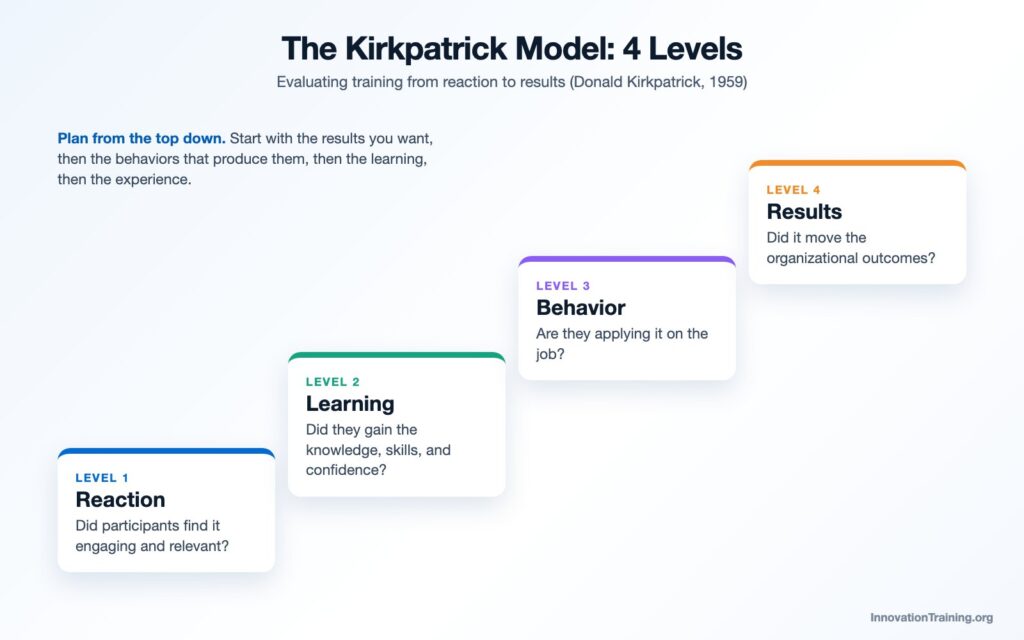
The Four Levels of the Kirkpatrick Model
Level 1: Reaction
The question: How did participants respond to the training?
Level 1 measures whether participants found the training engaging, relevant, and useful. It is the easiest level to measure and the most commonly used, usually through a short survey at the end of a session.
How to measure: End-of-session surveys, quick polls, one-word check-outs, and open questions such as “What will you use from today?” The most useful Level 1 questions focus on relevance and intent to apply, not only on whether people enjoyed the session.
Level 2: Learning
The question: Did participants gain the intended knowledge, skills, attitudes, confidence, and commitment?
Level 2 measures what people actually learned. It compares what participants knew or could do before the training with what they can do afterward.
How to measure: Pre- and post-assessments, skill demonstrations, role-plays observed against a checklist, case study analysis, and confidence ratings. For a facilitation course, a participant might lead a short segment and receive scored feedback.
Level 3: Behavior
The question: Are participants applying what they learned on the job?
Level 3 is where many programs fall short. People may leave training motivated and skilled, but if their environment does not support new behavior, they slip back into old habits.
How to measure: Manager observations, follow-up surveys at 30, 60, and 90 days, 360-degree feedback, work samples, and interviews. For example, after a coaching skills program for managers, HR might survey team members about how often their manager asks coaching questions in one-on-ones.
Level 4: Results
The question: Did the training contribute to the targeted outcomes for the organization?
Level 4 connects learning to business results such as productivity, quality, sales, retention, safety, customer satisfaction, or innovation. These are the measures senior leaders care about most.
How to measure: Business metrics tracked before and after the program, comparison groups, and leading indicators that predict long-term results. For a customer service program, Level 4 might be changes in customer satisfaction scores and repeat complaints.
Kirkpatrick Model Example: A Leadership Program
| Level | What you measure | Example measure |
|---|---|---|
| 1. Reaction | Relevance and engagement | 90% of participants rate the program as relevant to their role |
| 2. Learning | New skills and confidence | Participants demonstrate a structured feedback conversation in a role-play |
| 3. Behavior | Application on the job | Direct reports report more frequent, specific feedback at the 90-day survey |
| 4. Results | Organizational outcomes | Engagement scores and voluntary retention improve on participating managers’ teams |
The New World Kirkpatrick Model
In 2016, Jim and Wendy Kirkpatrick (Donald’s son and daughter-in-law) updated the framework as the New World Kirkpatrick Model. The updates address common mistakes in how organizations used the original.
- Start with Level 4. Plan training by first defining the results you want, then the behaviors that will produce them, then the learning needed, and finally the reaction you want.
- Required drivers at Level 3. Behavior change depends on processes and systems that reinforce, encourage, reward, and monitor new behavior, such as manager check-ins, job aids, and recognition.
- Leading indicators at Level 4. Short-term observations that show the program is on track toward long-term results.
- Expanded Level 2. Learning now includes confidence and commitment, not only knowledge and skills.
- Expanded Level 1. Reaction includes engagement and relevance, not only satisfaction.
How to Use the Kirkpatrick Model to Design Better Training
The model is most powerful when used at the start of a project. A simple planning conversation with stakeholders can follow the levels in reverse.
- Results: What will be different for the organization if this program works?
- Behavior: What do people need to do differently on the job to produce those results?
- Learning: What do they need to know, practice, and believe to do it?
- Reaction: What kind of experience will make them engaged and committed?
Answering these questions often changes the program itself. A team might realize that the real barrier to behavior change is a manager who never reinforces the new skill, and add a short manager briefing to the design. That kind of insight is why the 70-20-10 model and Kirkpatrick are often used together: most behavior change happens through on-the-job experience and support, not only in the training room.
Criticisms and Alternatives
- Levels are not always linked. Research shows that a positive reaction does not reliably predict learning or behavior change.
- Isolating the effect of training is hard. Many factors besides training affect business results.
- Many organizations stop at Level 1. Surveys are easy, so higher-level evaluation is often skipped.
Common alternatives and additions include the Phillips ROI Methodology, which adds a fifth level that calculates return on investment, and Will Thalheimer’s Learning-Transfer Evaluation Model (LTEM), which focuses more heavily on whether learning transfers to work.
Frequently Asked Questions
What are the four levels of the Kirkpatrick Model?
Reaction, Learning, Behavior, and Results. Together they measure how participants respond, what they learn, whether they apply it, and what difference it makes to the organization.
Which Kirkpatrick level is most important?
Level 4 (Results) matters most to the organization, but Level 3 (Behavior) is often the most revealing, because it shows whether learning actually reached the job.
Is the Kirkpatrick Model still relevant?
Yes. It remains the most widely used training evaluation framework. The New World Kirkpatrick Model addresses many earlier criticisms by focusing on results and on the support people need after training.
Design Training That Changes Behavior
InnovationTraining.org designs workshops and programs with the end in mind, building in practice, reflection, and follow-up so learning reaches the job. Explore our design thinking for learning approach and the facilitator training program, or contact us to talk about a custom program. Which Kirkpatrick level does your organization measure least?