
Every new team goes through an awkward start, a period of friction, and, if things go well, a stretch where work starts to flow. Bruce Tuckman’s stages of team development give that pattern a name: forming, storming, norming, performing, and adjourning. This guide explains each stage, what team members and leaders typically experience, how to help a team move forward, and activities that support each stage.
What Are Tuckman’s Stages of Team Development?
Tuckman’s model describes the stages groups go through as they develop into effective teams. Psychologist Bruce Tuckman proposed the first four stages (forming, storming, norming, and performing) in a 1965 article titled “Developmental Sequence in Small Groups.” In 1977, Tuckman and Mary Ann Jensen added a fifth stage, adjourning, to describe what happens when a team’s work ends.
The model is popular because it normalizes something many teams find uncomfortable. Conflict and confusion early in a team’s life are not signs that something is broken. They are part of how groups figure out how to work together. Knowing the stages helps leaders and team members respond with patience and the right kind of support.
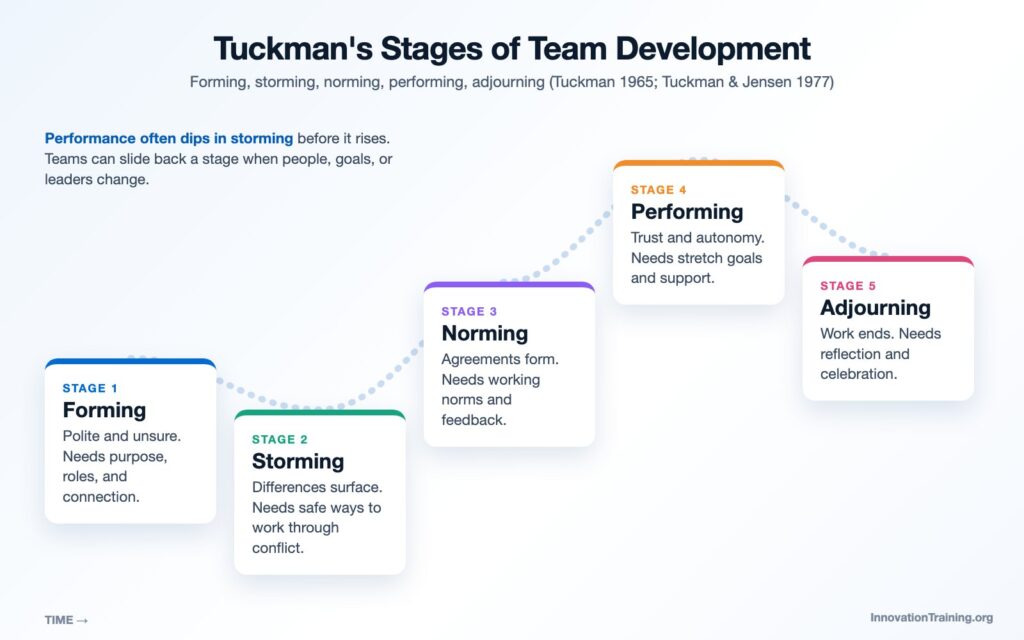
The Five Stages: Forming, Storming, Norming, Performing, Adjourning
Stage 1: Forming
The team comes together. People are polite, a little cautious, and eager to understand the goal, their role, and each other. There is often enthusiasm mixed with uncertainty. Members look to the leader for direction.
What the team needs: a clear purpose, defined roles, and chances to get to know each other.
Leader’s role: provide direction and structure, explain the why, and create space for introductions and relationship building.
Stage 2: Storming
Differences start to surface. People disagree about goals, approaches, priorities, or roles. Some push back on the leader or each other. Frustration and conflict rise, and productivity can dip. Some teams stay stuck here.
What the team needs: a safe way to work through disagreement and clarity about how decisions get made.
Leader’s role: coach rather than direct, name tensions openly, help the team resolve conflicts, and reinforce shared goals.
Stage 3: Norming
The team settles into agreed ways of working. People accept each other’s strengths and differences, roles become clearer, and trust grows. Members give each other feedback more easily and start taking ownership of the team’s process.
What the team needs: explicit working agreements and recognition of progress.
Leader’s role: facilitate, step back from day-to-day decisions, and encourage the team to take more responsibility.
Stage 4: Performing
The team works effectively toward its goals with high trust and autonomy. Members handle disagreements productively, adapt to change, and support each other without much direction. Energy goes into the work rather than into managing relationships.
What the team needs: challenging goals, growth opportunities, and protection from unnecessary disruption.
Leader’s role: delegate, remove obstacles, and focus on development and strategy.
Stage 5: Adjourning
The team’s work is finished, or the team is disbanding or being restructured. Members may feel pride, relief, or loss. This stage is sometimes called “mourning.”
What the team needs: a chance to reflect, celebrate, and capture lessons.
Leader’s role: recognize contributions, hold a final review, and help people transition to what comes next.
Signs of Each Stage at a Glance
| Stage | What you might hear | Helpful focus |
|---|---|---|
| Forming | “What exactly are we supposed to deliver?” | Purpose, roles, relationships |
| Storming | “That’s not how I think we should do this.” | Conflict resolution, decision rules |
| Norming | “Let’s agree on how we’ll handle this going forward.” | Working agreements, feedback |
| Performing | “I’ve got this, and I’ll flag it if I need help.” | Autonomy, growth, stretch goals |
| Adjourning | “What should the next team know?” | Reflection, celebration, transition |
Team Activities for Each Stage
Forming: personal maps and purpose statements
Have each person draw a quick personal map showing where they grew up, what they care about at work, and what they bring to the team. Then co-write a one-sentence team purpose. Tools like the Johari Window also help new teams build self-awareness and trust.
Storming: working styles and conflict norms
Use a short assessment or a simple discussion of working preferences (fast versus deliberate, big picture versus detail) so people understand why they clash. Then agree on how the team will handle disagreement. Our guide to using assessments for team building has more options.
Norming: team charter
Create a team charter covering purpose, goals, roles, decision making, communication norms, and how the team will give feedback. Revisit it every few months.
Performing: retrospectives and stretch challenges
Regular retrospectives keep high-performing teams improving. Give the team a stretch challenge or innovation sprint to keep energy high.
Adjourning: celebration and lessons learned
Hold a closing session with a timeline of highlights, appreciation for each member, and a list of lessons for future teams.
Applying Tuckman’s Model in Real Teams
Teams do not always move through the stages in a straight line. A team can slide back into storming when a new member joins, a leader changes, or the goal shifts. Remote and hybrid teams may spend longer in forming because relationships take more deliberate effort. Some teams skip visible storming because conflict stays hidden, which can cause problems later.
The most practical use of the model is as a conversation starter. Ask a team, “Which stage do you think we’re in, and what would help us move forward?” The discussion itself often helps the team progress.
Criticisms of the Model
- Real teams often move back and forth between stages rather than progressing neatly.
- The original research was based largely on therapy and laboratory groups, not workplace teams.
- The model does not say how long each stage should last or what causes movement between stages.
Even so, the model remains one of the most widely used frameworks in team development because it is simple, memorable, and useful for helping teams talk about how they work together.
Frequently Asked Questions
What are the five stages of team development?
Forming, storming, norming, performing, and adjourning, as described by Bruce Tuckman (1965) and Tuckman and Mary Ann Jensen (1977).
Which stage is the most difficult?
Storming is usually the hardest because conflict and frustration peak. Teams that work through it openly tend to build stronger trust than teams that avoid it.
How long does it take a team to reach performing?
It varies widely, from a few weeks for small, focused teams to many months for large or complex ones. Clear goals, good facilitation, and early attention to relationships speed up the process.
Help Your Team Reach Its Performing Stage
InnovationTraining.org designs team sessions, offsites, and leadership programs that help groups build trust, work through conflict, and do their best work together. Explore our offsite workshops and retreats and leadership retreats, or contact us to design a session for your team. Which stage is your team in right now?