Innovation projects often stall before the first idea, because the challenge is too broad to work on. “We need new products” or “we should be more innovative” gives a team nothing to grab onto. A clear challenge statement, followed by a few focused questions, turns a vague goal into something people can generate ideas for in minutes.
This guide shows how to write an innovation challenge or problem statement, offers examples from different fields, and explains how to “ladder” a broad challenge into specific questions, including the popular “how might we” format. It includes a short clip from a live workshop where Darin Eich guides participants through the same steps.
In this five-minute clip from a live workshop, Darin Eich has participants write a one-sentence challenge statement and then focus it into specific questions.
What Is an Innovation Challenge Statement?
An innovation challenge statement describes what you want to create and who it is for, in one sentence. It is the starting point for idea generation. A simple structure works well:
We want to create new [type of product, service, or program] for [specific people].
A problem statement is a close cousin. It describes the difficulty people face rather than what you want to create. Both work. Challenge statements suit opportunity-driven projects, such as launching new offers. Problem statements suit projects that start from a known pain point. In design thinking, the problem statement usually comes after customer research, in the define stage.
Innovation Challenge and Problem Statement Examples
- We want to create new small group programs for fitness professionals.
- We want to create financial training on how to get new clients for financial advisors.
- We want to create new recipes for busy families in our city.
- We want to create new idea competitions for employees across our organization.
- We want to create new innovation training programs for organizational leaders and consultants.
- New managers in our company struggle to run productive one-on-one meetings in their first 90 days.
- Patients leaving the hospital are unsure which follow-up steps matter most.
Notice that each names a type of solution or a specific problem and a specific group. That combination is what makes a statement usable.
Write It Fast
The most common mistake is overthinking the statement. Write the first version in under a minute, without judgment. A rough statement you can work with beats a perfect one you are still debating next week. You can always refine it after you learn more from customers.
Focus the Challenge with a Question Ladder
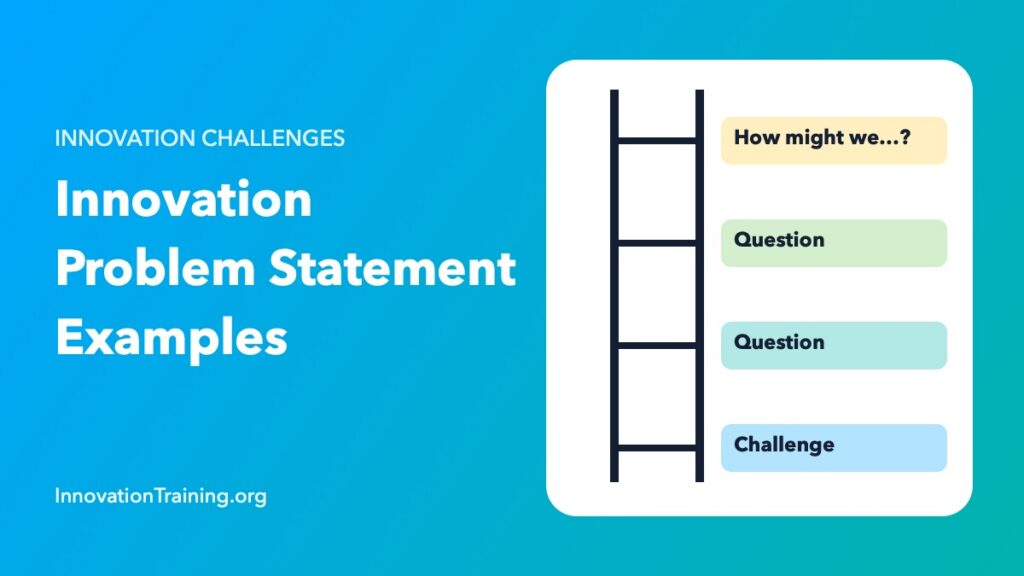
Even a well-written challenge statement is still general. The next step is to focus it into areas of opportunity by asking more specific questions. One way to picture this is a ladder: your general challenge sits on the ground, and each rung is a question that is more specific than the one below it.
For the challenge “new innovation training programs for organizational leaders and consultants,” the rungs might include:
- What products or services could be delivered one-on-one?
- What could we offer to groups on an ongoing basis?
- What could organizations embed on their own sites or learning platforms?
- What blended product and coaching combination would help someone innovate with a client?
- What could we create for experts who want to turn their expertise into a business?
Each question produces different ideas than the broad challenge would. Aim for at least two focused questions. If you can write 20, even better. When idea generation slows down later, return to the ladder and add a new rung.
Turning Questions into “How Might We” Statements
Design thinking teams often phrase focused questions as “how might we” statements. The format keeps the question open (“might” invites many answers), collaborative (“we”), and solvable (“how”).
- How might we help new managers run a great one-on-one in their first month?
- How might we make follow-up steps clear for patients before they leave the hospital?
- How might we offer ongoing support to groups of consultants without adding meetings?
A good “how might we” question is narrow enough to spark specific ideas and broad enough to allow more than one solution. If every answer is the same, widen it. If nobody can think of anything, narrow it.
Next: Generate Ideas
With a challenge and a few focused questions, you are ready to generate ideas. Our guide on how to come up with new product ideas covers five tips and six prompts for that step. For the full sequence from challenge to launch, see our overview of the innovation process steps.
Three Ways to Go Further
- Bring a workshop to your team. Our innovation workshops help teams frame the right challenge and generate ideas for it in one session.
- License the course for a group. Organizations license Innovation 101 for teams and cohorts. Contact us about group access.
- Learn at your own pace. The Innovation 101 online course walks through every step with the full live workshop recording.
What is your challenge statement, in one sentence, right now?