
Leaders often reach for the same approach to every problem: gather data, find the best practice, make a plan, execute. That works well for some situations and badly for others. The Cynefin framework helps leaders and teams recognize what kind of situation they are in, so they can choose a way of deciding and acting that fits. This guide explains the five Cynefin domains, how to respond in each one, workplace examples, and a simple way to use the framework in a team session.
What Is the Cynefin Framework?
The Cynefin framework is a sense-making model that helps people understand the nature of the situation they face and choose an appropriate response. Dave Snowden developed it in 1999 while working on knowledge management at IBM. It reached a wide business audience through a 2007 Harvard Business Review article by Snowden and Mary Boone, “A Leader’s Framework for Decision Making.”
Cynefin (pronounced kuh-NEV-in) is a Welsh word often translated as “habitat” or “place of multiple belongings.” Snowden chose it to suggest that we are shaped by our environment and experiences in ways we cannot fully see. The framework’s central idea is that cause and effect behave differently in different kinds of situations, so no single management approach works everywhere.
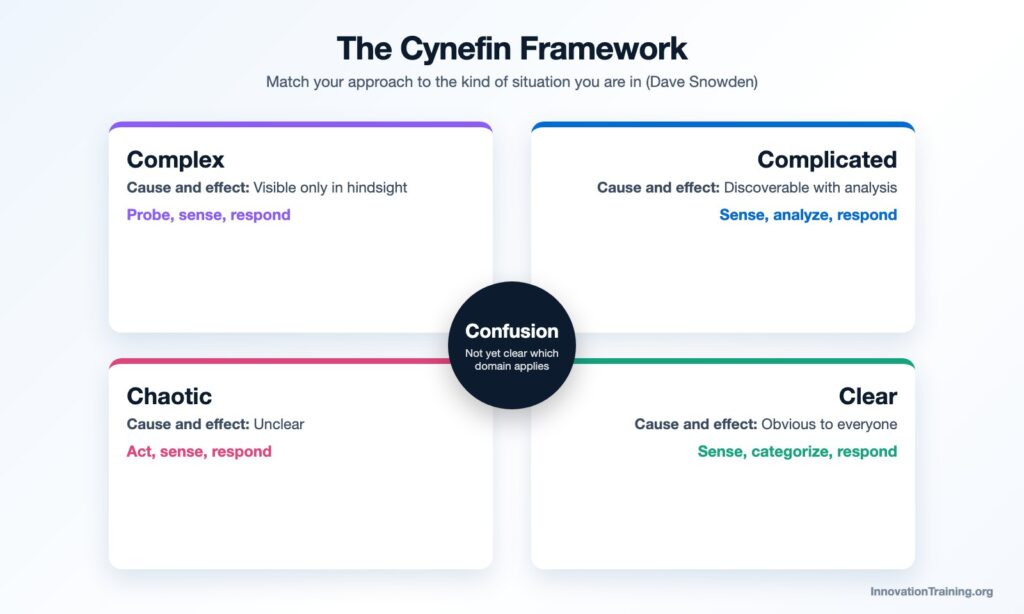
The Five Cynefin Domains
1. Clear (formerly Simple or Obvious)
What it is: Cause and effect are obvious to everyone. There is a known right answer.
How to respond: Sense, categorize, respond. Recognize the situation, apply the established best practice, and move on.
Example: Processing a standard expense report or resetting a password.
Watch out for: Complacency. Over-simplifying a situation that has quietly become more complex can tip it into chaos.
2. Complicated
What it is: Cause and effect exist but are not obvious. Finding them requires analysis or expertise. There may be several good answers.
How to respond: Sense, analyze, respond. Bring in experts, study the options, and apply good practice.
Example: Diagnosing a fault in a manufacturing line, designing a bridge, or planning a large software migration.
Watch out for: Analysis paralysis, and experts dismissing ideas from non-experts.
3. Complex
What it is: Cause and effect can only be understood in hindsight. The situation is shaped by many interacting factors, and outcomes are unpredictable. There are no right answers in advance, only patterns that emerge.
How to respond: Probe, sense, respond. Run small, safe-to-fail experiments, see what happens, then amplify what works and dampen what does not.
Example: Changing organizational culture, launching a new product in an unfamiliar market, or improving employee engagement.
Watch out for: Demanding a detailed plan and guaranteed results before acting. Complex problems reward experimentation and learning.
4. Chaotic
What it is: No clear relationship between cause and effect. The situation is turbulent and urgent.
How to respond: Act, sense, respond. Take immediate action to stabilize things, then assess and move the situation toward complexity, where experimentation becomes possible.
Example: A major system outage, a natural disaster affecting operations, or a sudden public crisis.
Watch out for: Staying in command-and-control mode after the crisis has passed.
5. Confusion (formerly Disorder)
What it is: It is not clear which of the other domains applies. People often default to the approach they are most comfortable with.
How to respond: Break the situation into parts and assign each part to the domain it fits best.
Cynefin Domains at a Glance
| Domain | Cause and effect | Approach | Practice |
|---|---|---|---|
| Clear | Obvious | Sense, categorize, respond | Best practice |
| Complicated | Discoverable with analysis | Sense, analyze, respond | Good practice |
| Complex | Visible only in hindsight | Probe, sense, respond | Emergent practice |
| Chaotic | Unclear | Act, sense, respond | Novel practice |
Why the Cynefin Framework Matters for Leaders
Many leadership failures come from applying the wrong approach to a situation. Treating a complex challenge like culture change as if it were complicated leads to long consulting reports and detailed rollout plans that do not survive contact with reality. Treating a complicated technical problem as if it were clear leads to quick fixes that miss the real cause.
Cynefin also explains why innovation methods like design thinking and agile have become so popular. Both are built for complex situations, using small experiments, prototypes, and rapid feedback instead of trying to predict the answer in advance.
How to Use Cynefin in a Team Session
This activity takes forty-five to sixty minutes and works well for leadership teams, strategy sessions, and project kickoffs.
- List the challenges. Ask the group to write the current issues they face on sticky notes, one per note.
- Introduce the domains. Draw the four main domains with a central confusion zone and explain each with an example.
- Place the notes. Teams place each challenge in the domain where they think it belongs. Disagreement is useful, so discuss items people place differently.
- Match the approach. For each domain, ask: Are we using the right approach for these items? Which complex challenges are we treating as complicated?
- Design probes. For the most important complex challenges, design two or three small experiments the team can run in the next month.
This session often shifts how a leadership team works. Instead of waiting for a perfect plan, they start learning through action. It pairs well with strategy workshops and with tools like the VUCA leadership self-assessment.
Frequently Asked Questions
What does Cynefin mean?
Cynefin is a Welsh word usually translated as “habitat” or “place of multiple belongings,” reflecting how our environment and history shape how we see situations.
What is the difference between complicated and complex?
Complicated problems can be solved with analysis and expertise because cause and effect can be worked out in advance. Complex problems involve many interacting factors, so cause and effect only become clear in hindsight, and progress comes from experimentation.
Who uses the Cynefin framework?
Leaders, strategists, agile coaches, policy makers, and innovation teams use Cynefin to choose decision-making approaches that fit their situation.
Lead More Effectively in Complex Situations
InnovationTraining.org helps leadership teams make sense of complex challenges and build the experimentation habits that complex work requires. Explore our innovation workshops and design thinking training, or contact us to design a session for your leaders. Which of your current challenges have you been treating as complicated when it might be complex?