
A colleague arrives late to your meeting, does not apologize, and spends the first ten minutes on their laptop. Within seconds, you have decided they do not respect your project. You might be right, or you might have climbed a mental ladder from a few facts to a firm conclusion without noticing. The ladder of inference is a simple model that explains how this happens and gives teams a way to slow down, check assumptions, and have better conversations. This guide explains the rungs of the ladder, gives workplace examples, and shares questions and activities for using it.
What Is the Ladder of Inference?
The ladder of inference is a model of how people move from observing the world to taking action, often without realizing how many steps of interpretation happen in between. Organizational psychologist Chris Argyris developed the concept, and Peter Senge popularized it in The Fifth Discipline and The Fifth Discipline Fieldbook, where it became a core tool for working with mental models.
The model pictures thinking as a ladder. At the bottom is everything that is observable. As we climb, we select some data, add meaning, make assumptions, draw conclusions, form beliefs, and act. Each step happens quickly and mostly unconsciously. The higher we climb without checking, the more likely we are to act on a story that the facts do not fully support.
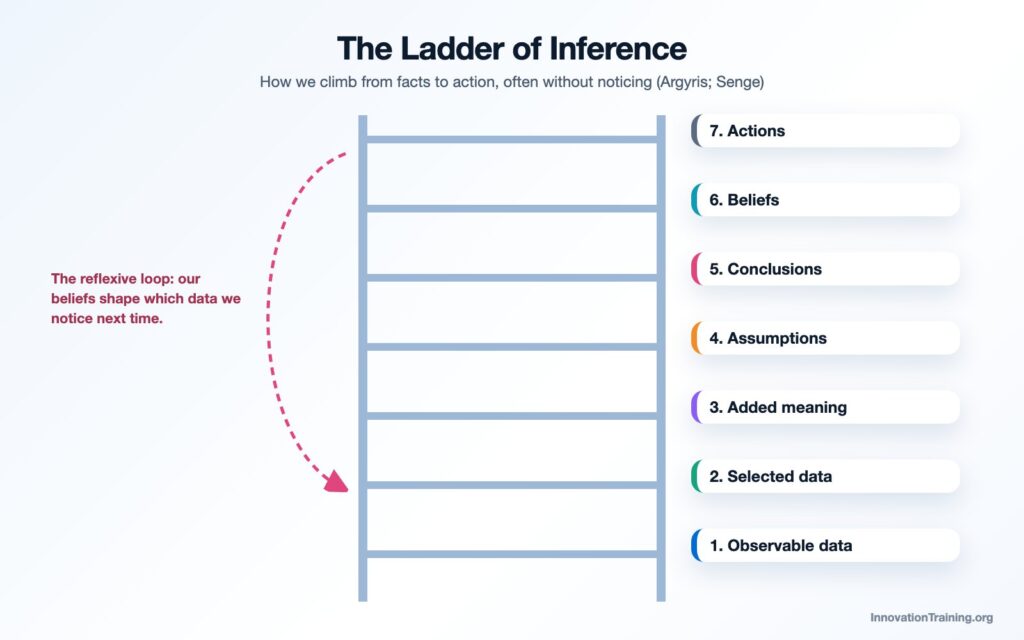
The Rungs of the Ladder of Inference
1. Observable data and experiences
Everything that could be noticed, as a video camera would record it. The colleague arrived at 10:07, did not say sorry, and opened a laptop.
2. Selected data
We notice only part of what is available, often the parts that fit what we already expect. You notice the laptop but not that the colleague looked stressed when they arrived.
3. Added meaning
We interpret the selected data using our culture, experience, and personal lens. “Being on a laptop in a meeting means not paying attention.”
4. Assumptions
We make assumptions based on the meaning we added. “They’re not interested in this project.”
5. Conclusions
We draw conclusions. “They don’t respect my work.”
6. Beliefs
We adopt or reinforce beliefs about the world. “People from that department never take our team seriously.”
7. Actions
We act based on those beliefs. You stop inviting the colleague to planning sessions, or you speak to them more coldly.
The Reflexive Loop
The most important part of the model is what happens next. Our beliefs influence which data we select the next time. If you believe a department does not respect your team, you will notice every late arrival and overlook every helpful email. This reflexive loop explains why misunderstandings between people and teams can harden over time, even when nobody intends harm.
The good news is that the loop can be broken at any rung by slowing down and asking questions.
Ladder of Inference Examples at Work
- A short email. A manager replies to a detailed proposal with “Let’s discuss.” The employee concludes the proposal was rejected and spends the evening worrying. In the meeting, the manager loves the idea and just wants to talk about timing.
- A quiet team member. A new hire rarely speaks in meetings. Their manager assumes they lack confidence or ideas. In a one-on-one, it turns out they come from a culture where interrupting senior people is considered rude, and they have plenty of ideas to share in writing.
- Customer research. A product team sees that customers rarely use a new feature and concludes it is not valuable. Interviews reveal that customers love it but cannot find it in the menu.
- Cross-team friction. Finance rejects a budget request twice. The marketing team concludes finance wants to block their work. A conversation reveals that the requests were missing a required field each time.
How to Use the Ladder of Inference
Senge and his colleagues described three practical skills for using the ladder in everyday work.
Reflection: climb down your own ladder
When you notice a strong reaction, pause and work back down the ladder. What conclusion have I reached? What assumptions led me there? What data did I select? What other data might I be missing?
Advocacy: make your thinking visible
When sharing a view, walk others through your reasoning. “Here is what I noticed, here is how I interpreted it, and here is my conclusion. Does that match what you saw?” This invites people to correct your data or interpretation.
Inquiry: ask about others’ thinking
When someone reaches a conclusion you disagree with, ask about the steps that got them there, with genuine curiosity. “What led you to that view? What data are you looking at?”
Questions to Climb Down the Ladder
- What are the facts, as a camera would record them?
- What am I assuming, and why?
- What other explanations could fit the same facts?
- What data might I be ignoring?
- Is my conclusion based on one event or a real pattern?
- What would I need to know to be more confident?
- How might the other person describe this situation?
A Ladder of Inference Workshop Activity
This activity takes about thirty minutes and works well in leadership programs, team sessions, and conflict resolution workshops.
- Draw the ladder and briefly explain each rung, using a light example like the late colleague.
- Ask each participant to think of a recent situation at work where they had a strong reaction to someone’s behavior.
- Individually, they write what they concluded at the top of the ladder, then work down to the observable facts.
- In pairs, partners ask each other the questions above, looking for other possible interpretations.
- As a group, discuss: What did you notice about how quickly you climbed? What would you do differently?
Participants often discover that the facts are thinner than they thought and that a short conversation would resolve many of their frustrations. The ladder pairs well with empathy-building exercises from design thinking, which also ask people to separate observation from interpretation.
Frequently Asked Questions
Who created the ladder of inference?
Chris Argyris developed the ladder of inference. Peter Senge brought it to a wide audience through The Fifth Discipline and The Fifth Discipline Fieldbook.
Why is the ladder of inference useful?
It helps people notice when they are acting on assumptions instead of facts, which leads to better decisions, fewer misunderstandings, and more productive conversations.
How is the ladder of inference used in leadership?
Leaders use it to check their own assumptions before making decisions about people, to explain their reasoning more transparently, and to coach teams through conflicts and disagreements.
Build Better Thinking and Communication on Your Team
The ladder of inference is one of many tools InnovationTraining.org uses in sessions on leadership, collaboration, and human-centered skills. Explore the softest of the soft skills workshops and emotional intelligence and conscious leadership training, or contact us to design a session for your team. When was the last time you climbed the ladder a little too fast?