Most small businesses start the same way. Someone has an idea, builds it, polishes it, and then launches it to the world, hoping customers will want it. Sometimes they do. Often they do not, and months of work go into something nobody asked for. Design thinking offers a different starting point: begin with the people you want to serve, learn what they need in their own words, and let that shape what you build.
This guide explains how design thinking helps entrepreneurs and small businesses, the mindsets that make it work, and a simple process any founder or small team can use this week. It includes a video from a live workshop where Darin Eich walks a room of business owners and corporate innovators through the same shift.
The Shift: From Inventing Alone to Plugging into Customers
Many of us learned to work in a closed loop. In school you write the paper alone and hand it to the professor. In many organizations the idea has to come from inside, developed behind closed doors, and revealed at launch. The risk with that approach is that the first real feedback arrives after the money and time are already spent.
Design thinking reverses the order. Instead of moving an idea from your head out to customers, you move insight from customers back to you. What problems do they describe? What are they already trying to do on their own? What would make their work or life easier? When a business is plugged into that source, new products, services, and marketing messages come from evidence instead of guesses.
A well-known example is the design firm IDEO’s shopping cart redesign. Rather than brainstorming in a conference room, the team went into a grocery store, watched how people shopped, and talked with shoppers about what frustrated them. The ideas came out of those observations. The same move works for a two-person consultancy, a local service company, or a startup testing its first offer.
In this clip from a live workshop, Darin Eich explains the shift from inventing on your own to designing with customers, and introduces the mindsets that help small teams act on it.
Six Design Thinking Mindsets for Business Owners
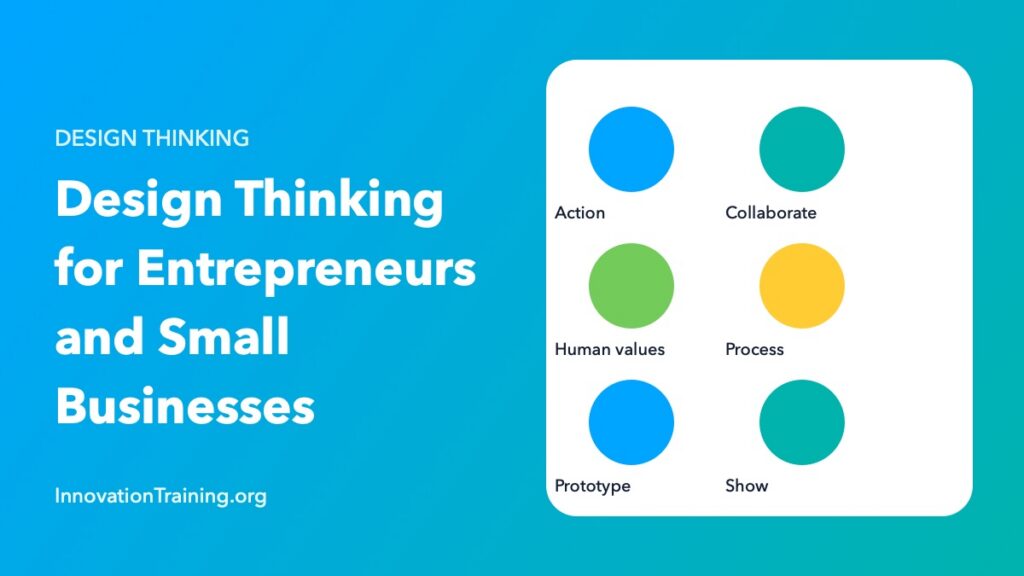
The Stanford d.school describes a set of mindsets that design thinkers bring to their work. For a small business, they translate into everyday habits:
- Bias toward action. Start before you feel ready. A short conversation with a customer this afternoon teaches more than a month of planning.
- Collaborate across boundaries. Partners, customers, and people outside your field see things you cannot. Innovation is hard, and most new products fail, so you need other perspectives.
- Focus on human values. Everything you sell is used by a person. Know who that person is and what matters to them.
- Be mindful of process. Creative work still benefits from a process. Knowing which stage you are in keeps you from jumping to solutions too early.
- Prototype toward a solution. Make an early, rough version. One famous handheld device started as a block of wood, carried around to see if it fit in a pocket.
- Show, don’t tell. People understand sketches, stories, and samples far faster than descriptions.
For a deeper look at each one, see our guide to design thinking mindsets.
A Simple Design Thinking Process for a Small Team
The Stanford d.school process has five stages, and IDEO’s human-centered design model condenses the work into three: hear, create, deliver. Either works for a small business. Here is how the five stages look when you have limited time and no research department.
1. Empathize
Talk to a handful of current or potential customers. Ask who, what, where, when, why, and how. You do not need formal interview training. Treat it as a curious conversation and write down the exact words people use.
2. Define
Look for the real problem underneath what you heard. It is often different from the one you assumed. Write it as a focused challenge you can work on.
3. Ideate
Generate ideas for that challenge. This step is easier after empathy, because customers often hand you the ideas or the problem that sparks them.
4. Prototype
Make something rough and quick: a sketch, a one-page offer, a short video describing a new service. The goal is to learn before you invest.
5. Test
Put the prototype in front of the people it is for. Do they engage, ask questions, or sign up? Some businesses test an offer by describing it and asking for a commitment before building it at all.
If you are new to the topic, our article on ways to define design thinking compares definitions from IDEO, MIT, and academic research.
Where Small Businesses See the Payoff
Design thinking pays off fastest in the places where a small business usually guesses:
- New offers. Building what customers have already asked for, instead of what seems clever.
- Marketing language. Describing your work in the words customers use, which makes it easier for the right people to find you.
- Your best customers. Understanding the 20 percent of clients who bring most of your revenue or meaning, so you can attract more like them.
- Customer experience. Seeing where people get stuck between first hearing about you and becoming a loyal customer.
Founders who start with conversations sometimes find that a customer describes the exact service they need and asks to buy it. That rarely happens when the idea is built in private first.
Three Ways to Go Further
- Bring a workshop to your team. We run hands-on design thinking workshops where teams apply the process to a real business challenge.
- License the course for a group. Organizations, accelerators, and universities can give a cohort access to the full online program. Contact us about group access.
- Learn at your own pace. The Starting with Design Thinking online course includes the full workshop recording, video modules, slides, and persona templates.
Which customer could you talk with this week to test an idea before you build it?