
Adaptability shows up on almost every list of skills employers want, yet few teams agree on what it looks like on a Tuesday afternoon when a plan falls apart. This guide defines adaptability at work, breaks it into skills you can observe and practice, gives examples from real workplace situations, and shares activities that help individuals and teams get better at it.
What Is Adaptability? (Definition)
Adaptability is the ability to adjust your thinking, behavior, and plans when circumstances change, and to keep performing well while you do it. An adaptable person notices that something has shifted, makes sense of what the change means, and responds with a useful next step instead of freezing or pushing harder on the old plan.
At work, adaptability covers both small and large changes. A meeting agenda gets blown up by an urgent issue. A client changes the scope halfway through a project. A reorganization gives you a new manager and a new set of priorities. A new technology changes how your role gets done. Each situation asks for the same basic capacity: letting go of what no longer fits and building something that does.
Adaptability is closely related to resilience, flexibility, and learning agility, but each word puts the emphasis in a slightly different place. Resilience is about recovering from setbacks. Flexibility is about being willing to bend. Learning agility is about learning quickly from new experiences. Adaptability pulls these together and adds action: you change course and keep moving.
Why Adaptability Matters in the Workplace
Most organizations now operate with a steady stream of change rather than occasional big shifts. Strategy updates, new tools, hybrid work, mergers, and changing customer needs all land on the same people who are trying to deliver this quarter’s results. When adaptability is low, every change becomes a fight, and teams spend their energy protecting the old way of working.
When adaptability is high, teams move faster and with less friction. People raise problems earlier because they expect plans to change. Leaders spend less time pushing and more time steering. Adaptable teams also tend to be more innovative, because experimenting with a new approach feels normal instead of risky.
For individuals, adaptability protects careers. Roles change faster than job descriptions do, and the people who keep growing are usually the ones who treat a new situation as something to figure out rather than something to survive.
The Core Skills of Adaptability
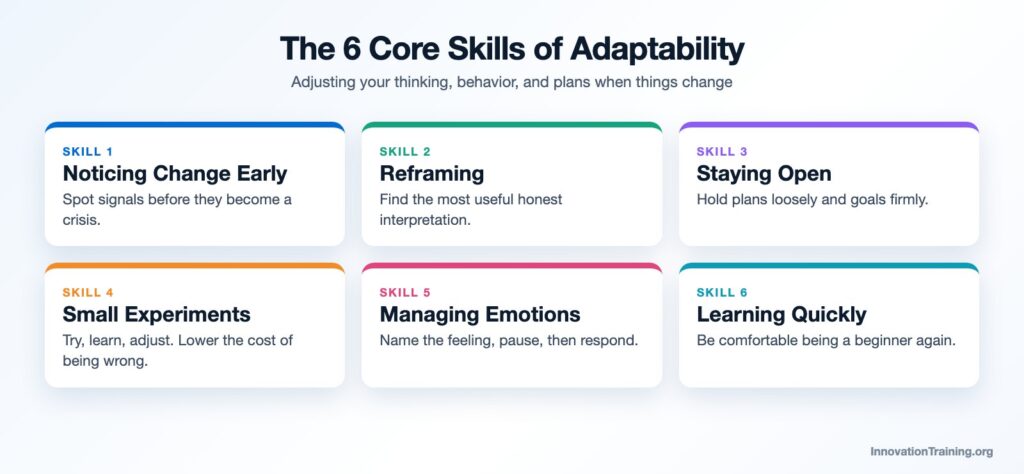
Adaptability is easier to develop when you break it into specific skills. These six show up again and again in adaptable people and teams.
1. Noticing change early
Adaptable people pay attention to signals: a customer complaint that repeats, a metric that drifts, a stakeholder who goes quiet. They ask “What is different here?” before the change becomes a crisis. Teams can build this habit by starting regular meetings with a short “What has changed since we last met?” round.
2. Reframing the situation
The story you tell yourself about a change shapes how you respond. “This new system is a waste of time” leads to resistance. “This new system will be clumsy for a month, then it might save us hours” leads to experimentation. Reframing does not mean pretending everything is fine. It means looking for the most useful honest interpretation.
3. Staying open to new information
Adaptable people hold their plans loosely and their goals firmly. They are willing to hear that their approach is not working and to update it. This connects directly to a growth mindset, the belief that ability grows through effort, practice, and feedback.
4. Experimenting with small steps
When the path is unclear, adaptable people try something small, learn from it, and adjust. A team facing a new client requirement might prototype one version of a deliverable and test it with the client before rebuilding the whole process. Small experiments lower the cost of being wrong.
5. Managing emotions under pressure
Change brings frustration, uncertainty, and sometimes loss. Adaptable people acknowledge those feelings without letting them make every decision. Simple practices like naming the emotion, taking a pause before responding, or talking it through with a colleague make a real difference.
6. Learning quickly
Every change creates something new to learn: a tool, a process, a relationship, a market. People who are comfortable being beginners adapt faster. The four stages of competence model is a helpful reminder that feeling awkward at first is a normal part of learning anything new.
Examples of Adaptability at Work
Abstract definitions only go so far. Here is what adaptability looks like in common workplace situations.
- A project changes scope. Instead of arguing to protect the original plan, a project lead asks the sponsor what outcome matters most now, then rebuilds the timeline around that outcome and is clear about what will be dropped.
- A new tool is rolled out. An employee who struggles with the new platform books thirty minutes with a colleague who has figured it out, then shares three shortcuts with the rest of the team.
- A workshop goes off track. A facilitator notices that the group is stuck on a problem that was not on the agenda. They pause the planned activity, give the group fifteen minutes to work the real issue, and adjust the rest of the session to fit.
- A team loses a key person. The remaining team members map who knew what, redistribute the critical work, and use the moment to simplify a few processes that only made sense to the person who left.
- A manager gets new priorities from leadership. Rather than passing the change down as an order, the manager explains the reasons, asks the team which current work can pause, and invites ideas for how to approach the new goal.
- A customer need shifts. A sales team hears the same new question from several clients. They bring it to product and marketing, and together they test a new offer within a few weeks.
How to Improve Adaptability: Activities for Individuals and Teams
Adaptability grows through practice in low-stakes situations, so the next real change feels familiar. These activities work well in team meetings, workshops, and leadership programs.
Change timeline reflection
Ask each person to draw a timeline of three changes they have navigated in their career, marking what helped and what got in the way. In pairs, they share one change and the lesson they took from it. The group then lists the patterns: what consistently helps people adapt? This builds confidence by reminding people they have adapted many times before.
Plan B sprint
Give a small team a simple task with a clear plan, such as designing a one-page event flyer in fifteen minutes. Halfway through, change a key constraint: the audience is different, the budget is gone, or the format must change. Debrief on how the team responded, who stepped up, and what they would do differently when the next surprise arrives.
Reframe practice
Write a few real changes the group is facing on cards. For each one, participants write the most frustrating interpretation, then the most useful honest interpretation. Discuss which interpretation leads to better action. This is a quick way to make reframing a visible, shared skill.
Small experiments board
Create a simple board with three columns: what we are trying, what we expect, and what we learned. Each team member commits to one small experiment for the next two weeks related to a change the team is facing. Reviewing the board together turns adaptation into a routine.
Scenario conversations
Leadership teams can explore two or three plausible futures for their market or organization and ask, “If this happened, what would we do first?” Thinking through scenarios ahead of time shortens reaction time when one of them starts to unfold. The VUCA leadership self-assessment is a useful companion for leaders who want to reflect on how they handle uncertainty.
How Leaders Build Adaptable Teams
Individual skills matter, but the environment decides whether people use them. Leaders shape adaptability in a few practical ways.
First, they explain the why behind changes. People adapt faster when they understand the reason, even if they do not like the change. Second, they make it safe to raise problems and admit that a plan is not working. Teams that punish bad news learn to hide it, which makes adaptation slower. Third, they reward learning, not only results. Recognizing a team that tried a new approach and shared what it learned sends a strong signal. Finally, they model it. A leader who says “I was wrong about this, here is what I am changing” gives everyone else permission to do the same.
Frequently Asked Questions About Adaptability
Is adaptability a soft skill?
Yes. Adaptability is usually grouped with soft skills such as communication, collaboration, and problem solving. It is also one of the most requested skills in hiring and promotion decisions because it affects how well people handle almost every other part of their job.
Can adaptability be learned?
Yes. Some people are naturally more comfortable with change, but adaptability improves with reflection, practice, and supportive feedback. Training that uses realistic scenarios and small experiments tends to work better than lectures about change.
How do you show adaptability in an interview?
Share a specific story about a time circumstances changed, what you noticed, how you adjusted your approach, and what happened as a result. Concrete details about the change and your actions are more convincing than describing yourself as flexible.
What is the difference between adaptability and flexibility?
Flexibility is a willingness to bend or accept change. Adaptability goes further: it includes making sense of the change and taking effective action so you keep performing in the new situation.
Build Adaptability Skills With Your Team
InnovationTraining.org designs interactive sessions that help teams practice adaptability on the real changes they are facing, from new strategies to new ways of working. Explore the adaptability skills training workshop, or contact us to talk about a custom session for your group. What change is your team adapting to right now?