
Every team solves problems all day, but few teams have a shared way of doing it. One person jumps to solutions, another wants more data, and a third is still unsure what the problem actually is. This guide explains what problem solving is, walks through a practical seven-step process teams can use together, and covers the techniques and habits that make problem solving faster and better.
What Is Problem Solving? (Definition)
Problem solving is the process of identifying a gap between where things are and where you want them to be, understanding why that gap exists, and finding and testing a way to close it. A problem can be something broken, such as a process that keeps producing errors, or something missing, such as a goal you have no clear path to reach.
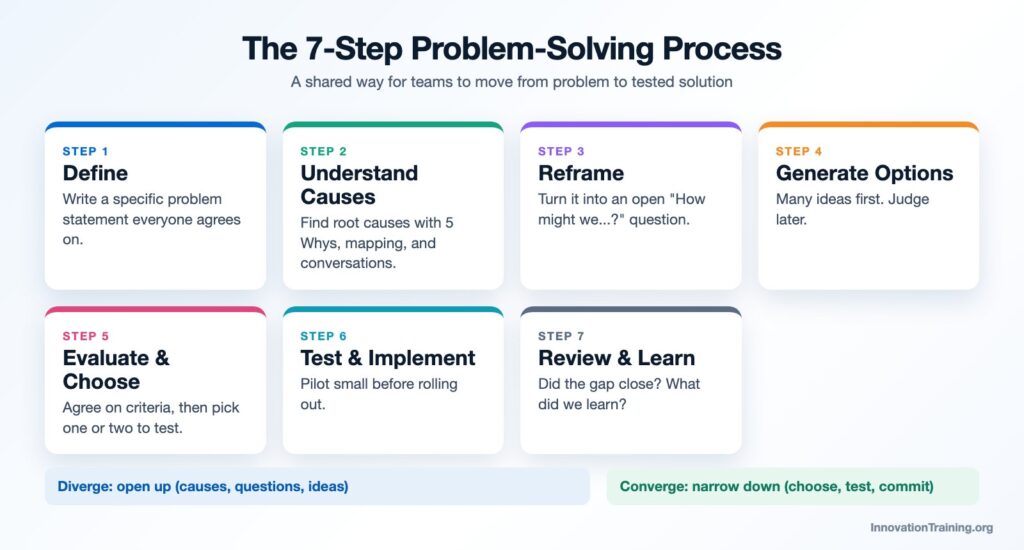
Good problem solving balances two kinds of thinking. Divergent thinking opens things up: exploring causes, generating many options, and questioning assumptions. Convergent thinking narrows things down: choosing the most important cause, selecting the best option, and committing to action. Many teams struggle because they mix the two at the same time, criticizing ideas before they have finished generating them.
The Problem-Solving Process: 7 Steps for Teams
There are many problem-solving models, but most share the same basic flow. This seven-step version works well for teams because each step has a clear output.
1. Define the problem
Write a clear, specific problem statement that the whole group agrees on. “Our onboarding is bad” is too vague to act on. “New hires take an average of eight weeks to complete their first project, and our target is four” gives the team something to work with. A useful test: could someone outside the team read the statement and understand what success would look like?
2. Understand the causes
Before generating solutions, explore why the problem exists. Techniques like the 5 Whys, cause-and-effect diagrams, and simple process mapping help teams find root causes rather than symptoms. Talk to the people closest to the problem. The four-step problem diagnosis approach is a helpful way to structure this stage.
3. Reframe the challenge
Turn the problem and its causes into an open question that invites ideas. A common format is “How might we…?” For example, “How might we give new hires a meaningful first project in their second week?” A good challenge question is broad enough to allow creative answers and narrow enough to be useful.
4. Generate options
Come up with many possible solutions before judging any of them. Quantity matters here, because the best ideas often come after the obvious ones are on the table. Set clear brainstorming rules, give people a few minutes to write ideas silently before sharing, and push the group past the first round of familiar answers.
5. Evaluate and choose
Now switch to convergent thinking. Agree on criteria such as impact, cost, speed, and risk, then compare the options. Dot voting, simple impact and effort grids, and pros and cons lists all help groups decide without the loudest voice winning by default. Choose one or two options to test.
6. Test and implement
Run a small pilot before rolling out a full solution. A team might try the new onboarding project with the next three hires before changing the process for the whole company. Pilots reveal problems while they are still cheap to fix.
7. Review and learn
Check the results against the problem statement from step one. Did the gap close? What worked, what did not, and what did the team learn about the problem along the way? A short review turns each problem into practice for the next one.
Common Problem-Solving Techniques
Different problems call for different tools. These techniques are widely used in workshops and team meetings.
- 5 Whys. Ask “why” repeatedly to move from a symptom to a root cause. Simple and fast for operational problems.
- Fishbone diagram. Sort possible causes into categories such as people, process, tools, and environment, so the group sees the whole picture.
- Six Thinking Hats. Look at a problem from six distinct perspectives, one at a time, so the group separates facts, feelings, risks, benefits, and ideas.
- Reverse brainstorming. Ask “How could we make this problem worse?” and then flip the answers into solutions. Useful when a group is stuck.
- First principles thinking. Break a problem down to its basic truths and rebuild a solution from there, instead of copying what others have done.
- TRIZ. A structured method for inventive problem solving based on patterns found across thousands of patents. Especially popular with engineering and product teams.
- Impact and effort grid. Plot options on two axes to find quick wins and separate them from big bets.
Problem Solving vs. Creative Problem Solving
Many problems have a known answer that just needs to be found: a broken link, a missing approval, a training gap. Analytical problem solving works well for these. Other problems have no obvious answer, such as how to reach a new market or how to redesign a service around changing customer needs. These call for creative problem solving, which puts more weight on reframing the challenge and generating original ideas.
The creative problem solving process is one of the best-known models for this second kind of problem. It separates clarifying, ideating, developing, and implementing into distinct stages, with divergent and convergent thinking in each one.
Problem-Solving Skills Worth Building
The process gives teams a shared structure, but individual skills make each step work.
- Asking good questions. The quality of a solution usually depends on the quality of the question that started it.
- Listening for causes. Hearing what people closest to the problem actually experience, not only what the data says.
- Suspending judgment. Holding back criticism long enough for unusual ideas to surface.
- Systems thinking. Seeing how a problem connects to other processes, teams, and incentives.
- Decision making. Choosing with incomplete information and committing to a test.
- Collaboration. Drawing on different perspectives instead of solving alone.
A Problem-Solving Example
A customer service team noticed that complaints about delayed refunds had doubled over three months. Their first instinct was to hire more staff. Instead, they wrote a problem statement: “Refunds now take an average of twelve days, and customers expect five.” Mapping the process showed that most of the delay came from a single approval step that required a manager signature for every refund, regardless of size.
The team reframed the challenge as “How might we keep control of large refunds while speeding up small ones?” They generated more than twenty ideas, then chose to pilot automatic approval for refunds under a set amount. After a month, average refund time dropped to four days, complaints fell, and managers had more time for complex cases. No new staff were needed.
Frequently Asked Questions About Problem Solving
What are the four basic steps of problem solving?
A simple four-step version is: define the problem, generate possible solutions, choose and implement a solution, and evaluate the results. The seven-step process above expands this by adding cause analysis, reframing, and testing.
Why is problem solving important at work?
Problem solving lets teams improve processes, respond to change, and create new value instead of repeating the same workarounds. It is consistently ranked among the most valued skills by employers.
How can teams get better at problem solving?
Use a shared process, separate idea generation from evaluation, practice on real problems, and review what you learned after each one. Facilitated workshops help teams build these habits quickly.
What books help with problem solving?
See our list of the best problem solving books, with notes on who each book is best for.
Practice Problem Solving on Your Real Challenges
InnovationTraining.org runs interactive sessions where teams learn a problem-solving process by applying it to challenges they are facing right now. Explore the creative problem solving workshop and problem solving techniques training, or get in touch to design a session around your team’s goals. Which problem would your team work on first?