
Most people can define a growth mindset. Fewer can point to what it sounds like in a team meeting, a performance review, or a project that just failed. This guide gives concrete growth mindset examples at work, side-by-side fixed and growth mindset phrases, examples for leaders and teams, and simple ways to practice the habits behind them.
What Is a Growth Mindset?
A growth mindset is the belief that abilities can be developed through effort, good strategies, and help from others. The term comes from Stanford psychologist Carol Dweck, whose research compared people who see talent as something you either have or do not have (a fixed mindset) with people who see it as something you build (a growth mindset).
Dweck has been clear that nobody has a pure growth mindset. Everyone moves between the two depending on the situation, and certain triggers, like criticism, a tough new task, or someone else’s success, can push people toward fixed thinking. The goal is to notice those moments and choose the growth response more often.
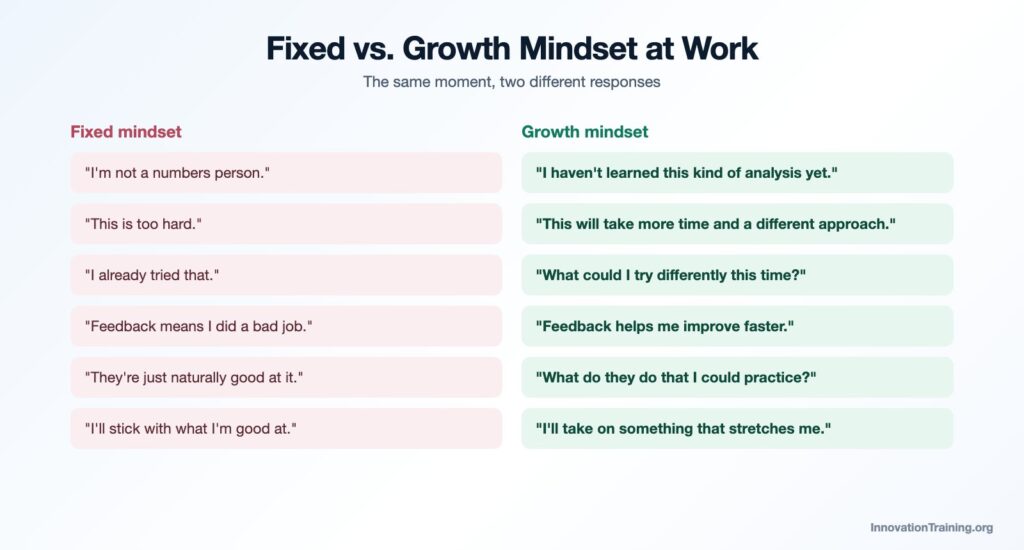
Growth Mindset vs. Fixed Mindset: Phrases at Work
One of the easiest ways to recognize mindset is through language. Here are common workplace phrases and their growth mindset alternatives.
| Fixed mindset | Growth mindset |
|---|---|
| “I’m not a numbers person.” | “I haven’t learned this kind of analysis yet. Who could show me?” |
| “This is too hard.” | “This will take more time and a different approach.” |
| “I already tried that and it didn’t work.” | “What could I try differently this time?” |
| “They’re just naturally good at presenting.” | “What do they do that I could practice?” |
| “I made a mistake, so I’m bad at this.” | “That mistake shows me what to work on next.” |
| “Feedback means I did a bad job.” | “Feedback helps me improve faster.” |
| “We’ve always done it this way.” | “Is there a better way to do this now?” |
| “I’ll stick with what I’m good at.” | “I’ll take on something that stretches me.” |
Growth Mindset Examples for Employees
- Asking for feedback early. An analyst shares a rough draft of a report with a colleague on Tuesday instead of polishing it alone until Friday, because early input saves time and improves the result.
- Volunteering for a stretch project. A team member with no budgeting experience offers to help build next year’s budget, knowing it will be uncomfortable at first.
- Treating a mistake as data. After a client presentation goes poorly, a consultant writes down three things that did not land and practices a new opening before the next meeting.
- Learning from a peer’s success. When a colleague wins an award, an employee asks them to lunch to learn how they approached the project, instead of feeling diminished.
- Using “yet.” A new manager tells their own manager, “I’m not comfortable running difficult conversations yet. Can we role-play one before my review meetings?”
- Breaking a hard skill into practice steps. Someone who wants to get better at public speaking starts by giving a two-minute update in every team meeting for a month.
- Seeking out the hard question. In a project review, a team member asks, “What is the weakest part of our plan?” and genuinely wants the answer.
Growth Mindset Examples for Leaders and Managers
- Praising process, not talent. Instead of “You’re a natural,” a manager says, “The way you tested three versions of that email before sending it really paid off.”
- Admitting what they are still learning. A director opens a strategy meeting by sharing a decision they got wrong last quarter and what they changed as a result.
- Making it safe to fail small. A leader sets aside time and budget for experiments and celebrates the lessons from ones that did not work.
- Coaching instead of rescuing. When an employee brings a problem, the manager asks, “What options have you considered?” before offering their own answer.
- Developing people, not only selecting them. A manager hires for curiosity and learning ability, then invests in training, rather than only looking for people who already have every skill.
- Reviewing projects for learning. After every major project, the team runs a short review focused on what to repeat and what to change, without blame.
Growth Mindset Examples for Teams
Mindset shows up at the team level too. A team with a growth mindset culture tends to share these habits:
- Regular retrospectives where people discuss what went wrong openly.
- Pairing experienced and newer team members on challenging work.
- Sharing “lessons learned” as often as wins in team updates.
- Running pilots and prototypes before committing to big decisions.
- Rotating roles, such as meeting facilitator, so everyone builds new skills.
- Setting learning goals alongside performance goals.
Growth Mindset Examples in Everyday Situations
Here are a few short scenarios showing the same situation through both lenses.
A new software system. Fixed: “I’m terrible with technology, I’ll just keep using spreadsheets.” Growth: “I’ll spend twenty minutes a day on the tutorials this week and ask for help when I get stuck.”
A promotion goes to someone else. Fixed: “Leadership doesn’t value my work.” Growth: “I’ll ask what skills would make me ready next time and build a plan to develop them.”
Critical feedback in a review. Fixed: “My manager doesn’t like me.” Growth: “This is uncomfortable, but it tells me exactly what to focus on for the next six months.”
A failed product launch. Fixed: “We should never have tried this.” Growth: “What did customers tell us that we didn’t know before, and how does it change our next version?”
How to Practice a Growth Mindset at Work
Notice your fixed mindset triggers
Pay attention to the moments when you feel defensive, discouraged, or tempted to give up. Common triggers include criticism, comparison, and taking on something new. Simply naming the trigger (“I’m feeling defensive because this is feedback on something I care about”) makes it easier to choose a different response.
Add “yet” to your self-talk
“I can’t run this analysis” becomes “I can’t run this analysis yet.” It is a small change, but it reframes a limit as a stage of learning. The four stages of competence explains why feeling clumsy at a new skill is normal and temporary.
Set a learning goal
Alongside your performance goals, choose one skill you want to build this quarter, the steps you will take, and how you will know you are improving.
Reflect regularly
Spend five minutes at the end of each week answering: What did I learn? What challenged me? What will I try next week? Our collection of reflection quotes for growth and motivation can be a helpful prompt to open a reflection or team meeting.
Read and discuss
Teams that read and discuss mindset research together build shared language. See our list of the best books on growth mindset for good starting points.
Frequently Asked Questions
What is an example of a growth mindset at work?
Asking for feedback on a draft before it is finished, volunteering for a project that requires new skills, and treating a failed experiment as a source of lessons are all examples of a growth mindset at work.
What is a fixed mindset example?
Avoiding challenges to protect your image, ignoring useful feedback, giving up quickly when something is hard, and feeling threatened by a colleague’s success are common fixed mindset examples.
Can a company have a growth mindset?
Yes. Research by Dweck and colleagues found that employees in organizations with a growth mindset culture reported more trust, more support for risk taking, and stronger commitment. Culture is shaped by how leaders praise, hire, develop, and respond to failure.
Bring Growth Mindset Training to Your Team
Knowing the examples is the first step. Building the habits takes practice with real situations and a team that supports it. InnovationTraining.org offers an interactive growth mindset workshop and longer growth mindset training for organizations. Contact us to design a session for your team. Which phrase from the table above do you hear most often at work?