
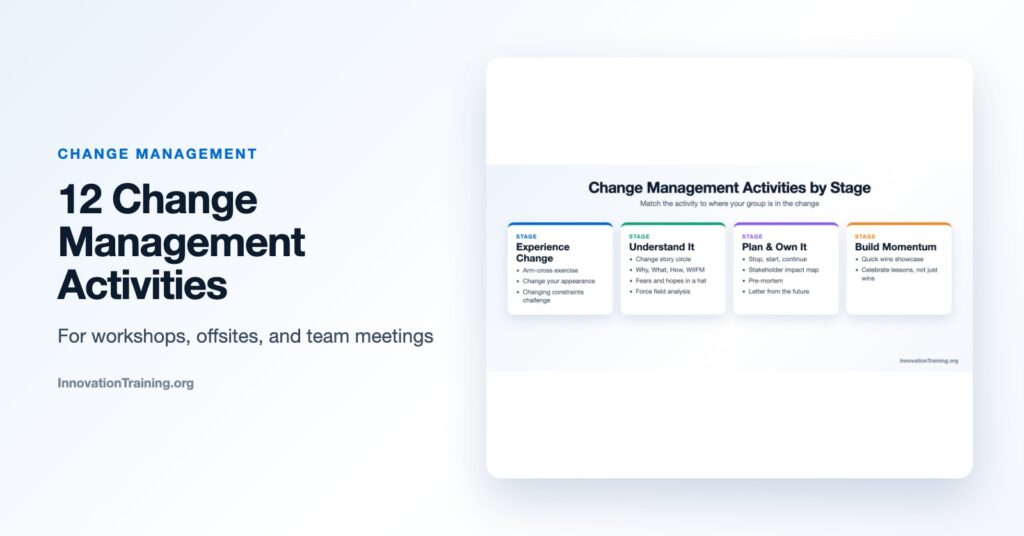
People rarely resist change because of a slide deck. They resist because they have questions nobody has answered, fears nobody has named, and no say in how the change will work. Good change management workshops give people a chance to talk, practice, and help shape what happens next. These twelve change management activities work for team meetings, leadership offsites, and full change workshops, with instructions, timing, and tips for each.
How to Choose the Right Change Management Activity
Before picking an activity, be clear about where your group is in the change. Early on, people need to understand why the change is happening and voice their concerns. In the middle, they need to work out what it means for their daily work. Later, they need to build momentum and share what is working. The activities below are grouped by those three stages.
Also consider group size, time, and trust level. Activities that ask people to share fears work best after some trust has been built, while quick physical warm-ups can open almost any session.
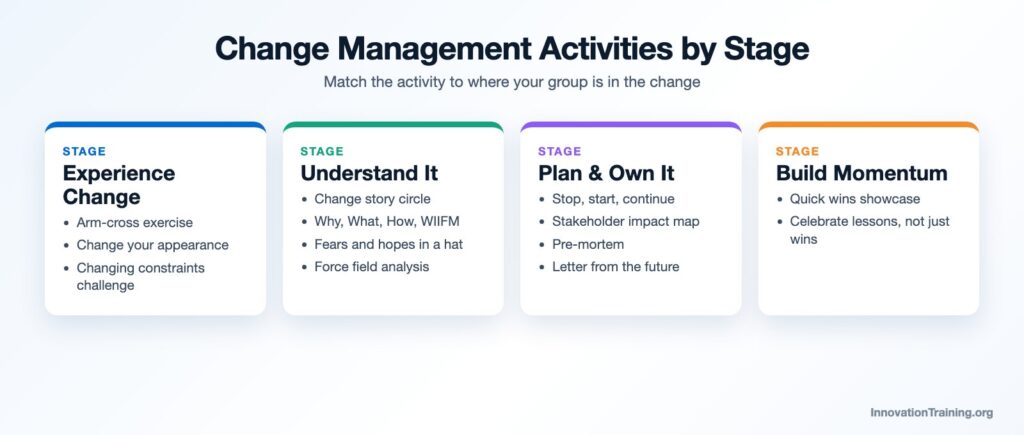
Warm-Up Activities: Experiencing Change
1. The arm-cross exercise
Time: 5 minutes. Group size: any.
Ask everyone to cross their arms. Then ask them to cross them the other way, with the opposite arm on top. Most people hesitate and feel awkward. Ask: “How did that feel? What would it take for the new way to feel normal?” This quick exercise shows that even tiny changes feel uncomfortable at first and that comfort comes with repetition.
2. Change your appearance
Time: 10 minutes. Group size: pairs.
Partners face each other for thirty seconds, then turn around and each change three things about their appearance (remove a watch, roll up a sleeve, move a name badge). They turn back and guess the changes. Then ask them to change five more things. People usually groan, and many put the items back once the activity ends. Debrief on how people respond to change, why we tend to subtract rather than add, and how quickly we return to old habits.
3. Changing constraints challenge
Time: 20 minutes. Group size: teams of four to six.
Give teams a simple build task, such as making the tallest tower from paper and tape. Halfway through, change the rules: one person can no longer speak, the materials are cut in half, or the goal shifts from tallest to strongest. Debrief on how teams reacted, who adapted first, and what helped them keep going. Connect the lessons to the real change the group is facing.
Activities for Understanding the Change
4. Change story circle
Time: 20 minutes. Group size: groups of three or four.
Each person shares a story about a change they lived through in their career or life: what made it hard, what helped, and what they learned. The group listens for patterns, then shares the most useful lessons with the room. This reminds people that they have adapted before and surfaces practical advice in their own words. Stories also build connection, which our storytelling for transformation workshop uses at a larger scale.
5. Why, what, how, and WIIFM
Time: 30 minutes. Group size: any.
Post four large sheets labeled Why are we changing?, What is changing?, How will it happen?, and What’s in it for me? Leaders share their answers briefly, then participants rotate around the sheets adding questions, concerns, and gaps. Leaders respond to the most common questions before the session ends. This makes the gaps in communication visible and gives people a direct voice.
6. Fears and hopes in a hat
Time: 20 minutes. Group size: 8 to 40.
Everyone writes one fear and one hope about the change on separate cards, anonymously. Collect them, mix them, and redistribute so each person reads someone else’s card aloud. The group then clusters the fears and hopes and discusses which ones leaders can address directly. Anonymity helps people say what they really think.
7. Force field analysis
Time: 30 minutes. Group size: teams of four to eight.
Based on Kurt Lewin’s model, draw a line down the middle of a page with the change written at the top. On one side, list the forces driving the change. On the other, list the forces restraining it. Teams rate the strength of each force, then brainstorm ways to strengthen key drivers and reduce the biggest barriers. This turns vague resistance into specific issues the team can work on.
Activities for Planning and Ownership
8. Stop, start, continue
Time: 25 minutes. Group size: any.
Ask teams to identify what they should stop doing, start doing, and continue doing as a result of the change. This simple framework helps people translate an abstract change into concrete daily behaviors and makes it clear that not everything is changing.
9. Stakeholder impact map
Time: 30 minutes. Group size: teams of four to six.
Teams list every group affected by the change, then rate how much each will be affected and how much influence each has. For the most affected and influential groups, they plan how to involve and support them. This activity is especially useful for leaders and change champions.
10. Pre-mortem
Time: 30 minutes. Group size: teams of four to eight.
Ask the group to imagine it is one year from now and the change has failed badly. Each person writes down every reason they can think of for the failure. Share, cluster the reasons, and identify the most likely and most damaging ones. Then plan actions to prevent them. Developed by psychologist Gary Klein, the pre-mortem makes it safe to raise doubts because the failure is hypothetical.
11. Letter from the future
Time: 20 minutes. Group size: individuals, then pairs.
Each person writes a short letter dated one year in the future, describing how the change worked out well for them and their team. What is different? What did they do to help it succeed? Partners read their letters to each other and pick out the actions they could take now. This builds optimism and gives people a picture to work toward.
Activities for Building Momentum
12. Quick wins showcase
Time: 30 minutes. Group size: any.
A few weeks into the change, invite teams to share one small win, one lesson learned, and one request for help. Keep each share to two minutes. Leaders listen and commit to acting on the requests. Celebrating early progress shows the change is real and working, and sharing lessons spreads good practices across teams.
Tips for Facilitating Change Management Workshops
- Acknowledge loss. Even good changes mean giving something up. Naming that openly builds trust.
- Let leaders listen more than talk. A workshop where leaders present for most of the time is a briefing, not a change workshop.
- Close the loop. If people raise questions and concerns, follow up on them. Silence after a workshop quickly erodes trust.
- Mix individual and group work. Quiet reflection before group discussion helps introverts contribute and produces better ideas.
- Connect to real work. End each activity by asking what it means for how people will work on Monday.
Frequently Asked Questions
What is a change management workshop?
A change management workshop is a facilitated session that helps people understand a change, voice concerns, plan how it will work in practice, and build the skills and commitment needed to make it succeed.
How long should a change management workshop be?
Short sessions of ninety minutes to half a day work well for team-level changes. Larger organizational changes often benefit from a full-day workshop for leaders followed by shorter sessions for each team.
How do you make change management training engaging?
Replace long presentations with activities that let people experience change, talk honestly, and plan their own actions. Use the group’s real change as the content wherever possible.
Bring Change Management Workshops to Your Team
InnovationTraining.org designs interactive change sessions that help people move from uncertainty to ownership. Explore the change management workshop, read our guide to change leadership and change management, or contact us to design a session around the change your organization is facing. Which of these activities would your group need most right now?