
Many managers want to coach their people but are not sure how to structure the conversation. They ask a question or two, then slide back into giving advice. The GROW model solves that problem with a simple four-step structure that works for a five-minute hallway chat or an hour-long development conversation. This guide explains what the GROW model is, each stage with sample coaching questions, a full example conversation, and tips for using it well.
What Is the GROW Model?
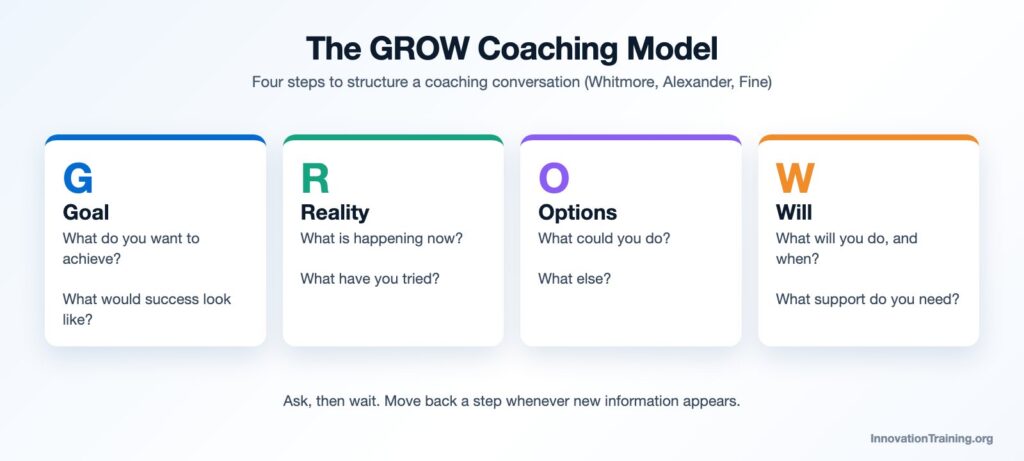
The GROW model is a framework for structuring coaching conversations. GROW stands for Goal, Reality, Options, and Will (sometimes called Way Forward). The coach uses questions to help the other person clarify what they want, understand their current situation, explore possible actions, and commit to a next step.
The model was developed in the United Kingdom in the 1980s by business coaches Graham Alexander, Alan Fine, and Sir John Whitmore. Whitmore popularized it in his 1992 book Coaching for Performance, which remains one of the most widely read books on workplace coaching. GROW’s strength is its simplicity: it is easy to remember, easy to teach, and flexible enough for almost any coaching topic.
The Four Stages of the GROW Model
G: Goal
Start by clarifying what the person wants to achieve, both from the conversation and in the bigger picture. A clear goal gives the conversation direction.
- What would you like to get out of our conversation today?
- What do you want to achieve?
- What would success look like?
- How will you know you have reached your goal?
- Why does this matter to you?
R: Reality
Explore the current situation. What is actually happening, what has been tried, and what is getting in the way? This stage often reveals that the real issue is different from the one first described.
- What is happening right now?
- What have you already tried, and what happened?
- What is getting in the way?
- Who else is involved or affected?
- On a scale of 1 to 10, where are you now?
O: Options
Generate possible ways forward. The coach’s job here is to help the person think broadly before narrowing down, and to resist jumping in with their own solution.
- What could you do?
- What else? What else?
- What would you do if you had no constraints?
- What would someone you admire do in this situation?
- What are the pros and cons of each option?
W: Will (Way Forward)
Turn options into commitment. Agree on specific actions, timing, and support, and check the person’s motivation to follow through.
- Which option will you choose?
- What is your first step, and when will you take it?
- What might get in the way, and how will you handle it?
- What support do you need?
- On a scale of 1 to 10, how committed are you to this action?
A GROW Coaching Conversation Example
Here is a short example between a manager (M) and a team member, Priya (P), who feels overwhelmed by her workload.
Goal. M: “What would you like to get out of this conversation?” P: “I want to stop working late every night and still deliver the launch on time.” M: “What would that look like in a typical week?” P: “Leaving by six at least four days a week.”
Reality. M: “What is taking up most of your time right now?” P: “Answering questions from the sales team. It’s probably two hours a day.” M: “What have you tried so far?” P: “Mostly answering faster.”
Options. M: “What could you do differently?” P: “I could write a short FAQ. I could set office hours for questions. Maybe one person on sales could collect questions for me.” M: “What else?” P: “I could ask whether the launch date has any flexibility, though I’d rather not.”
Will. M: “Which of those will you try?” P: “The FAQ and office hours. I’ll draft the FAQ by Wednesday and announce office hours at Thursday’s sales meeting.” M: “What support do you need from me?” P: “If you could mention the office hours to the sales director, that would help.”
In about ten minutes, Priya has a clear goal, a better understanding of the real problem, and two actions she chose herself, which makes her far more likely to follow through than if she had simply been told what to do.
Tips for Using the GROW Model Well
- Spend real time on Reality. Many coaching conversations rush to options. A clear picture of the current situation often makes the right option obvious.
- Go back when you need to. GROW is a guide, not a script. If new information appears during Options, return to Goal or Reality.
- Ask, then wait. Silence after a good question gives the other person time to think. Resist filling it.
- Use “what else?” The first option someone names is rarely the best. Two or three rounds of “what else?” usually produce better ideas.
- Offer ideas last, and lightly. If you have a suggestion, ask permission first and offer it as one option among several.
- Close with a clear action. A coaching conversation without a specific next step is just a pleasant chat.
When to Use the GROW Model
- One-on-one meetings between managers and team members
- Career and development conversations
- Helping someone solve a work problem without taking it over
- Goal setting at the start of a project or quarter
- Peer coaching programs
- Self-coaching, by answering the questions in writing
GROW Model Variations
Several variations add steps to the original model. TGROW adds a “Topic” stage at the start to clarify the subject before setting a goal. GROWTH adds “Tactics” and “Habits” at the end to support follow-through. The OSKAR model, a solution-focused alternative, emphasizes outcomes, scaling, and what is already working. All share the same core idea: help the person think for themselves through good questions.
Frequently Asked Questions
What does GROW stand for in coaching?
Goal, Reality, Options, and Will (or Way Forward).
Who created the GROW model?
Graham Alexander, Alan Fine, and Sir John Whitmore developed the GROW model in the 1980s. Whitmore’s book Coaching for Performance made it widely known.
Can managers use the GROW model?
Yes. GROW is one of the most common frameworks taught in coaching skills programs for managers, because it gives a simple structure for turning everyday conversations into development opportunities.
Build Coaching Skills Across Your Organization
InnovationTraining.org helps managers and leaders practice coaching conversations that build capability and ownership. Explore our coaching for managers training and innovation coaching, or contact us to design a program for your leaders. Which GROW question would change your next one-on-one?