
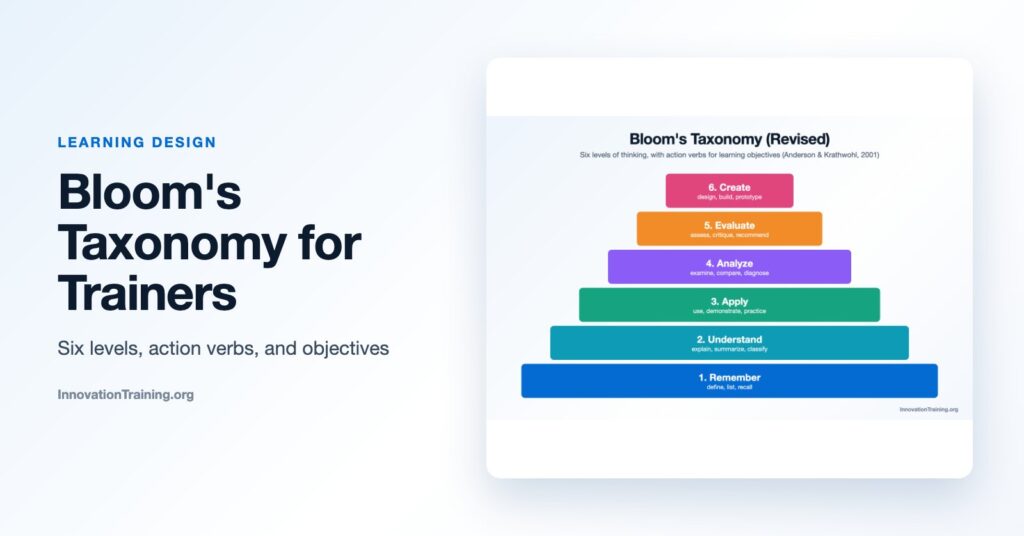
Many training sessions aim to help people “understand” something and then wonder why nothing changes back at work. Bloom’s taxonomy gives trainers and facilitators a sharper way to decide what level of thinking a session should reach, from remembering facts to creating something new. This guide explains the six levels of Bloom’s taxonomy, the action verbs for each level, how to write learning objectives with it, and how to design workshop activities that reach the higher levels.
What Is Bloom’s Taxonomy?
Bloom’s taxonomy is a framework that classifies learning objectives by the complexity of thinking they require. Educational psychologist Benjamin Bloom and a team of colleagues published the original version in 1956 as Taxonomy of Educational Objectives. In 2001, Lorin Anderson (one of Bloom’s former students) and David Krathwohl led a revision that renamed the levels as verbs and placed “create” at the top.
The taxonomy is usually shown as a pyramid or staircase. Lower levels involve simpler thinking, such as recalling information. Higher levels involve more demanding thinking, such as evaluating options or creating something original. Each level generally builds on the ones below it.
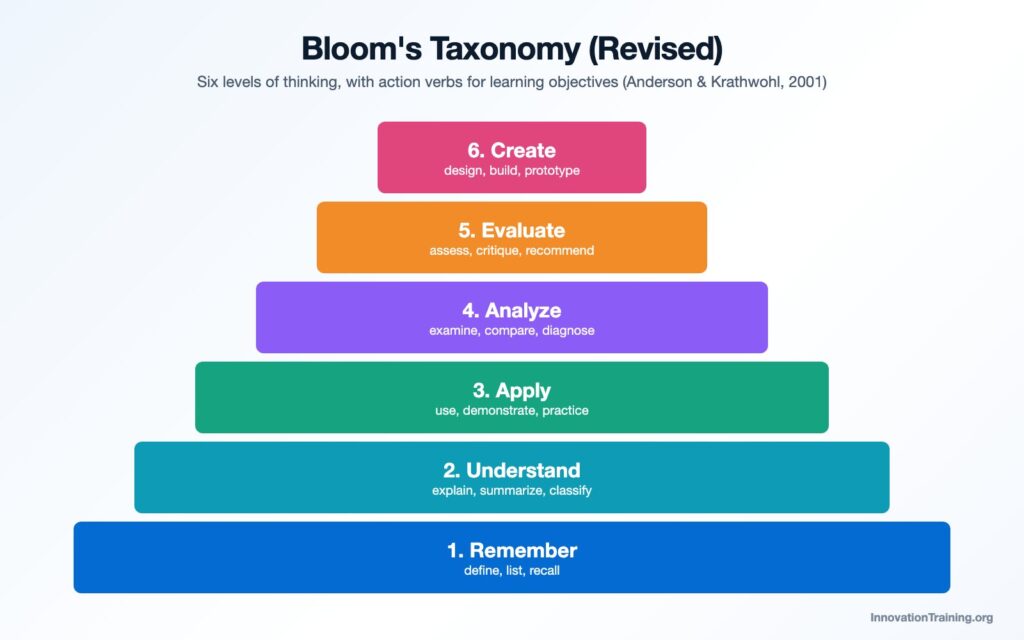
The Six Levels of Bloom’s Taxonomy (Revised)
1. Remember
Recall facts, terms, and basic concepts.
Verbs: define, list, name, recall, recognize, identify.
Workplace example: List the five stages of the company’s sales process.
2. Understand
Explain ideas or concepts in your own words.
Verbs: explain, summarize, describe, classify, compare, interpret.
Workplace example: Explain why each stage of the sales process matters to the customer.
3. Apply
Use information or a method in a new situation.
Verbs: use, demonstrate, implement, solve, carry out, practice.
Workplace example: Use the discovery questions in a role-play with a new client.
4. Analyze
Break information into parts and examine relationships.
Verbs: analyze, differentiate, examine, organize, compare, diagnose.
Workplace example: Review three lost deals and identify where in the process each one went off track.
5. Evaluate
Justify a decision or judge the value of something against criteria.
Verbs: evaluate, assess, critique, prioritize, recommend, justify.
Workplace example: Assess two proposed changes to the sales process and recommend one, with reasons.
6. Create
Produce new or original work by combining elements in a new way.
Verbs: design, develop, build, plan, prototype, compose.
Workplace example: Design a new onboarding sequence for customers in a market the company has not served before.
How to Write Learning Objectives With Bloom’s Taxonomy
A strong learning objective names who will learn, what they will be able to do (using a Bloom’s verb), and, where useful, the conditions and standard. A common format is: “By the end of this session, participants will be able to [verb] [content] [context or standard].”
| Vague objective | Bloom’s-based objective |
|---|---|
| Understand design thinking. | Apply the five stages of design thinking to a real customer problem in a small team. |
| Learn about feedback. | Demonstrate a structured feedback conversation in a role-play using the situation-behavior-impact model. |
| Know the change management process. | Analyze a current change initiative and identify the two biggest sources of resistance. |
| Be more innovative. | Create and pitch a prototype solution to a team challenge by the end of the workshop. |
Avoid verbs like “understand,” “know,” and “appreciate” in objectives. They describe something real but are hard to observe or measure. Choosing a specific verb forces a clearer decision about what participants should actually do.
Designing Workshop Activities for Each Level
Bloom’s taxonomy is most useful for designing sessions, not only writing objectives. Here are activities matched to each level.
- Remember: quick quizzes, matching games, flashcards, “name three” warm-ups.
- Understand: explain-it-to-a-partner, summarize in one sentence, sort examples into categories, the Feynman technique.
- Apply: role-plays, simulations, practice exercises on real cases, live demonstrations.
- Analyze: case studies, root cause analysis, comparing examples, process mapping.
- Evaluate: debates, peer review against criteria, prioritization exercises, pitch feedback.
- Create: design sprints, prototyping, writing a plan, building a new process or tool.
A common pattern in effective workshops is to move quickly through the lower levels and spend most of the time on apply, analyze, evaluate, and create. Participants can often read the basics before the session, freeing live time for practice and creation. This is one of the core principles behind design thinking for learning.
Bloom’s Taxonomy and Other Learning Models
Bloom’s taxonomy pairs well with other frameworks trainers use. Kolb’s experiential learning cycle describes how people learn through experience and reflection, which naturally engages the higher Bloom’s levels. The Kirkpatrick Model helps measure whether higher-level learning reaches the job. Instructional designers using the ADDIE model typically write Bloom’s-based objectives during the design phase.
Criticisms of Bloom’s Taxonomy
- Learning does not always move neatly up the levels. People can be creative before mastering every fact.
- The levels can overlap, and the same activity may involve several types of thinking.
- The original taxonomy focused on the cognitive domain. Bloom’s team also described affective (attitudes) and psychomotor (physical skills) domains, which get less attention but matter in workplace learning.
Frequently Asked Questions
What are the six levels of Bloom’s taxonomy?
In the revised taxonomy: remember, understand, apply, analyze, evaluate, and create.
What is the difference between the original and revised Bloom’s taxonomy?
The 2001 revision changed the level names from nouns to verbs (for example, “knowledge” became “remember”), and swapped the top two levels so that “create” sits above “evaluate.”
How do trainers use Bloom’s taxonomy?
Trainers use it to write clear learning objectives, choose activities that match the level of thinking required, and design assessments that check whether participants can actually do what the training intended.
Design Training That Reaches Higher-Level Thinking
InnovationTraining.org designs interactive workshops where participants spend their time applying, analyzing, and creating, not just listening. Explore our facilitator training program and facilitation workshop, or contact us to design a session. What level of Bloom’s taxonomy does your next session really need to reach?