Teams often say they would love to understand customers better, then assume that means a long research project. In most organizations the evidence is already sitting there. It is buried in the support inbox, the chat logs, the contact form, the product reviews, and the notes from last week’s sales call. Design thinking treats this like an archaeology dig: the clues exist, and the work is to unearth them and make sense of what they say.
This article covers the places to look for customer insights you already have, how to go a level deeper with contextual inquiry, and how to turn scattered clues into themes your team can act on. It includes a clip from a live workshop where Darin Eich walks business owners through the approach.
Why Existing Evidence Beats Guessing
Guesses about customers feel convincing in a planning meeting. Evidence is different: it is what a real person typed, said, or did. When someone writes “I only have a small amount left in my training budget this year, which course should I take?” they have told you their problem, their constraint, and the kind of solution they want, in their own words. A dozen messages like that point to a product or service far more reliably than a brainstorm about what customers might want.
In this clip from a live workshop, Darin Eich explains why design thinking resembles archaeology and shows where customer clues are usually hiding.
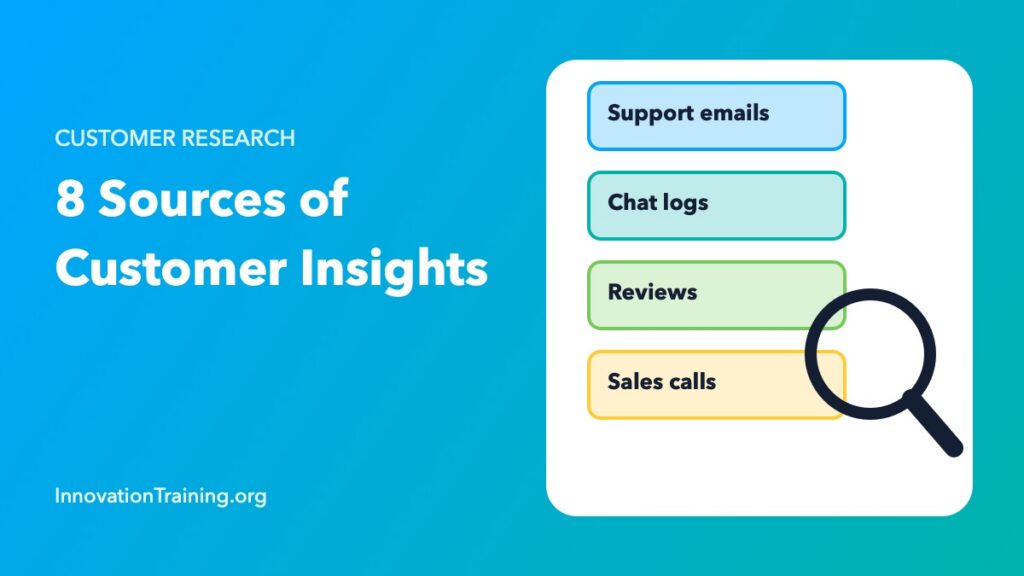
8 Sources of Customer Insights
- Support emails and tickets. Recurring complaints and questions show where your product or service falls short.
- Live chat logs. Chat captures people mid-task, often describing exactly what they were trying to do.
- Contact and inquiry forms. First messages reveal how people describe their challenge before they learn your vocabulary.
- Customer service calls. Call notes and recordings show emotion and urgency that written channels miss.
- Reviews. Your own reviews and competitors’ reviews show what people value and what disappoints them.
- Sales conversations. Objections and “do you also do this?” questions are direct requests for new offers.
- Social media comments and messages. Public replies show which ideas resonate and which confuse.
- Search data. The terms people type into search engines reflect real needs at scale. See our guide to using Google Trends for market research.
A practical habit: make it easy for people to tell you what they need. A visible contact form, a simple email address, and a chat option all invite customers to describe their challenge in their own words. Then review what comes in on a regular schedule, with a colleague, looking for patterns.
The Gold Standard: Interviews and Contextual Inquiry
Existing data is the fastest place to start. Talking with customers directly is the gold standard. There are two levels.
Customer interviews
Set up a short conversation by phone or video and ask about the person’s goals, frustrations, and how they currently solve the problem. If formal interviewing feels intimidating, start with the basic questions: who, what, where, when, why, and how. A curious conversation is enough to learn a great deal.
Contextual inquiry (with an example)
Contextual inquiry means learning from people while they are in the middle of the activity you want to understand. Instead of asking someone to remember how they manage their finances, you sit beside them while they open the spreadsheet they built to do it. Software companies such as Intuit have used this approach, meeting customers where they work and watching how they solve problems on their own. You see the workarounds, the hacks, and the moments of friction that people forget to mention in an interview.
For a training program, that might mean asking participants what is working while they are still in the session. For a product, it might mean watching someone unbox and use it for the first time.
From Clues to Themes
Insights become useful when you see the patterns. A simple way to do this with a team:
- Pull 15 to 30 pieces of evidence: quotes from emails, chat excerpts, review lines, interview notes.
- Write each one on a sticky note or digital card, keeping the customer’s exact words.
- Group similar notes and name each group. These names are your themes.
- For each theme, ask what need or problem it reveals, and who has it most.
Themes often point straight to a customer persona or to a stage in the customer journey that needs attention. They also give your team shared language grounded in what customers actually said.
Three Ways to Go Further
- Bring a workshop to your team. Our client insight workshop and broader design thinking training help teams gather and use customer insight on a live challenge.
- License the course for a group. Give a team or cohort access to the full online program. Contact us about group access.
- Learn at your own pace. The Starting with Design Thinking online course includes the full workshop recording and templates.
What is one place in your organization where customer clues are piling up unread?