
How do you help people move from talking about a culture of innovation to actually building one? For over twenty years, we have collaborated with more than 100 organizations on in-person and virtual innovation, design thinking, and leadership workshops. One of our favorite focus areas is helping people lead and facilitate design thinking to grow a culture and mindset of innovation.
This guide shares what happens inside a culture of innovation workshop: the ideas and activities we use, the elements of an innovative culture that participants themselves have defined, and what leaders say they take back to their organizations. Whether you are designing your own culture workshop or exploring bringing one to your team or conference, you can use what our participants created and learned.
What Participants Want From a Culture of Innovation Workshop
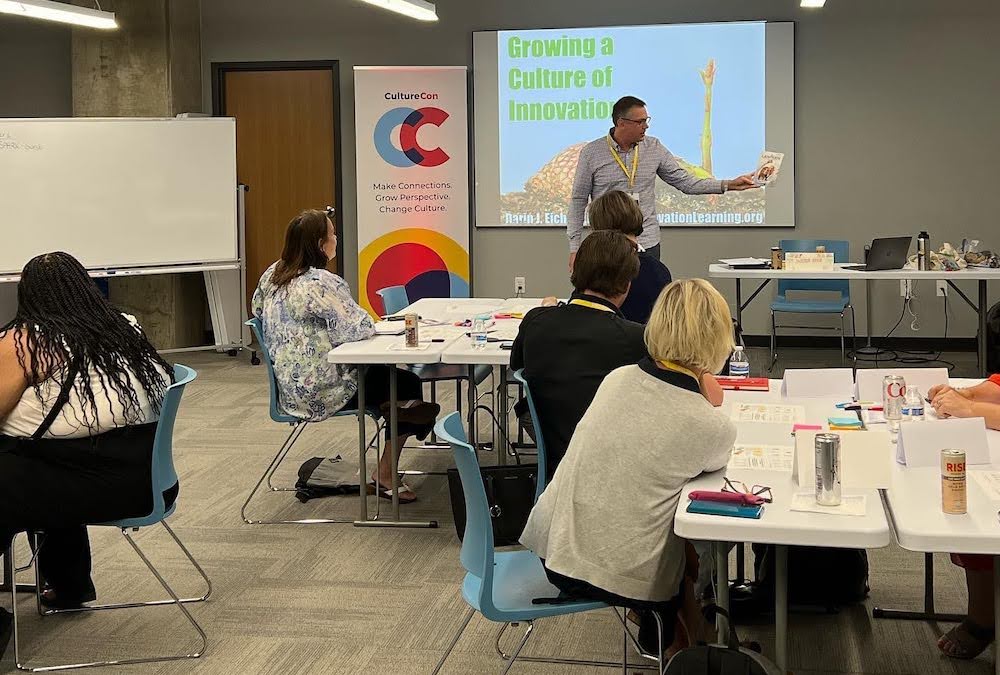
Whenever we open one of these workshops, we ask participants what they hope to learn or focus on. Across sessions and years, their answers cluster around four themes:
Connection. How to connect with others in the room, and how to facilitate that same connection back at their own organization. Networking, engaging an audience, connecting with employees across a large organization.
Personal capability. How to lead change, be relatable, generate new ideas, and inspire with impact.
Facilitative leadership. How to become a better storyteller, facilitate workshops, put design thinking into action, and build better teams.
Reinvigorating a stuck culture. How to grow a culture of innovation from a stagnant place, build a culture-positive workplace, and get employees more engaged.
That last theme is consistently the most requested, so it shapes how we design the experience. Understanding what your participants actually need before you design anything is itself the first move of design thinking: empathize before you build.
Five Elements of a Culture of Innovation, Defined by Participants
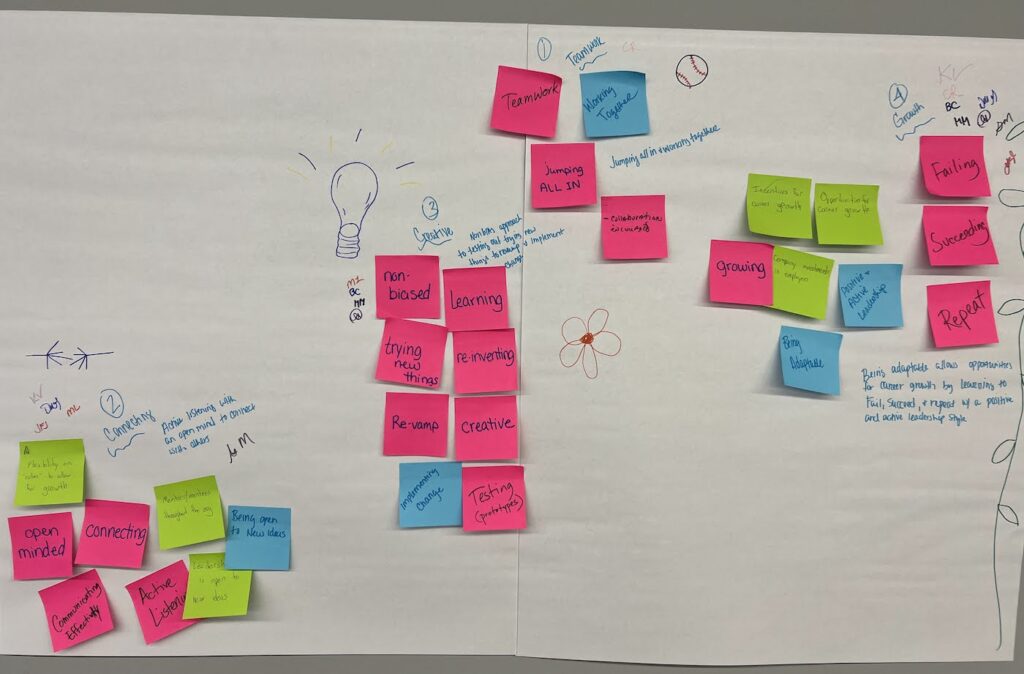
In one of our favorite activities, participant teams work together to define the key elements of an organizational culture of innovation. Here is what one group of culture leaders converged on:
- Growth
- Vulnerability and risk tolerance
- Adapting and evolving
- Connecting
- Creating
Notice that these are behaviors and postures, not programs. That pattern holds across every group we have run this activity with, and it tells you something important about culture change: it lives in how people interact, not in what the organization announces.
Culture Workshop Ideas and Activities That Work
If you are planning a culture workshop of your own, these are activity types we return to because they reliably move a group from discussion to creation:
Define the culture you want. Teams name the elements of the culture they are trying to build (like the five above). This creates shared language before anyone proposes solutions.
Story rounds. Participants tell a story connected to the culture challenge to three different people in succession. By the third telling, the story sharpens and the feedback improves. One participant described exactly this: “By telling my story to three different people, by the third time I was like, OK, this is how I want to say it.”
Play-based reframing. Improvisation and playful exercises help people look at familiar challenges with fresh eyes. As one leader reflected: “Very simple activities can unlock something, and sometimes we have to grapple with the discomfort of being awkward.”
Brainstorm for options, not answers. Generate many possible culture ideas before evaluating any. “When you’re speaking with a diverse group of people, you can just come up with ideas so quickly.”
Rapid prototyping. Make one culture idea visible and testable: sketch the employee storytelling session, draft the recognition ritual, outline the leader listening tour.
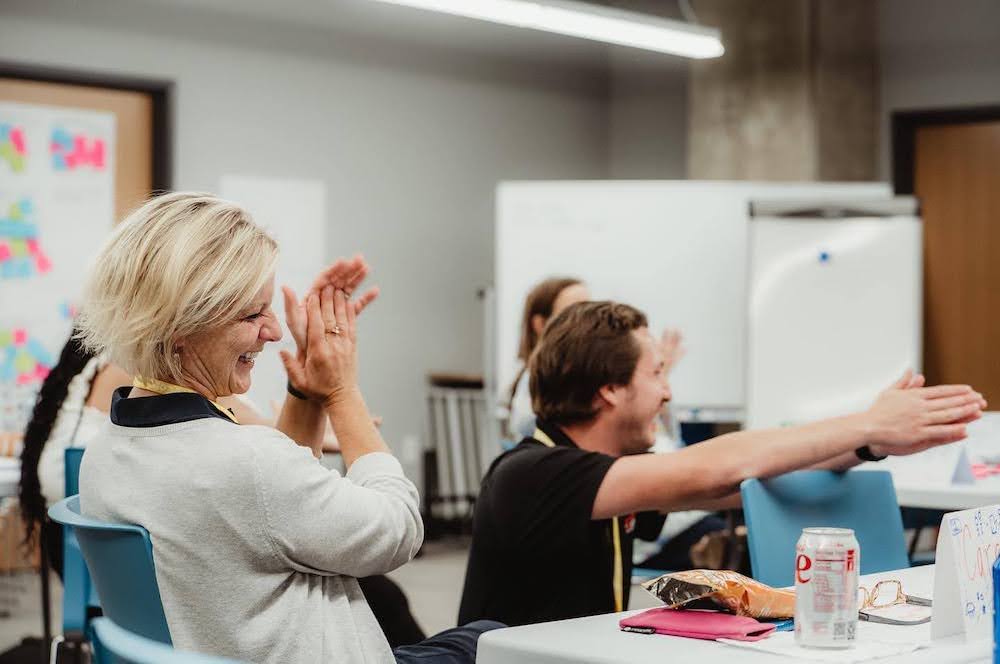
Mix the groups. Regroup people throughout so no one gets too comfortable. Participants consistently name this as a reason they connected with more people and heard more perspectives.
Closing reflection. End by having each person capture what they will carry forward, then cluster the reflections as a group. The group writes the ending, not the facilitator. For more on this, see our guide to reflection activities for workshops.
What Leaders Take Back to Their Organizations
The measure of a culture workshop is what happens afterward. Here is a sample of what participants have told us they are taking back:
- I don’t think I’ve ever laughed so hard I cried with people I’ve only known for four hours. What I think I took away the most from this is the idea of just getting away from words and sometimes going to pictures. It can be a really interesting way of telling a story and getting to know people. Storytelling is something we struggle with as an organization, and we don’t really focus on it as much as we should. I really want to change that moving forward.
- I learned so much today. This is a very exciting, dynamic environment. I appreciated all of the people here today. I had tried doing things like this previously and it just fell completely flat, and we ended up going back to our usual ways of doing things with a whiteboard. So, to see this in practice in a way that worked was beautiful and inspiring.
- For me, I was so excited to participate and take part in this experience because I have tried a lot of things that we talked about before at work. It was useful to realize I am on the right track, and during this workshop, I picked up a lot of little tips and hints that can be used throughout the day that will help me translate the theory into the practice and changes that need to happen on the ground in the work we are trying to do. So, for me, this workshop was all about affirmation and confidence for a more powerful way going forward.
- Well, first off, it’s been a lot of good information, but I really like the activities that we did and the way that we brainstormed different things. It’s not typical to how most people are usually brainstorming and having meetings in an office. I think that this is a way to brainstorm to be creative, be a little silly, but also generate good, positive ideas.
- I can definitely see us taking back the team building exercises to our company and trying to implement them in different departments. A lot of the situations from the workshop were also things we’re not seeing all the time, and so I learned how to be adaptable and open to learning new things. Also, the communication and feedback. You may take something from someone else to help you or, you never know, something you say may help them. Looking forward to continuing on with relationships that are built here, so that we can continue to grow.
- One takeaway I like is that we weren’t always working in the same groups, so we weren’t getting too comfortable too quickly. And, with some of the activities, I learned how to be more open and comfortable hearing other people’s viewpoints and opinions.
- The abstract nature of some of the activities really helped and will be brought back to our company to brainstorm and build relationships.
- What stood out to me is that it’s a “muscle”. You have to work and keep working to generate ideas. I want to practice it more to get better at it.
What This Reveals About Leading Culture Change
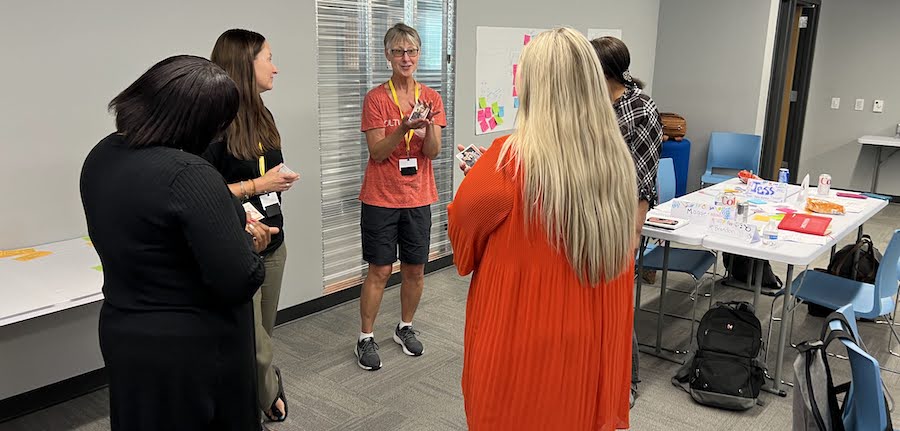
Across years of these workshops, participants rarely describe culture innovation as launching another large program. They focus on the moments and behaviors that shape people’s everyday experience of work: leaders listening, employees having a voice, people sharing stories, teams experimenting, and organizations creating room for play, feedback, belonging, and action.
The ideas are often simple. That does not mean they are small. A culture is formed through repeated interactions, and changing those interactions is one of the most practical ways to begin changing the culture. Design thinking fits culture work because it starts with empathy for how people actually experience the organization, generates many options instead of betting everything on one initiative, and tests small before scaling.
Virtual Leadership & Facilitation Online Workshop
Last year, we held a virtual design thinking leadership retreat centered around facilitation and digital transformation in leading. The outcome of the workshop was to help leaders understand how to design more engaging and interactive workshops, events, and breakout sessions of their own. At the end of the event, we asked participants to reflect and share what they learned and thought about the process. Here’s what they had to say:
- Watching Darin and learning from Darin just emphasized again that all of life is an experiment. You might do it and it might fail, and that’s okay. And the other takeaway is the importance of practice. My mantra is to never be in “performance mode” but admitting that I’m always just practicing and learning.
- One thing that I’m taking away is to just start and do it, experiment. I’ve been thinking a lot about what I need to do for the presentation, and I think it’s about just getting started and putting things together is a good way to move forward.
- For me, this workshop reinforced the concept of letting go of perfection. The impact of being messy – and positive outcomes that come from play and chaos!
- My takeaway was to continue to challenge the status quo. You can take almost any meeting and workshop and apply the things we learned to make it more fun, more engaging, and probably better results as well.
- In my breakouts, a lot of my discussions were about being creative and not blocking the creative experience with so many thoughts that exist. So, breaking down those barriers and trying a new way.
- One of the things that stuck with me is the rhythm of how we pace things. It’s almost like music, the way you mix short activities with longer ones and breaks. And even the way you group and regroup people. It feels like there is a pulse to it. You have to let go of control to allow this to work, which is hard when you are leading something and want it to work well. I really like how you showed us what your plan was and then showed us what the actual experience was like. You can’t blow off the planning, but you need to be flexible and nimble with how people are working.
We keep offering this program in-person each year. Here’s a message I’ve appreciated receiving from a recent “innovating your culture” in-person workshop participant:
“I know I upleveled last week as a result of attending the conference – especially the pre-conference. Darin, the gifts through your teaching and facilitation you gave us last week and below (Holy Smokes GENEROSITY in ACTION) are priceless. Learning from you and the others was an invaluable experience and I have already begun spreading the word about your approach and the pre-conference with more to come. Fantastic to connect with you all in a well-crafted space. I look forward to continued connection and send you all the best as you head out to further build communities that enable humans to thrive.
Here are some other comments from participants on LinkedIn after we ran this workshop as the CultureCon pre-conference experience:
First day at CultureCon was phenomenal!!! Learning alongside like-minded, compassionate and inspiring leaders fills my soul so I can come back to my team and lead, empower and inspire them, so they can best serve other organizations and communities. PLUS, I’m getting and generating some powerfully impactful ideas.
This was so much fun to experience in person! Thanks for sharing your passion and expertise with us, Darin! I can’t wait to apply the learnings.
Thank you, Darin! So grateful for this meaningful experience with you and everyone who participated.
Your PreCon helped set the tone for the CultureCon. Thank you for leading us through all of your creative strategies. What a memorable experience!
Thank you for a great pre-conference experience, Darin Eich, Ph.D. ! It was a privilege to work with you and the team.
Here are more short reflections from recent participants about our “culture of innovation” workshop experience:
I really enjoyed doing things multiple times and learning from my mistake[s]. By telling my story to three
different people, by the third time. I was like, OK, this is how I want to say it. [I] figured out a better way
to share what [I am] working on to get more beneficial feedback.
~~~~
We used to talk as a company a lot about innovation … It feels like that conversation’s probably stalled
a little bit so I want to bring it back, making sure that that is part of our value.
~~~~
Collaboration and action: I actually experienced it and felt it.
~~~~
[This was] such a nice reminder that we can have different perspectives, and we can learn so much
from them.
~~~~
I really appreciate your style of facilitation… I picked up a few things that I’m going to implement.
~~~~
Learning what words and language we can use and to feel like, oh, I’m not alone … We are sharing
similar challenges
~~~~
When you’re speaking with a diverse group of people, you can just come up with ideas so quickly.
~~~~
I like how you’ve used AI and I’m going to be using it more often now.
~~~~
I have the courage to do something different.
~~~~
I enjoy that there’s no right way. There’s that kind of connectivity and kind of making space for that.
~~~~
Very simple activities can unlock something and sometimes we have to grapple with the discomfort or
sort of being awkward.
~~~~
So, when I first said “what do I want to learn more or what do I want to feel,” I wrote confident and
reflective. I feel like that’s basically what this did.
The last activity, [I was] feeling overwhelmed initially and then by the end of it, feeling much more
capable as a group, so that was a really wonderful feeling.
~~~~
Darin always brings new fun things, but the humans who show up make all the difference. When we go
back to our organizations, I will remember that each person brings something to the department or the
challenge at hand.
~~~~
We all came with different but same problems, but we came up with solutions very, very quickly and
joyfully. I think that we can get so serious and forget that it’s even more important to come to your
solution for our serious problems in a very playful way.
Interested in experiencing a program like this yourself or to bring it to your group? Please contact us to learn more about our innovation workshops, design thinking training or innovative facilitator program.