
This guide is for facilitators, trainers, and leaders who want a storytelling workshop that people actually remember. These are the storytelling activities I use most in my workshops, in person and on Zoom or Teams with a shared whiteboard. Each one includes how it works, when to use it, and what participants tend to say afterward. Mix and match them to fit the purpose of your session, whether that is leadership, transformation, pitching a project, or simply helping a team connect.
One principle runs through all of them: people learn storytelling by finding, telling, and improving their own stories, not by listening to a lecture about storytelling. As one participant wrote after a session, “It was a great experience to share my story and improve it each time I retold it.”
1. Turning Points Timeline
How it works: Participants sketch a quick timeline of moments when their work, role, or thinking changed, then circle the two or three that feel most important. Each circled moment is a story idea.
When to use it: Early in a session, especially for storytelling for transformation or change. It solves the most common problem in any storytelling workshop: “I don’t have any stories.”
In one transformation workshop, a participant reflected, “It was insightful to look at past transformation points. Something unsuspecting led to much bigger things.”
2. The Story Idea List
How it works: Using a few prompts tied to your workshop’s purpose (a project, a change, a value, a customer), participants list as many story ideas as they can in five to ten minutes, without judging them. Then they pick one to develop.
When to use it: Any time you want people to leave with more than one story. Generating many ideas before choosing one is straight out of design thinking, and it reliably surprises people. A participant summed it up: “I do actually have some stories that help share a purpose or result I want to drive home. Didn’t think I did.”
Encourage people to keep the list going after the workshop. “Keeping a list of professional stories is vital to personal success,” one leader wrote.
3. Three-Panel Storyboard
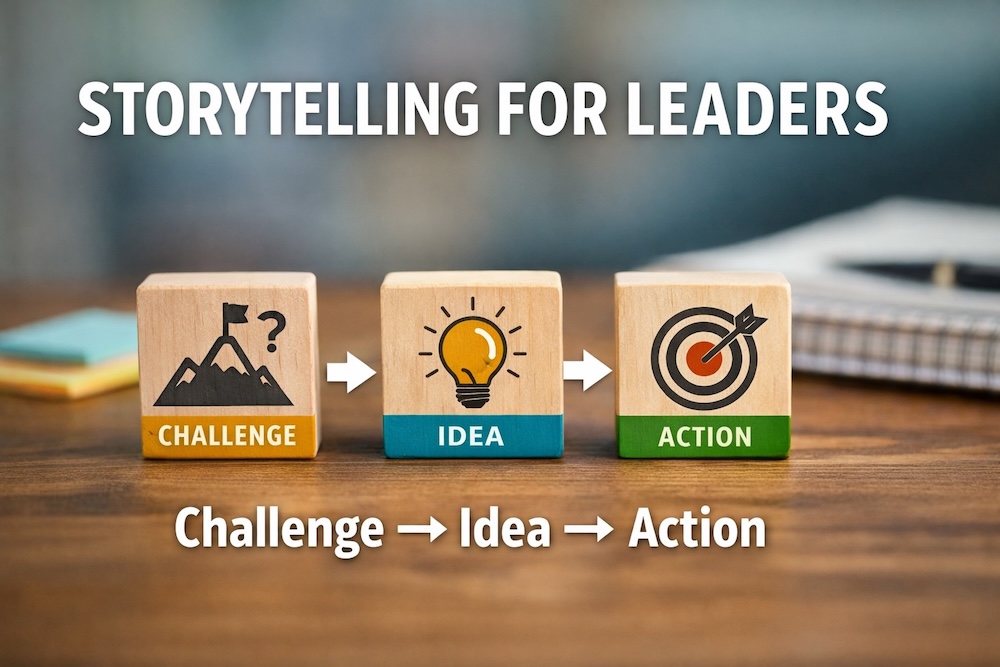
How it works: Participants sketch their story like a three-panel comic strip: beginning, middle, and end. I usually use my Challenge, Idea, Action model for the panels, though Context, Action, Result or a classic three-act structure work too. Stick figures and a few words are plenty.
When to use it: Right after choosing a story idea. Sketching instead of writing keeps the story loose and easy to change. Participants consistently name this as the turning point: “The 3-panel storyboard is helpful,” and “I didn’t realize how helpful a storytelling framework could be until I tried it in the breakout rooms. It made a big difference.”
Here is a short module from my storytelling workshops walking through storyboard formats:
4. Tell, Feedback, Retell Rounds
How it works: In pairs or triads, each person tells their story in about two minutes. Listeners share what stuck with them and what they wanted to know more about. Then the storyteller tells it again, often to a new partner.
When to use it: In every storytelling workshop. This is where most of the improvement happens, and it is the activity participants mention most. “Sharing my story twice helped me improve its delivery.” “Share your story even if not fully formed! Other people’s questions help build!” “We learned the power of getting messy, stepping back, then refining.”
Keep the feedback simple and generous. Asking “What stuck with you?” works better than asking people to critique.
5. Story Circles
How it works: Groups of four to six take turns telling a story on a shared theme while everyone else simply listens. After the round, the group names connections they noticed across the stories.
When to use it: For team building, culture work, or any group that needs to get to know each other quickly. Facilitators in one session noticed how fast the connection happens: “Stories are contagious. A specific place or theme catalyzes other stories,” and “So many of our stories are interconnected.”
6. Hero’s Journey Map
How it works: Participants map a meaningful chapter of their life or work onto the stages of Joseph Campbell’s hero’s journey: the call to adventure, the challenges, the guides who helped, the transformation, and what they brought back. It works well for longer personal or leadership stories.
When to use it: In leadership development, career and life design workshops, or any session where people reflect on growth. To make it hands-on, have participants build their story with our free interactive Hero’s Journey Story Builder, which walks through each stage step by step. You can also read more about telling your life’s epic story with the hero’s journey stages.
One participant found two versions of their story in this activity, “one hero, one as guide,” which is a useful prompt in itself: in which story are you the hero, and in which are you the guide who helps someone else?
7. Leadership Journey Story
How it works: Ask one question: “Why do you lead? What’s your leadership journey story?” Give people a few minutes to reflect and write a short version, then tell it in small groups.
When to use it: With emerging leaders, mentoring programs, and leadership cohorts. In one virtual workshop with a cohort of young leaders, participants produced powerful stories in minutes, about childhood moments of service, being underestimated in their field, and the turning points that led them to lead. One reflected, “Initially, I told a generic story, but the workshop helped me realize my project could be my family’s story.”
8. Artifact Story
How it works: Participants choose an object or image that represents something they care about, such as a photo, a tool, or something on their desk, and tell the story behind it.
When to use it: As a warm-up or an opener, especially online, where people can hold something up to the camera. An artifact gives people an easy way into a personal story without pressure. Several groups have noted that “visuals and artifacts are super helpful and important.” For more on objects as storytelling tools, see my post on Froebel blocks and design education.
9. Grateful Encounters
How it works: Participants reflect on a person who changed their life, often someone who never knew the impact they had, and tell that “forgotten but unforgettable” story to a partner.
When to use it: At retreats, year-end gatherings, team offsites, or anywhere you want a warm and human moment. It is the heart of our gratitude workshops and storytelling retreats.
10. Future Story
How it works: Participants imagine the story they want to be able to tell one year from now, then work backward to the first step they would need to take this week.
When to use it: As a closing activity, especially in transformation, strategy, or goal-setting sessions. It turns reflection into action. A participant captured it perfectly: “Think of the story you want to be able to tell one year down the line. To make that real, what do you need to do today!”
Bonus: Hook Brainstorm
Once people have a draft story, give them three minutes to brainstorm different ways to open it: a question, a surprising fact, an image, a moment of humor, or a cliffhanger. Then they test one on a partner. In a corporate session, participants listed hooks as one of their top takeaways, including this advice: “Find the hook that resonates with you. It is likely to resonate with others.”
Tips for Facilitating a Storytelling Workshop
- Model it first. Tell one of your own stories before asking anyone else to. It sets the tone and shows that stories can be short and imperfect.
- Let people choose how personal to get. Some will share a life story and others a work moment. Both work. For a few people, vulnerability “feels risky,” so make the choice explicit.
- Use music. Quiet background music during reflection time makes a surprising difference. It comes up in participant reflections again and again.
- Warm up the tools in virtual sessions. If you use a whiteboard like Mural or Miro, spend a few minutes letting people add a sticky note before the real activities begin. In shorter sessions, choose fewer activities and give each round more time.
- Close with reflection. End by asking what people learned and how they might use it. The answers are often the best summary of the workshop, and the best quotes you will ever collect.
Want Help Designing or Leading a Storytelling Workshop?
I design and facilitate storytelling workshops for leaders and teams, built around the kind of story your group needs to tell, from 90-minute conference sessions to half-day and full-day programs, in person or virtual. See our business storytelling training and storytelling workshops for leaders, or read the guide to storytelling for leaders.
If you are a facilitator or trainer who wants to lead activities like these yourself, my Train the Trainer facilitator program and online storytelling course for leaders, innovators, facilitators, and trainers are good next steps.