
Need retrospective ideas? If you have not been running a scrum retrospective, or your sprint retros leave the team feeling that nothing in your agile practice ever actually changes, the problem is often the format rather than the team. A retrospective with no structure becomes a status meeting with feelings attached.
Below are the retrospective formats worth knowing, when each one is the right choice, and the ready-made boards you can run them on. Reflect on your sprint to improve the next one: what went well, what could have gone better, and what you will change.
The board we use: most of our own sessions run on Miro. We have been paying customers for years, and for collaborative workshop and meeting work we think it is the strongest tool in the category. The other tools below are worth knowing about, and several have good templates, but Miro is the one we recommend if you are choosing where to start.
Which retrospective format should you run?
The format decides what the conversation surfaces. Running the same one every sprint is the most common reason retros go stale, because a team learns to give the same answers. Rotate them.
Start, Stop, Continue
Three columns. What should we start doing, what should we stop, what is working and should continue. The most direct route from discussion to a decision, because every item is already phrased as an action.
Use it when the team is new to retrospectives, or when previous sessions produced conversation but no change. Time: 45 minutes.
What Went Well / What Did Not
The classic two-column retro, usually with a third step for next steps. Simple enough that nobody needs it explained, which matters when half the team is new.
Use it when you have limited time or a group that is new to each other. Watch for: teams that list only safe, procedural items. If the “did not go well” column is shorter than the other, the room does not feel safe yet.
Mad, Sad, Glad
Participants sort the sprint into what made them angry, what disappointed them, and what they were pleased about. Sorting by emotion rather than by process surfaces things a task-focused format never reaches.
Use it when something went visibly wrong, or when morale matters more than throughput this sprint. Time: 45 to 60 minutes. Watch for: a facilitator who rushes past the “mad” column to get to solutions.
The 4Ls: Liked, Learned, Lacked, Longed For
Four quadrants. What you liked, what you learned, what was missing, and what you wished you had. The “learned” and “longed for” quadrants are what make this one useful, because they pull out knowledge and unmet needs that the other formats never ask about.
Use it when the sprint involved something genuinely new, or at the end of a project phase. Time: 60 minutes.
Starfish
Five segments: stop, less of, keep, more of, start. It is Start/Stop/Continue with the middle ground added, which is where most real answers live. Few practices are purely good or bad; most need dialling up or down.
Use it when the team has outgrown three columns and keeps saying “well, it depends”. Time: 60 minutes.
Sailboat
A visual metaphor: the island is the goal, the wind is what pushes you toward it, the anchor is what holds you back, and the reef is the risk ahead. The only common format that asks about the future as well as the past.
Use it when the team is tired of grids, or when risks ahead matter as much as what already happened. Time: 60 minutes.
7 agile sprint retrospective templates
These top agile and scrum sprint retrospective templates can be used during remote meetings with your team.
1. Miro: Facilitating Agile Retrospectives Workshop
Facilitating Agile Retrospectives Workshop template
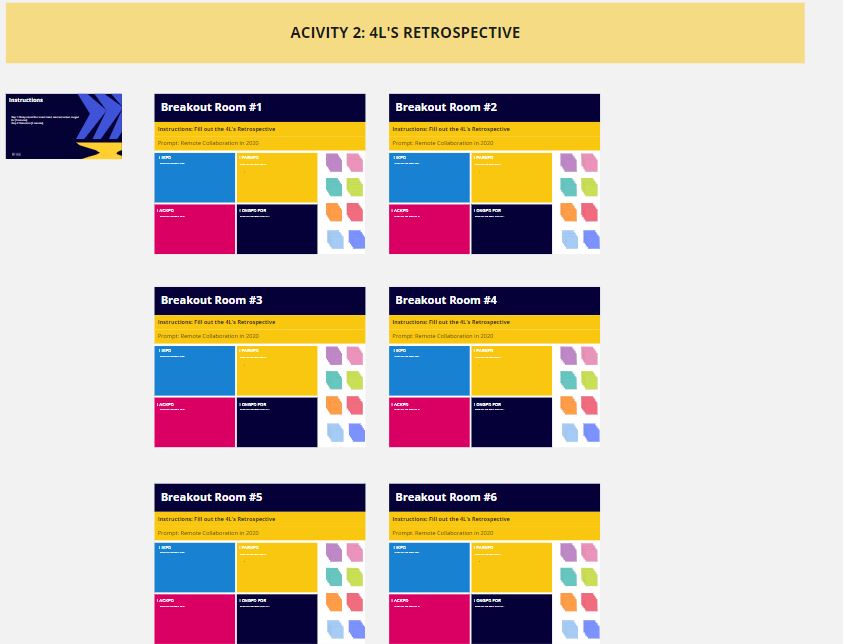
This board is directly from a Miro team member and is designed to help facilitators of retrospective sessions guide their agile team effectively through the process. The ready-made workshop offers:
- Three activities to generate actionable insights from team members
- Techniques training through breakout rooms
- Ready-made Miro frames to copy and use in the future
Best for: facilitators who want to learn the craft, not just run one session.
2. Miro: Team Retrospective
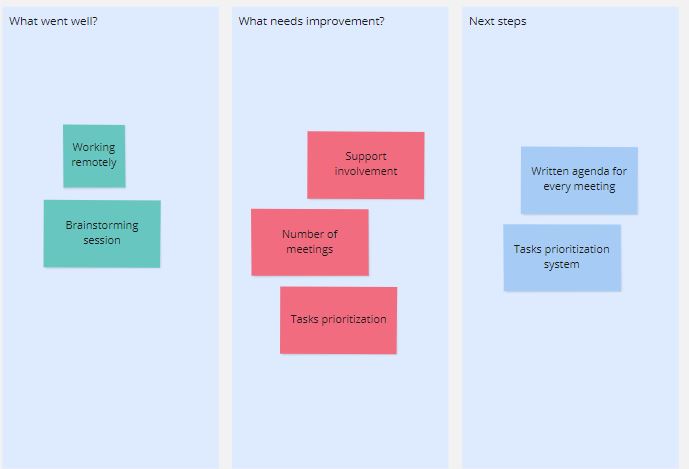
Atlassian’s retro template on Miro features a concise, 30 minute plan to guide teams through their session. Teams walk through four steps:
- “Turn your brain on” – discussion and establishing rules of engagement
- “What went well?” – use sticky notes to write down ideas and discuss as a team
- “What needs improvement?” – use sticky notes to write down ideas and discuss as a team
- “Next steps” – generate actionable tasks, assign owners, and set a due date
Runs the format: What Went Well / What Did Not. Best for: a short, reliable retro you can run every sprint.
3. Miro: Sailboat Retrospective Template
Sailboat Retrospective template
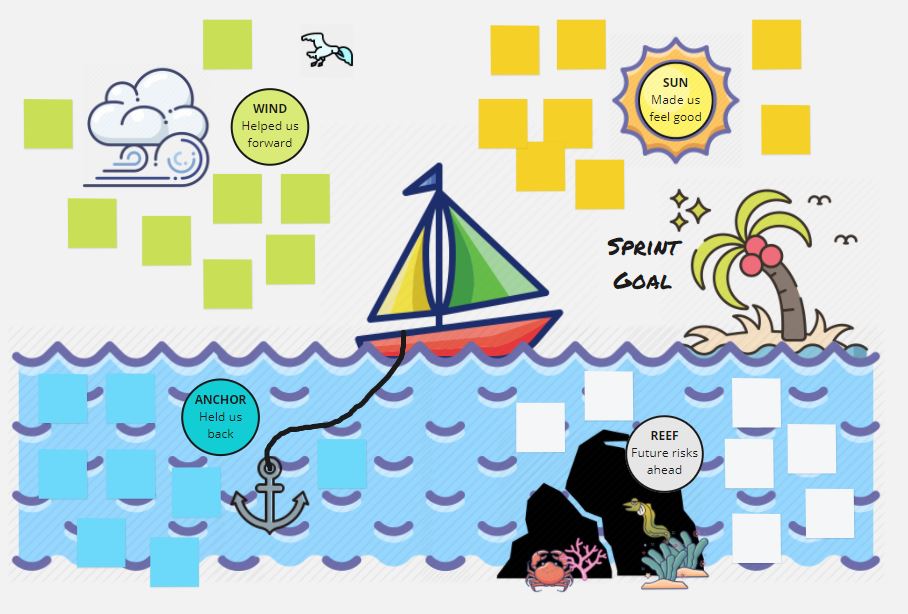
This fun and themed sprint sailboat retrospective template from Miro is a great way to boost communication and reflect as a team. With this template you focus on:
- “The tropical island” – the sprint goal to achieve
- “The wind” – everything helping you achieve the goal
- “The sun” – all the things that make the team happy and feel good at work
- “The anchor” – everything slowing the team down or holding them back
- “The reef” – potential risks ahead that will jeopardize future work
Runs the format: Sailboat. Best for: a team bored of grids, or a sprint where the risks ahead matter.
4. Miro: Agile Retrospective Template
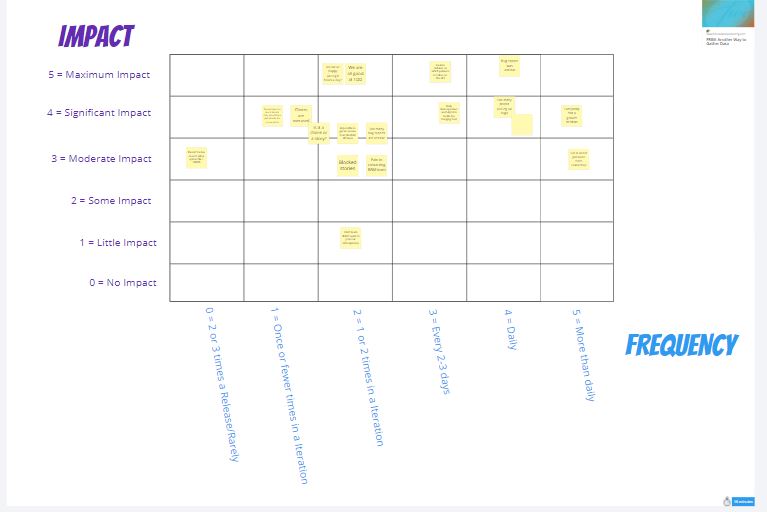
Avanscoperta’s agile retrospective Miro template offers frameworks through five steps of an agile retro. This structured template is useful because it helps teams think critically about the task at hand, gather a shared perspective, and then come up with a series of actionable items for follow-through once the session ends.
Best for: teams that reach good conclusions and then fail to act on them.
5. Lucidspark: Quick Retrospective Template
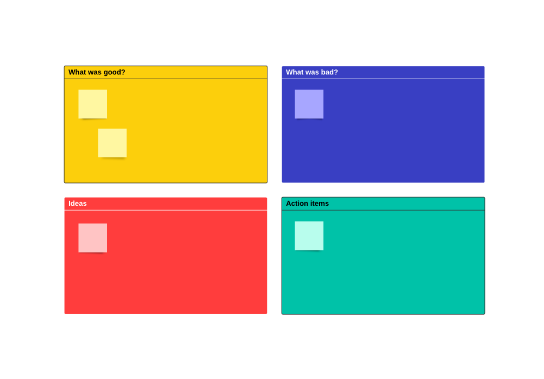
This Lucidspark quick retrospective template allows you to reflect at the end of an innovation workshop or session. Talk through what went well, what did not work, and what happens next, so everyone is on the same page leaving the meeting.
Best for: closing a workshop rather than a sprint.
6. Zoom Whiteboard: Team Retrospective Template
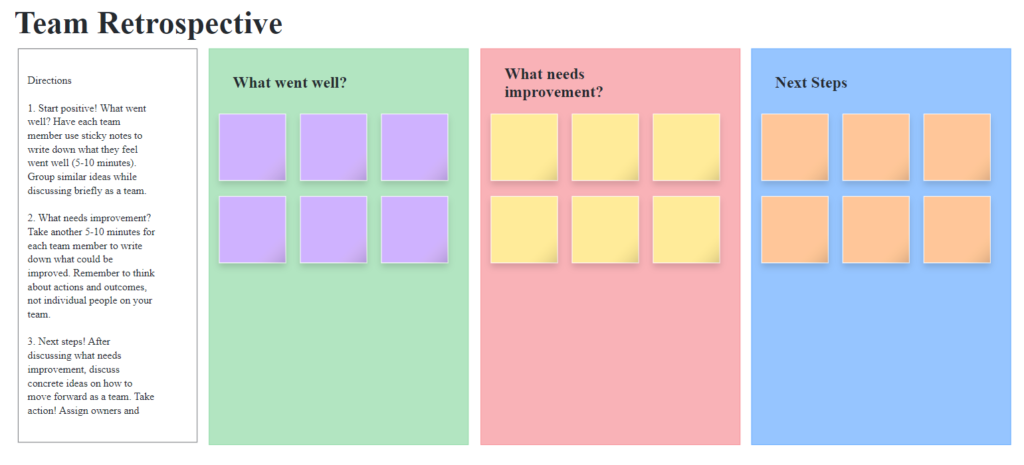
This Zoom Whiteboard template is useful at the end of a session to reflect on the experience. Use the space to discuss what went well, what needs improvement, and what needs to happen next for things to keep working.
Best for: teams already meeting in Zoom who do not want to move everyone to another tool mid-session.
7. Klaxoon: Agile Retrospective Template
Klaxoon Agile Retrospective template
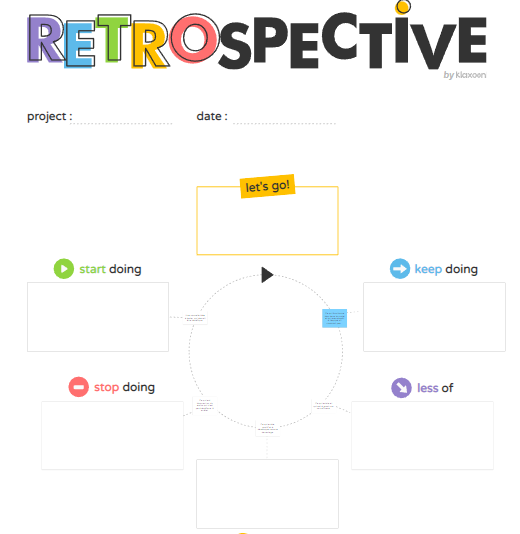
This Klaxoon template allows you to take a step back and define your team actions. It is an effective method for teams to put concrete plans in place based on shared ideas and a shared view of the sprint.
Running a retrospective that actually changes something
The format and the board are the easy part. These are what separate a retro that changes the next sprint from one that repeats every two weeks forever.
- Rotate the format. A team running the same grid every sprint learns to produce the same answers. Changing the question changes what surfaces.
- Write silently first. Whoever speaks first anchors the whole discussion. Two minutes of individual writing before anyone talks gets you the quiet person’s view, which is often the useful one.
- Leave with fewer actions than you want. A retro producing twelve improvements produces none. Pick one or two, name an owner, set a date.
- Start by checking the last retro’s actions. Five minutes. If the team sees that last time changed nothing, they will not invest this time, and you will not know why.
- Separate the facilitator from the manager. A team rarely says what held them back to the person who set the deadline. Rotate facilitation, or bring in someone neutral.
Improving your sprint retrospective meetings
Do not just sprint, sprint, sprint with your team. Stop to reflect, learn, and align with a sprint retrospective. Agile is one of our favourite approaches for a culture of innovation, and a new retrospective template at your next agile team meeting can provide a spark of new life.
You do not have to be a scrum master with a scrum team to benefit from the continuous improvement the agile methodology provides. We learn and develop the most from working on and reflecting on real projects. This can be a good way to start implementing agile and scrum thinking into your own work, your team, or your organization, and ultimately your culture.
What is a reflective practice? It is something that can make a real difference to your work and your own learning and development.
If you want to build the facilitation skills behind these sessions, our Train the Trainer facilitator program covers designing and leading sessions like these, and our facilitation workshop builds them through practice. Tell us what your team is working on and we will suggest where to start.
Disclosure: the Miro links above are affiliate links, and if you start a plan through one of them we may earn a commission at no additional cost to you. We have been paying Miro customers for years and it is the tool we work in. The other templates here are options we researched and thought were worth sharing, not tools we use daily.