
SCAMPER is one of the simplest and most reliable creativity techniques you can teach a group. It takes something that already exists, such as a product, service, process, or event, and pushes the group to look at it from seven different angles. This guide explains what SCAMPER stands for, gives example questions and real examples for each letter, and shows how to run a SCAMPER session with a team.
What Is SCAMPER? (Meaning)
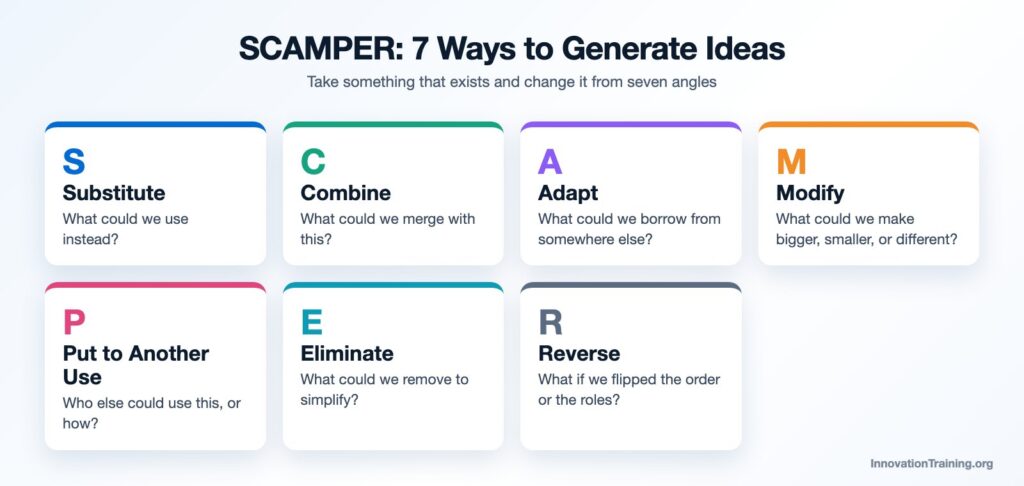
SCAMPER is an idea generation technique that uses seven prompts to help people come up with new ideas by changing something that already exists. Each letter stands for a different way to modify an idea: Substitute, Combine, Adapt, Modify, Put to another use, Eliminate, and Reverse.
The technique was developed by Bob Eberle in the early 1970s, building on the idea-spurring checklist created by Alex Osborn, the advertising executive who also popularized brainstorming. Its strength is structure. Instead of asking a group to “think outside the box” with no guidance, SCAMPER gives them seven specific doors to walk through.
What Does SCAMPER Stand For?
S: Substitute
Replace a part, material, person, rule, or step with something else.
- What could we use instead?
- Who else could do this?
- What other materials, ingredients, or processes could work?
Example: Plant-based meat substitutes animal protein with plant protein while keeping the familiar burger experience.
C: Combine
Bring two or more ideas, products, or functions together.
- What could we merge with this?
- Which purposes or features could we combine?
- Which teams or partners could we bring together?
Example: The smartphone combined a phone, camera, music player, and web browser into one device.
A: Adapt
Borrow an idea from another context and adjust it to fit yours.
- What else is like this?
- What could we copy from another industry?
- What has worked before in a different setting?
Example: Hospitals have adapted checklists from aviation to reduce errors in surgery.
M: Modify (also Magnify or Minify)
Change the size, shape, frequency, or other attributes. Make it bigger, smaller, stronger, or faster.
- What could we exaggerate or make more frequent?
- What could we make smaller, lighter, or simpler?
- What could we change about the color, form, or feel?
Example: Microlearning modifies a full training course into short lessons of a few minutes each.
P: Put to Another Use
Use the idea, product, or resource for a different purpose or audience.
- Who else could use this?
- How could this be used in a different setting?
- What could we do with the waste or leftovers?
Example: Bubble wrap was originally developed as textured wallpaper before it became packaging.
E: Eliminate
Remove parts, steps, or features to simplify.
- What could we remove without losing value?
- Which steps are unnecessary?
- What would the simplest version look like?
Example: Budget airlines eliminated free meals and assigned seating to lower prices.
R: Reverse (or Rearrange)
Turn it around, change the order, or do the opposite.
- What if we did the steps in a different order?
- What if we flipped the roles?
- What is the opposite of what we do now?
Example: The flipped classroom reverses traditional teaching. Students watch lectures at home and do practice work in class with the teacher.
A SCAMPER Example: Redesigning a Team Meeting
SCAMPER works on services and processes as well as products. Here is how a team might apply it to a weekly status meeting that everyone finds tedious.
- Substitute: Replace verbal status updates with a shared written update posted before the meeting.
- Combine: Combine the status meeting with the monthly planning meeting into one focused session.
- Adapt: Adapt the agile daily stand-up format so each person answers three short questions.
- Modify: Shrink the meeting from sixty minutes to twenty and hold it standing up.
- Put to another use: Use the meeting time for solving one shared problem each week instead of reporting.
- Eliminate: Remove the meeting entirely for teams whose work is not interdependent.
- Reverse: Have team members bring questions for the manager, instead of the manager asking for updates.
In about twenty minutes, the team has seven distinct directions to consider, several of which they would never have reached with an open “any ideas?” discussion.
How to Run a SCAMPER Session With a Group
1. Choose a clear subject
Pick a specific product, service, process, or experience to improve. “Our customer onboarding email series” works better than “customer experience.” Write it where everyone can see it.
2. Share the seven prompts
Give each person or table a sheet or virtual board with the seven letters and two or three questions for each. Ready-made SCAMPER templates for Miro, MURAL, and other whiteboards save setup time.
3. Work through the letters in rounds
Give the group three to five minutes per letter. For larger groups, assign different letters to different tables, then rotate. Encourage quantity and wild ideas during this stage and hold off on judging.
4. Share and cluster
Have each group share its most interesting ideas. Cluster similar ideas together and look for combinations across letters.
5. Select ideas to develop
Use dot voting or an impact and effort grid to choose two or three ideas worth prototyping or testing. Assign an owner and a next step for each one.
Tips for Facilitating SCAMPER
- Warm up first. A quick creativity exercise like the alternative uses test gets people into a generative frame of mind.
- Do not force every letter. Some prompts will be more useful than others for a given subject. It is fine to spend more time on the productive ones.
- Use real examples. Showing one or two examples per letter, like the ones above, helps people understand the prompt quickly.
- Combine with other methods. SCAMPER pairs well with brainstorming, the 100 ideas exercise, and design thinking prototyping.
- Keep the subject concrete. SCAMPER works best on something that exists. For entirely new challenges, start with a “How might we” question instead.
Frequently Asked Questions About SCAMPER
Who created the SCAMPER technique?
Bob Eberle developed SCAMPER in the early 1970s, organizing questions from Alex Osborn’s earlier idea-generation checklist into an easy-to-remember acronym.
When should you use SCAMPER?
Use SCAMPER when you want to improve or reinvent something that already exists, such as a product, service, process, event, or policy, and the group needs structure to generate fresh ideas.
Is SCAMPER a brainstorming technique?
Yes. SCAMPER is often described as a guided brainstorming technique, because it uses specific prompts to direct the group’s idea generation instead of relying on open-ended discussion.
Can SCAMPER be used for personal development?
Yes. People apply SCAMPER to their routines, careers, and habits. For example, “What could I eliminate from my week?” or “What could I combine to save time?”
Bring SCAMPER and Creative Thinking to Your Team
SCAMPER is one of many idea generation methods InnovationTraining.org teaches in hands-on sessions. Explore our innovation workshops for teams and creativity and innovation training, or contact us to plan a session around a real challenge your team is facing. Which letter of SCAMPER would you try first on your own work?