
Human-centered design is behind many of the products, services, and experiences people describe as easy to use or genuinely helpful. It is also one of the most practical approaches a team can adopt, whether they build software, run a hospital, design training, or manage internal processes. This guide explains what human-centered design is, its core principles, the process, how it relates to design thinking, and examples of it in practice.
What Is Human-Centered Design? (Definition)
Human-centered design (HCD) is an approach to problem solving that starts with the people you are designing for and keeps them involved throughout the process. Instead of beginning with a technology, a business goal, or an internal assumption, a human-centered team first works to understand people’s needs, behaviors, and context, then creates and tests solutions with them until the solution truly works in their lives.
The international standard ISO 9241-210 describes human-centred design as an approach that aims to make systems usable and useful by focusing on users, their needs, and their requirements. In practice, HCD is used far beyond software. Teams apply it to services, spaces, policies, training programs, and organizational change.
The design firm IDEO, which helped popularize the approach, describes a good human-centered solution as one that sits where three things overlap: what is desirable to people, what is technically feasible, and what is viable for the organization. Human-centered design starts with desirability and works toward the other two.
The Core Principles of Human-Centered Design
Don Norman, author of The Design of Everyday Things, summarizes human-centered design in four principles. They make a useful checklist for any project.
1. Be people-centered
Focus on the people who will use or be affected by the solution. Understand their goals, frustrations, abilities, and the situations they are in, through observation and conversation rather than guesswork.
2. Solve the right problem
The problem people ask you to solve is often a symptom. Human-centered designers spend time identifying the underlying problem before jumping into solutions.
3. Think of everything as a system
Most problems are connected to other processes, people, and incentives. A new form, tool, or policy succeeds or fails based on how it fits into the larger system around it.
4. Make small and simple interventions
Prototype, test, and refine in small steps. Each round of feedback from real people improves the solution and reduces the risk of building the wrong thing.
The Human-Centered Design Process
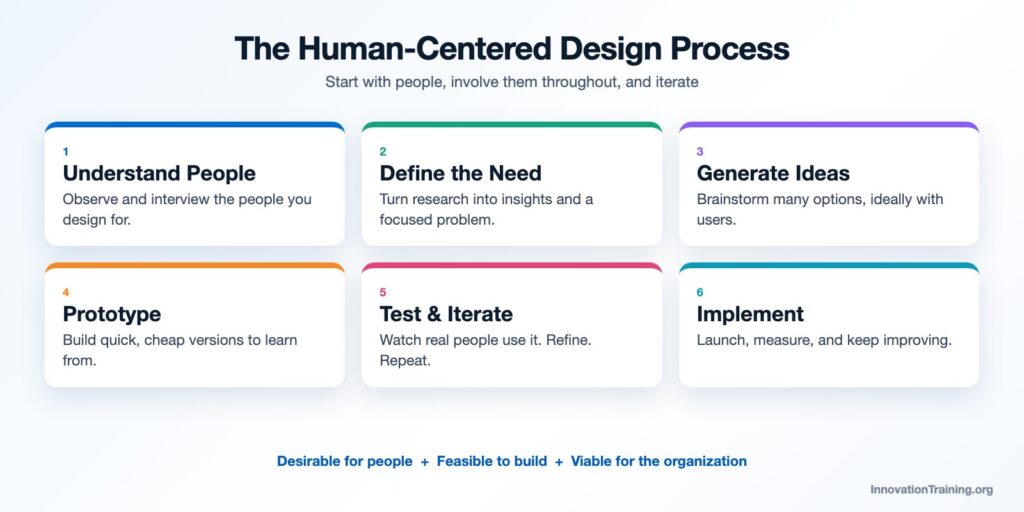
Different organizations use different names for the stages, but most human-centered design processes follow a similar flow. IDEO.org, for example, describes three phases: inspiration, ideation, and implementation. A more detailed version looks like this.
Understand people
Spend time with the people you are designing for. Interview them, observe them in their environment, and ask them to walk you through their experience. Tools like empathy maps help teams organize what they learn about what people say, think, do, and feel.
Define the need
Turn your research into clear insights and a focused problem statement. Many teams create personas or journey maps to keep the people at the center of every later decision.
Generate ideas
Brainstorm many possible solutions, ideally with the people you are designing for in the room. Co-creation sessions often surface ideas that internal teams would miss.
Prototype
Build quick, low-cost versions of the most promising ideas: a paper sketch, a role-play of a service, a mock-up of a screen, or a pilot of a new process. The goal is to learn, not to impress.
Test and iterate
Put prototypes in front of real people, watch what happens, and refine. Several rounds are normal. Each round should answer a specific question about what works and what does not.
Implement and keep learning
Launch the solution, measure how well it meets people’s needs, and keep improving it based on ongoing feedback.
Human-Centered Design vs. Design Thinking
The two terms are closely related and often used interchangeably. A helpful way to separate them: human-centered design is the philosophy of designing with and for people, and design thinking is a popular process and set of methods for putting that philosophy into action. The five-stage design thinking model (empathize, define, ideate, prototype, test) is essentially a human-centered design process packaged for teams and organizations.
Other frameworks also carry human-centered principles. The Double Diamond framework, developed by the UK Design Council, maps the same path from understanding the problem to delivering a solution. Our guide to design thinking mindsets explores the attitudes that make these processes work.
Examples of Human-Centered Design
- Healthcare. Hospitals have redesigned patient discharge by shadowing patients and families, discovering confusion about medications, and creating simpler instructions and follow-up calls. See more human-centered design examples in healthcare.
- Government services. Public agencies have rebuilt online forms after watching citizens struggle to complete them, cutting completion time and support calls.
- Workplace training. A learning team interviews new managers and finds they need quick help in the moment, not a two-day course. They create short just-in-time guides and peer coaching instead.
- Product design. Kitchen tools with large, soft-grip handles were designed with people who have arthritis in mind, and many other people found them easier to use too.
- Internal processes. An HR team maps the employee onboarding experience from the new hire’s point of view and removes several steps that only existed for historical reasons.
Benefits of Human-Centered Design
- Solutions people actually use. Designing with people reduces the risk of building something nobody wants.
- Lower cost of failure. Prototyping and testing early catches problems while they are cheap to fix.
- More innovative ideas. Deep understanding of people often reveals needs that competitors have missed.
- Stronger buy-in. People who help shape a solution are more likely to support it.
- Better collaboration. Cross-functional teams share a common focus on the people they serve.
Frequently Asked Questions
What are the three phases of human-centered design?
IDEO.org describes three phases: inspiration (learning from people), ideation (making sense of what you learned and generating and prototyping ideas), and implementation (bringing the solution to life).
Is human-centered design the same as user-centered design?
They are very similar. User-centered design usually focuses on the people who directly use a product. Human-centered design takes a broader view that includes everyone affected by a solution, such as families, staff, and communities.
How do you learn human-centered design?
The best way is to practice it on a real project with coaching. Books and courses help too. Explore our lists of top books on human-centered design and human-centered design resources.
Bring Human-Centered Design to Your Organization
InnovationTraining.org runs hands-on human-centered design workshops where teams practice research, prototyping, and testing on their own challenges. We also offer design thinking training for teams and leaders. Contact us to talk about a session for your group. Who are the people your team most needs to understand better?