

The double diamond is a design process model that splits any challenge into four phases: Discover, Define, Develop, and Deliver. The first diamond helps a team understand the problem before deciding what to solve. The second diamond helps the team explore possible solutions before committing to one. Each diamond opens wide with divergent thinking and then narrows with convergent thinking.
Below you will find how each phase works, which methods to use in each one, how the double diamond compares with other design thinking models, the mistakes teams make most often, and resources and training to help your team put the framework to work on real projects.

What Is the Double Diamond Model?
Developed and popularized by the British Design Council, the double diamond framework has been around since 2004. It gives teams a clear and visual description of the design process, and in its fuller form it also includes key principles and design methods that can be used to achieve long-lasting positive change.
The process is symbolized by two diamonds. The left diamond covers the problem space: exploring an issue widely, then focusing on a clear definition of what to solve. The right diamond covers the solution space: generating many possible answers, then focusing on the ones that work. The shape is the point. It reminds teams to open up before they close down, twice, instead of jumping from a first impression of the problem straight to a first idea for the solution.
The Four Phases of the Double Diamond
Double diamond includes four different phases. Here is what each one is for, the question it answers, and methods that work well in a workshop setting.
1. Discover: Understand the Real Problem
Discover means understanding what the real problem is through communication and discussion with the people who are actively affected by it. The team holds off on solutions and gathers evidence instead.
- Key question: What is actually going on, and for whom?
- Methods: stakeholder and customer interviews, observation, empathy maps, journey mapping, and a quick review of existing data.
- Facilitator tip: give the group a small number of real conversations to hold before the workshop. Five honest interviews will shift a room more than fifty slides of survey results.
2. Define: Frame the Right Challenge
Insights gathered in the Discover phase help you define the challenge in a different and more beneficial way. This is where the first diamond converges.
- Key question: Of everything we learned, what matters most to solve?
- Methods: affinity clustering, personas, insight statements, and “How might we” questions that turn a problem into an opportunity.
- Facilitator tip: ask teams to write three or four versions of the challenge and vote. The best framing is often the second or third one written, after the obvious version is out of the way.
3. Develop: Explore Many Possible Solutions
Develop means finding different answers to the clearly defined problem, seeking inspiration from everywhere and co-designing with different people.
- Key question: What are all the ways we could solve this?
- Methods: brainwriting, SCAMPER, reverse brainstorming, analogies from other industries, and co-design sessions with the people who will use the solution.
- Facilitator tip: separate idea generation from idea judging. Set a quantity target first, then cluster and choose in a second round.
4. Deliver: Test, Learn, and Launch
Deliver means testing different solutions at a small scale, rejecting those that do not work, and improving the ones that will.
- Key question: Which ideas hold up when real people try them?
- Methods: rough prototypes, storyboards, role plays, pilot tests, feedback grids, and short design sprints to compress testing into days.
- Facilitator tip: make the first prototype cheap enough that nobody feels attached to it. Paper, sticky notes, and a quick role play are usually enough to learn what to change.
This is not a linear process. Sometimes you’ll learn something about the underlying issue that requires you to go back to the Discover and Define stages. Because no idea is ever “finished,” there will always be more work done to improve existing products and services.
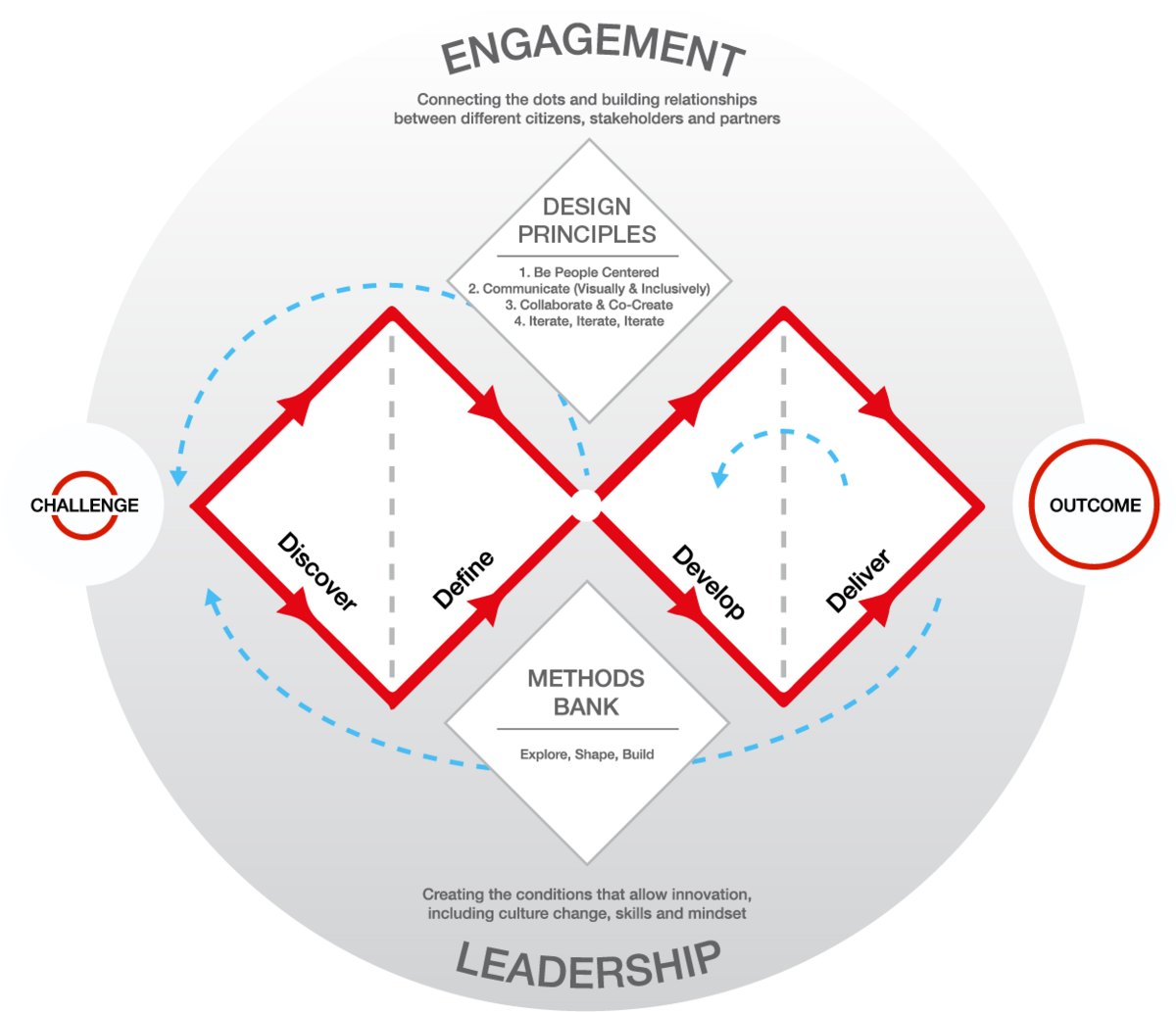
Design Principles That Double Diamond Relies On
These four principles are also core to the double diamond framework, designed to help problem-solvers adapt quickly and work as effectively and efficiently as possible.
- Put people first: Focus on deeply understanding the needs of the people using a service, including their aspirations and challenges.
- Communicate visually and inclusively: Help your team build a shared understanding of the problem and possible solutions.
- Collaborate and co-create: Work together and inspire each other to build better.
- Iterate: Keep testing to avoid risk and build confidence in your ideas.
Double Diamond vs. Design Thinking: How the Models Compare
The double diamond is one way of picturing the design thinking process. The other model many teams know is the five-stage version often taught as Empathize, Define, Ideate, Prototype, and Test. The two map onto each other closely:
| Double diamond phase | Five-stage design thinking | What the team is doing |
|---|---|---|
| Discover | Empathize | Learning from the people affected |
| Define | Define | Choosing and framing the problem |
| Develop | Ideate (and early prototyping) | Generating and shaping solutions |
| Deliver | Prototype and Test | Testing, refining, and launching |
The main difference is emphasis. The double diamond makes the rhythm of opening up and narrowing down visible, and it gives the problem side of the work a full diamond of its own. That makes it especially useful for teams that tend to rush to solutions, and for service design, policy, and organizational challenges where getting the problem right is most of the battle. Other models, such as the creative problem solving process and our own Challenge, Ideas, and Action framework, follow the same diverge and converge pattern with different labels. For a walk-through of the stage-based approach, see steps to design thinking in practice.
Common Mistakes Teams Make With the Double Diamond
- Skipping the first diamond. Teams arrive with a solution already in mind and treat Discover and Define as a formality. The framework only works if the problem is allowed to change.
- Diverging and converging at the same time. Judging ideas while generating them shrinks the list too early. Keep the two modes in separate, clearly labeled activities.
- Treating it as a one-way process. Testing in Deliver often reveals a gap in understanding. Going back to Discover is a sign the process is working.
- Doing research without the people affected. Discovery done only through internal opinions or desk research misses the insights that make the second diamond useful.
- Leaving out the facilitation. The diagram is simple. Running each phase well, with the right activities, timing, and group dynamics, is the hard part, and it is a learnable skill.
Double Diamond Workshop and Training Options
InnovationTraining.org designs and leads double diamond workshops for teams, leadership groups, and offsites, in person or virtually. Participants learn the framework by working through it on a real challenge from your organization. Choose one option, combine several into a full-day program, or spread them across a series.
Learn the Framework
Double Diamond Fundamentals
Move a real challenge through all four phases in a single hands-on session and leave with a tested concept and a plan for what comes next.
Double Diamond for Leaders
Help leaders recognize which diamond a project is in, ask better questions at each stage, and protect time for discovery before decisions are made.
Design Thinking Training for Teams
Pair the double diamond with the broader design thinking toolkit and mindsets. See our design thinking training workshops for sample agendas.
Contact us to plan your double diamond workshop
The First Diamond: Discover and Define
Discovery Interviews and Field Research
Practice listening for underlying needs and turning what you hear into usable insight, with guidance from our empathy training approach.
Journey Mapping
Map the full experience of a customer, patient, student, or employee to find the moments that matter. Learn more about our journey mapping workshop.
Problem Framing and “How Might We” Questions
Turn research into a sharp challenge statement the whole group agrees on, using methods from Jobs to Be Done and first principles thinking.
Contact us to plan your double diamond workshop
The Second Diamond: Develop and Deliver
Ideation and Co-Design
Generate a wide range of ideas with structured techniques, then build them out with the people who will use them. Our innovation and brainstorming workshops go deeper on ideation.
Rapid Prototyping and Testing
Build quick, low-cost versions of the best ideas, test them with real users, and decide what to keep, change, or drop.
Design Sprints
Compress the second diamond into a focused multi-day sprint with a tested prototype at the end. See our design sprint facilitator training.
Contact us to plan your double diamond workshop
Applying the Double Diamond in Your Organization
Double Diamond for Engineering and Design Firms
Apply the framework to technical and client challenges so teams solve the right problem before engineering the solution. See our design thinking workshops for engineering and design firms.
Double Diamond Offsites and Summits
Guide a leadership team or a large group through both diamonds on a shared strategic challenge at your offsite, retreat, or summit.
Train Your Internal Facilitators
Build the skills of the people who will lead double diamond projects after the workshop through our facilitation workshop or our online train-the-trainer program.
Contact us to plan your double diamond workshop
What Clients and Participants Say
“People who did not think they had the capacity to innovate left with ideas, solutions and renewed energy for the project.”
“He incorporated our topics into his materials to make for a personalized and real experience for the dozens of engineers and managers attending this event.”
Double Diamond Framework Books, Videos, and Guides
Here are additional materials to learn more about this design thinking and innovation framework.
Book: Just Enough Research
This book by Erika Hall is a great resource for the Discover phase. Learn how to research your audience, spot your own biases and blind spots, and more.
Video: The Double Diamond by Service Design Academy
This short introductory video explores the basics of the four phases and is useful for visual learners.
Miro Template: Triple Diamond
This spin-off template from Zendesk uses three diamonds and can be applied to status updates, onboarding, retrospectives, and more.
Design Council: The Double Diamond
The Design Council’s own overview of the framework, with its history and the full Framework for Innovation.
Double Diamond FAQ
Who created the double diamond?
The British Design Council introduced the double diamond in 2004 drawing on research into how design teams at leading companies worked. It later expanded the model into its Framework for Innovation, which adds design principles, a methods bank, engagement, and leadership.
Is the double diamond a linear process?
No. The phases are shown in order, but teams regularly loop back. A failed test in Deliver might send a team back to Define to reframe the challenge, or back to Discover to learn more.
How long does a double diamond project take?
It depends on the challenge. A team can move through all four phases in a one-day workshop to learn the process and make real progress. Larger service or product projects often run the first diamond over several weeks and the second through a series of sprints and pilots.
What is the triple diamond?
The triple diamond is a variation that adds a third diamond, usually for building, launching, and learning from a solution at scale. The Zendesk template listed above is one example.
Bring the Double Diamond to Your Team
The double diamond is simple to draw and harder to run well. If you want your team to learn the framework by using it on a challenge that matters, contact us and we will design a session around your goals. You can also explore our design thinking certificate program for teams that want a credential.
Check out these other innovation and design thinking resources:
- Design Thinking Workshop Resources
- Design Thinking Software Tools
- Top Remote Working Software Tools for Innovation
The double diamond diagram on this page is by the Design Council, licensed under CC BY 4.0.